
Peloni: None of this is new, shocking or in question. The preference to pretend that the LAF can act against the Shia majority’s sacred cow, Hezbollah, is quite difficult to argue as being based on misconceptions, as these misconceptions continue to be leveraged to keep Hezbollah in power in Lebanon while also continue to be fed massive annuities in the form of aid at the expense of US taxpayers. Washington needs to end the charade which keeps the terrorists in Lebanon funded. This is the minimum which should be understood to be in the interest of Trump’s pursuit of eliminating waste, fraud and abuse, all of which have played a hand in funding the terrorists regimes in the Middle East, and continues to fund the Hezbollah aligned LAF.
David Daoud
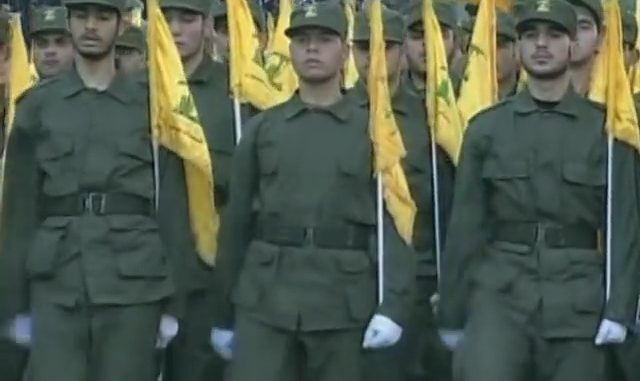 Hezbollah. Photo by Voice of America – YouTube – View/save archived versions on archive.org and archive.today, Public Domain, Wikipedia
Some senior U.S. officials believe showering the Lebanese government with praise will hasten disarming Hezbollah.
In a statement issued on February 9, U.S. CENTCOM Commander Adm. Brad Cooper lauded the Lebanese Armed Forces (LAF) for “recently finding a massive underground Hezbollah tunnel for the second time in the past two months.” The tone of his comments recalled remarks made last August by Senator Lindsey Graham (R-SC), who advocated for a mutual defense agreement with the United States. But Graham’s endorsement of the LAF has now soured. Earlier this month, Graham abruptly ended a direct meeting with LAF Commander Rodolphe Haykal after the latter stated that Hezbollah was not a terrorist organization “in the context of Lebanon.”
Haykal was merely executing the instructions of the Lebanese Cabinet, the executive power in Beirut. His statement, however, indicates strongly that Lebanon remains wedded to its so-called “special circumstances” that have underpinned its reluctance to restrain or disarm Hezbollah, thereby facilitating the group’s growth.
Lebanese Leaders Refuse To Treat Hezbollah as a Terrorist Organization
Lebanon is a sectarian conglomerate. To maintain peace among the fractious Lebanese, power-sharing agreements were created — some embedded in the constitution, others in binding, unwritten agreements — to give each sect a share of the figurative Lebanese pie. That share would devolve upon the political figure or party with the highest support among that sect.
In the context of the Shiites — long presumed, in the absence of an accurate Lebanese census in almost a century, to be the country’s largest sect — that support has overwhelmingly gone to either the Amal Party or Hezbollah. Since the Shiites are a legitimate, and sizable, part of the Lebanese political and social fabric, the logic of Lebanese politics dictates that the government treat Hezbollah as legitimate.
Sectarianism: Hezbollah’s Sword and Its Shield
The recent war with Israel significantly degraded Hezbollah’s military capabilities. However, its support among Shiites — which in September of 2024 stood at 85 percent — has demonstrably remained intact. As a result, in the months since the November 27, 2024, ceasefire deal reaffirmed Lebanon’s obligation to disarm Hezbollah, Beirut and the LAF have nevertheless avoided direct confrontation with the group. The Lebanese government’s fear that civil war will be the result of clamping down upon Hezbollah persists, as Shiites will perceive such a move as an attack on their sectarian prerogatives and domestic standing.
Hezbollah perfectly understands that this perception among Shiites keeps disarmament at bay. Secretary-General Naim Qassem has repeatedly said that disarmament poses an “existential threat” to Lebanese Shiites. In the meantime, Hezbollah has been exploiting the resulting immunity to regenerate its military and social welfare arms, to the point where the group already feels confident enough to threaten intervention on Iran’s behalf if the United States attacks the Tehran regime.
Washington Should Not Tolerate Beirut’s Deference to Hezbollah
U.S. national security and interests must not be beholden to domestic Lebanese considerations – especially when the benefits of the U.S.-Lebanon relationship overwhelmingly accrue to Beirut.
As a matter of fixed ideology, Hezbollah has declared the United States its primary enemy. This is not mere rhetoric; Hezbollah has a history of directly killing Americans, including U.S. forces deployed to Lebanon as peacekeepers, as well as assisting its Iraqi militia allies to do the same following the U.S. invasion of Iraq. In recent years, Hezbollah — lacking opportunities to directly attack Americans — has focused its energies on harming U.S. interests and allies in the Middle East, seeking to diminish American influence in a region that is critical for its trade routes and natural resources.
In such an environment, the LAF’s piecemeal and periodic dismantlement of the group’s installations cannot offset the fertile ground Beirut is providing for the group’s revival. Unless future engagement with senior Lebanese officials — and aid to the LAF — is conditioned upon Beirut proscribing Hezbollah and disarming the group, then Washington will be welcoming the deceptively charming enablers of one of its worst and most committed adversaries.
David Daoud is a senior fellow at the Foundation for Defense of Democracies (FDD), where he focuses on Israel, Hezbollah, and Lebanon affairs. For more analysis from David and FDD, please subscribe HERE. Follow David on X @DavidADaoud. Follow FDD on X @FDD. FDD is a Washington, DC-based, nonpartisan research institute focusing on national security and foreign policy.


Leave a Reply
You must be logged in to post a comment.