
By Kelleigh Nelson
May the Children of the Stock of Abraham, who dwell in this land, continue to merit and enjoy the good will of the other Inhabitants; while everyone shall sit in safety under his own vine and Figtree, and there shall be none to make him afraid. He also declared that the United States government “gives to bigotry no sanction, to persecution no assistance”. George Washington’s letter to the Hebrew Congregation in Newport, Rhode Island, in 1790.
I will insist that the Hebrews have done more to civilize men than any other nation. If I were an atheist and believed in blind eternal fate, I should still believe that fate had ordained the Jews to be the most essential instrument for civilizing nations. If I were an atheist of the other sect, who believe, or pretend to believe, that all is ordered by chance, I should believe that chance had ordered the Jews to preserve and propagate to all mankind the doctrine of a supreme, intelligent, wise, Almighty Sovereign of the universe, which I believe to be the great essential principle of all morality, and consequently of all civilization. President John Adams, Letter to Francis Adrian Van der Kemp, Feb. 18, 1809
[The Jewish people] by its sufferings has furnished a remarkable proof of the universal spirit of religious intolerance inherent in every sect, disclaimed by all while feeble, and practiced by all when in power. Our laws have applied the only antidote to this vice, protecting our religious, as they do our civil rights, by putting all on an equal footing. President Thomas Jefferson, Letter to Mordecai Manuel Noah, May 28, 1818.
The Hebrews, persecuted and downtrodden in other regions, takes up his abode among us with none to make him afraid. He may boast…of his descent from the patriarchs of old – of his wise men in council and strong men in battle. He may even turn his eye to Judea, resting with strong confidence on the promise that is made him of the restoration to the Holy Land, and he may worship the God of his fathers after the manner that worship was conducted by Aaron and his successors in the priesthood, and the aegis of the Government is over him to defend and protect him. President John Tyler, in one of the first speeches he made after taking office, 1841.
If the statistics are right, the Jews constitute but one percent of the human race. It suggests a nebulous dim puff of smoke lost in the blaze of the Milky Way. Properly, the Jew ought hardly to be heard of, but he is heard of, has always been heard of. He is as prominent on the planet as any other people, and his commercial importance is extravagantly out of proportion to the smallness of his bulk. His contributions to the world’s list of great names in literature, science, art, music, finance, medicine, and learning are also way out of proportion to the weakness of his numbers. He has made a marvelous fight in this world, in all the ages; and has done it with his hands tied behind him. The Jew is a survivor — and always will be. Harper’s Magazine, September 1899 Mark Twain
Our Constitution requires sufficient virtue among men for self-government, otherwise, nothing less than the chains of despotism can restrain them from destroying and devouring one another. President James Madison
I have taken liberty in sharing these lengthy quotes so that readers know the sentiments of our founders regarding America’s Jewish citizens. Early in the establishment of this country, our Jewish brothers and sisters were welcomed with open arms.
It is accurate to say that our founding documents, as well as the spirit and principles embodied in them, opened the door to the inclusion and welcoming of Jewish people within the framework of religious liberty. Religious freedom is a cornerstone of our Constitution and Bill of Rights.
While some of the colonies had stricter religious policies initially, the overall trend in the early days of our country, particularly after the War for Independence, was tolerance and acceptance, especially of Jewish communities. This made America a welcoming home for all legal immigrants and was a significant departure from European countries where minorities faced persecution or discrimination.
Although the Statue of Liberty was gifted to America by France in 1884, it wasn’t dedicated until 1886. Yet, the early open embrace of immigrants was a beacon of hope to those who were looking for a home where they would be safe from harm and free to worship their faith.
James Madison, the fourth President of the United States, is considered the Father of our U.S. Constitution. Madison was the primary author of the First Amendment. He was President Thomas Jefferson’s Secretary of State. Jefferson authored the Virginia Statute for Religious Freedom, and it was championed by Madison. It was adopted in 1786 and influenced the First Amendment. Jefferson considered it a significant achievement. It guaranteed that no one could be compelled to support or attend a religious worship, and that individuals were free to profess their religious opinions without civil repercussions.
Men of Letters
The term “Judeo-Christian” refers to “the influence of the Hebrew Bible and the New Testament on one’s system of values, laws and ethical code.” It is not just a system of theological thought, but a culture of values as seen in one’s individual’s right to life, liberty and the pursuit of happiness. America has long been referred to as a Judeo-Christian society because Christianity shares scriptures from the Hebrew Bible along with the Ten Commandments which have influenced our western culture. (Thankfully, several states have once again posted them in classrooms.)
Our founders, especially those who gathered to write the U.S. Constitution, were great men of letters. Thomas Jefferson was the Ambassador to France when the delegates gathered in Philadelphia to revise the Articles of Confederation, but instead, decided to scrap the Articles and create an entirely new framework for government, the U.S. Constitution. Despite his absence from the convention, he remained informed about the proceedings through correspondence, particularly with James Madison.
Jefferson was sent to a private school until the age of 16, where he excelled in languages. The next two years were spent at William and Mary College. He studied 15 hours per day. After college he studied law with George Wythe, learning languages including English, French, Italian, Latin, and Spanish, while also having some knowledge of German and Dutch and reading Ancient Greek.
James Madison graduated from the College of New Jersey, present day Princeton University. Madison studied and learned Hebrew at Princeton under a tutor named John Witherspoon and learned to speak and read the language. His study of Hebrew was profound and influenced his work, as he came to understand the power of parallelism in the Old Testament.
Many of the founders saw in the Hebrew Bible, a model for a republican form of government. Biblical principles were also influential in shaping American laws and legal culture, particularly in areas of morality and justice.
Haym Salomon
Is it any wonder then, after eight long years of war, that our founders desired religious freedom as a hallmark of their new country? The man who gave his fortune for freedom from tyranny, was Haym Salomon, a Jewish American who procured the funds for Washington’s army that led to our independence from Britain.
Salomon was born in Poland but emigrated to America in the 1770s arriving in New York on the eve of the Revolution. As he learned more of Britain’s tyranny, he decided to risk his life by joining the Sons of Liberty. They were responsible for the Boston Tea Party and the slogan “No Taxation Without Representation.” The Sons of Liberty were a secret revolutionary organization that played a key role in resisting British rule in the American colonies. Many of America’s founders were members. Samuel Adams was considered their leader.
When the British suspected him of spying, Salomon was arrested and confined, but his life was spared. He managed to secure his freedom by agreeing to act as translator for the English and Hessian guards who struggled to communicate with one another. His loyalty had not shifted, though; some have speculated that Haym used his role to convince hundreds of Hessian soldiers to defect from the British army. Soon enough Haym was arrested again, this time for espionage, and this time, sentenced to death. But by ingratiating himself to a guard, he managed to escape once more.
Continuing to give information to the Americans, he assisted their prisoners to escape British captivity while operating a profitable victualing business, providing all the necessities for the troops, in New York City which were under British occupation.
During the American Revolution, Haym Salomon’s primary role was financial, which was crucial to the army’s ability to procure provisions and continue fighting. He helped convert French and Dutch loans into ready cash by selling bills of exchange to American merchants, providing the government with the liquidity to pay for necessary supplies.
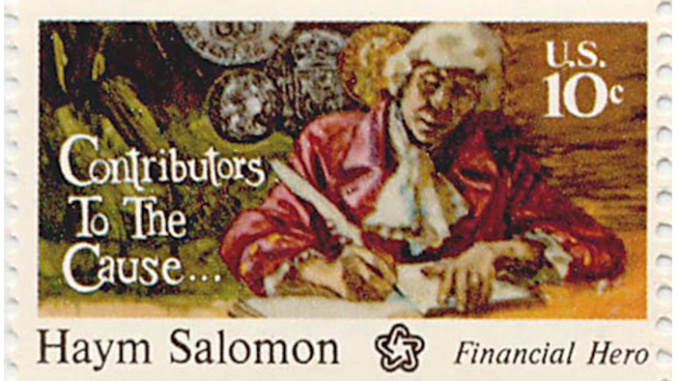
According to the Jewish Federation of Philadelphia, “Haym fled to Philadelphia, where he restarted his brokerage firm and became an active member of Congregation Mikveh Israel. The leaders of the Revolution respected Haym, despite some antisemitism in the ranks, relying on him to help oversee Congress’ financial transactions.
“He went above and beyond, raising over $650,000 (about $15 million today) for the war, much of which was from his own pocket. In 1781, when George Washington was told that Congress could not afford the $20,000 in cash he needed to march his troops in the north to Yorktown, Virginia, where southern forces had trapped the British army, he simply responded, ‘Send for Haym Salomon.’ Within days, Haym raised the $20,000 (nearly half a million dollars today), allowing Washington’s army to race to Yorktown winning the final battle of the Revolutionary War.”
Washington’s forces defeated Lord Charles Cornwallis’ veteran army dug in at Yorktown, Virginia. Victory at Yorktown led directly to the peace negotiations that ended the war in 1783 and gave America her independence.
Salomon died prematurely at 45, leaving a widow and four children. His loans to the American army were never repaid. He is buried in an unmarked grave in Philadelphia’s
Mikveh Israel Cemetery, though his burial site is marked by a plaque and a granite memorial placed by his descendants and other organizations. The cemetery is a significant historical site, being the first Jewish burying ground in Philadelphia and the oldest in the nation.
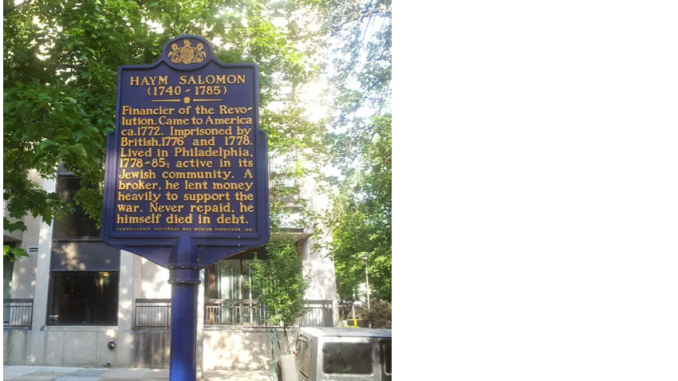
Haym Salomon saved Washington’s Army and literally helped to win the War of Independence. But that wasn’t the first war won with Jewish involvement.
Master Sargeant Roderick “Roddie” Waring Edmonds
On January 27, 2016, a ceremony was held at the Israeli embassy in Washington DC. Israeli ambassador, Ron Dermer, and Yad Vashem Council Chairman, Rabbi Lau, presented the Yad Vashem Righteous medal and certificate of honor to Master Sargeant Roddie Edmunds’ son.
 Photo by Jrryjude – Own work, CC BY-SA 4.0, Wikipedia
Master Sergeant Roddie Edmonds (b. 1919) of Knoxville, Tennessee, served in the US Army during World War II. He was captured by German forces during the Battle of the Bulge in December 1944 and became the senior non-commissioned officer at the German prisoner-of-war camp Stalag IX-A, a camp near Ziegenhain, Germany. Master Sergeant Edmonds was responsible for the camp’s 1,275 American POWs.
Stalag IX-A, a camp in line with their anti-Jewish policy, the Germans singled out Jewish POWs, and many of them on the Eastern Front were sent to extermination camps or killed.
Close to the end of the war on January 27, 1945, the Germans announced that all Jewish POWs in Stalag IX-A were to report the following morning. Master Sergeant Edmonds ordered all POWs, Jews and non-Jews alike, to stand together. When the German officer in charge saw that all the camp’s inmates were standing in front of their barracks, he turned to Edmonds and said, “They cannot all be Jews.” To this Edmonds replied, “We are all Jews here.” The German took out his pistol, putting it to Edmonds head, but the Master Sergeant did not waver and retorted, “According to the Geneva Convention, we have to give only our name, rank, and serial number. If you shoot me, you will have to shoot all of us, and after the war you will be tried for war crimes.”
The German commandant backed down. Edmonds’ actions are credited with saving up to 300 Jewish-American soldiers from possible death. He never told anyone about this.
After his death in 1985, Edmonds’ wife gave his son, Chris Edmonds, several of the diaries his father had kept while in the POW camp. Chris Edmonds, a Baptist minister, began researching his story, and stumbled upon a mention of the event at the POW camp. He located several of the Jewish soldiers his father saved, who provided witness statements to Yad Vashem. Edmonds is only the fifth United States citizen, and the first American soldier, to earn the honor of “Righteous Among the Nations”.
Soldiers’ Testimonies
Among the Jewish-American POW servicemen who were saved was Sonny Fox, an American television host and executive, who witnessed and later recounted Edmonds’ actions. After being captured at the Battle of the Bulge and traveling in a boxcar to the camp for three days without food and water, he arrived at Stalag IX-A.
Fox recalled in decade-old interviews, now on YouTube, that an American POW registering the newly arrived prisoners asked Fox his name, rank and serial number. And then he asked Fox for his religion. “Jewish,” Fox said through the physical and mental fog of no food and little sleep.
“Protestant,” the clerk answered.
Fox thought the clerk hadn’t heard him. “Jewish,” he repeated.
“Protestant,” the clerk said and then dismissed him.
A few days later, Fox understood why. The Nazi guards swept through and seized all prisoners who had answered “yes” or had Jewish-sounding names or “looked Jewish.” They were sent to the Berga concentration camp, many never to return. Sonny Fox died at the age of 95 from Covid.
Lester Tanner explained that in World War II, a man named Roddie Edmonds stood up for him. It became the defining moment in his life.
In 2008 an article appeared in The New York Times about Lester Tanner, who in 1980 sold his townhouse to former President Richard Nixon, after Nixon had been rejected from an apartment building because residents there didn’t want him living near them.
Tanner, a devoted Democrat, thought that was terrible.
He reached out to the Nixons and said they could buy his place.
In explaining why, he, a Democrat, would be gracious to a disgraced Republican, Tanner explained that in World War II, a man named Roddie Edmonds stood up for him. It became the defining moment in his life and made him committed to doing the same.
Another eyewitness was former combat medic Paul Stern. He described how when they were captured by the Germans, the prisoners were forced to march for four days in the bitter cold to a railway station. POWs died on the way. At the station they were loaded into boxcars and driven for several days, without food, to a camp near Bad Orb, Stalag IX-B, where the Jewish POWs were segregated into special barracks, with lice-infested mattresses and starvation food rations.
Stern and the other Jewish noncommissioned officers were fortunate and were taken to the nearby camp of Ziegenhain, while the other lower ranking Jewish POWs were sent to slave labor camps. It was in this second camp, Stalag IX-A, where, thanks to Edmonds’s courage, Stern and the other Jewish POWs were saved from the second attempt to single out the Jewish POWs.
There are many more stories of Jewish soldiers who were saved by Master Sargeant Roddie Edmonds. He also inspired bravery in all the men and gave them hope that they could survive the camp and return home.
Conclusion
How few know that a Jewish man saved Washington’s Army and helped him win the final battle, giving America her independence.
How few know that a WWII veteran from Knoxville, TN risked his own life to save 200-300 Jewish soldiers from certain death by the Nazis. Yad Vashem recognized Edmonds as one of the Righteous Among the Nations, he is the first American soldier to receive that honor.
We know antisemitism never really faded away, but the hatred has exploded again.
The Hebrew Bible states in Leviticus 19:18 “but thou shalt love thy neighbour as thyself: I am the Lord.”
The Christian Bible echoes Leviticus in Romans 13:9 “Thou shalt love thy neighbour as thyself.”
Where is the church that gave us Roddie Edmonds?
We are all Jews now. To fight antisemitism, it is time to don a Kippah.
Never Again is Now!

The Lefties have made sure That the bio of Chaim Solomon is not known. The narrative is that the goy Robert Morris was the financer. Once you realize that our Founders were British using the Bank of England.
Our Congress has always been dishonest and not only didn’t pay him back. They buried him.in poverty.
I SEE-
That my mention of Judah Benjamin has suddenly brought to life a whole plethora of the most interesting information of therole of Jews in the Civil War and the many goyim who supported them
Kol Hakovod to those who dug up the wonderful information which, present all the time, laid unmentioned by anyone on this site.
“,,,In 1914, at the start of World War I, Turkey which controlled Israel at that time, mistreated the Jews terribly. The US government sent ships to Israel in 1914 and 1915 to distribute food among the Jews. A total of 13 port visits were made by more than four ships. According to one report, 23,000 people in Jerusalem “received an allotment of food from just one ship in 1915.” The US Navy evacuated 6,000 Jews from Jaffa in Israel in 1915 before the Turks could expel them. President Roosevelt wrote in 1918, “It seems to me that it is entirely proper to start a Zionist State in Jerusalem. On September 21, 1922, President Warren Harding signed into law a joint resolution unanimously passed by both houses of Congress “Favoring the establishment in Palestine of a national home for the Jewish people.”
US government support for Israel is well-known. April 1936 was the start of a vicious anti-Semitic and violent “Arab Revolt” in Israel that would last through 1939. We have pictures of congressional visits to Israel in 1936 showing US support of Jews in Israel.”
https://blogs.timesofisrael.com/american-support-of-israel-since-1840-shown-in-photos/#:~:text=American%20Secretary%20of%20State%20William,Jews%20in%20the%20holy%20city.
Wow. Amazing story.
https://www.tabletmag.com/sections/history/articles/hunt-for-judah-p-benjamin-jewish-confederate-spy
“Near the end of the war, Benjamin privately persuaded Robert E. Lee and other Confederate military leaders that the South’s best chance was to emancipate any slave who volunteered to fight for the Confederacy. When Benjamin repeated this proposal to an audience of 10,000 persons in Richmond in 1864, his remarks lit a firestorm. Georgian Howell Cobb observed, “If slaves will make good soldiers, our whole theory of slavery is wrong.” Benjamin’s idea, however valuable, was rejected as politically impossible. As Evans observes, “The South chose [instead] to go down in defeat with the institution of slavery intact.”
https://www.jewishvirtuallibrary.org/judah-benjamin
“The Civil War divided Jews as it did all Americans. Southern Jews supported the Confederacy; Northern Jews favored the Union.”
“…Two vocal Jewish abolitionists were Ernestine Rose and Rabbi David Einhorn. Rose, a Polish immigrant, was a popular speaker and an outspoken advocate of women’s rights. “Emancipation from every kind of bondage is my principle,” she exclaimed. Einhorn, who had brought about American Judaism’s first major reforms at Baltimore’s Congregation Har Sinai, used his pulpit and his journal, Sinai, to preach, “It is the duty of Jews to fight bigotry since, for thousands of years, Jews have consciously or unconsciously fought for freedom of conscience.”
Yet some Jews held other views of the slavery issue. Rabbi Morris Raphall of New York’s Congregation B’nai Jeshurun was a dramatic orator and writer who had the distinction of being the first Jewish clergyman to deliver an opening prayer for a session of the United States Congress (February 1, 1860).
On National Fast Day he delivered a widely reprinted sermon, “A Bible View of Slavery.” In the North, many were disappointed with his words; Southerners viewed it with satisfaction. “Slavery has existed since the earliest time,” the rabbi wrote. “Slave holding is no sin,” he declared, since “slave property is expressly placed under the protection of the Ten Commandments.” Rabbi Einhorn was aghast and forcefully rebutted Raphall’s words in Sinai…”
“Thousands of Jews volunteered and many died on both sides of the conflict. An estimate by Congressman Simon Wolf placed the number in the Union forces at about 8,400 and in the Confederate forces at about 10,000. Other estimates differ, but it is clear that Jews fought on both sides in numbers greater than their percentage in the general population.
There were nine Jewish generals in the North and several in the South. Jews fought not only for their respective causes, but also for equal treatment for themselves. Six .Jewish soldiers in the Union army received the coveted Congressional Medal of Honor for their bravery. When the war ended, Jewish soldiers returned to their homes to rebuild their country and their lives.
In the North, two events galvanized the Jewish community at large during the war: the appointment of a Jewish chaplain to the military and General Grant’s Order No. 11.”
https://www.myjewishlearning.com/article/jews-in-the-civil-war/
https://jewishmag.com/171mag/august_bondi/august_bondi.htm
Why not one also to the forgotten even more famous Jew…Judah Benjamin, whose brains kept the Confederacy together for the whole war period.
He has been very shabbily treated, ….by Jews who never mention him.
Typical Victors writing the history.
@Edgar
I agree. He was a brilliant man, and fiercely loyal to Jeff Davis, taking the blame for Davis’ wartime mismanagement more than once to his own disadvantage, ultimately being vilified by both the North and the South.
Ahhh yes, you can read about Judah Benjamin in Robert Rosen’s book, THE JEWISH CONFEDERATES. Perhaps that would be an excellent article challenge. I loved reading about him…such a brilliant man.
Such a wonderful post! I didn’t know about the Jewish POWS or Edmons but I remember Sonny Fox on TV when I was a kid. Haym Solomon is an unsung hero and never mentioned in ourcountry’s story.
And he should be in every American history textbook because without him, we might still be under the thumbs of the Brits.
http://www.whatwouldthefoundersthink.com/commodore-levy-a-novel-of-early-america-in-the-age-of-sail-by-irving-litvag/comment-page-1
Could have sworn there was an opera but nothing comes up.
https://alephmilitary.org/the-founding-of-the-commodore-uriah-p-levy-center-and-chapel/
In 1997-1998 I was the executive producer for a national talk radio host. We did a 21 week series on the Holocaust entitled, WE MUST REMEMBER. The show was aired on Wednesday evenings with survivors and various other guests. All were quite excellent, but I remember fondly Col. Irving Heymont who was in charge of a displaced persons camp in Germany. He sent me his last book, which was a collection of the letters he had sent home to his wife with personal details omitted. I had it rebound and returned to him.
Roger Fredinburg interviews Col. Irving Heymont, who was in charge of a displacement camp and wrote letters to his wife describing what he saw. He wrote two books, “Combat Intelligence in Modern Warfare” (1960) and “Among the Survivors of the Holocaust 1945: The Landsberg DP Camp Letters of Major Irving Heymont, United States Army” (1982), which has become a standard resource for people investigating the Holocaust.
After his death, I spoke to his family and learned that streets had been named after him. He told that he became so angry with running out of space, that he went into town, displaced Germans from their homes, and put the Jewish refugees into them. He then forced the Germans to look at what they had allowed. His letters home were heart wrenching. I loved the Colonel…like my grandfather who fought in both WWI and then reupped for WWII. Heymont was of course Jewish and we chatted on the phone many times. He was a wonderful man.