
It seems that there is now concern in Washington that Damascus is not able to hold things together. Israel has played a complex role in this.
By SETH J. FRANTZMAN | JULY 20, 2025
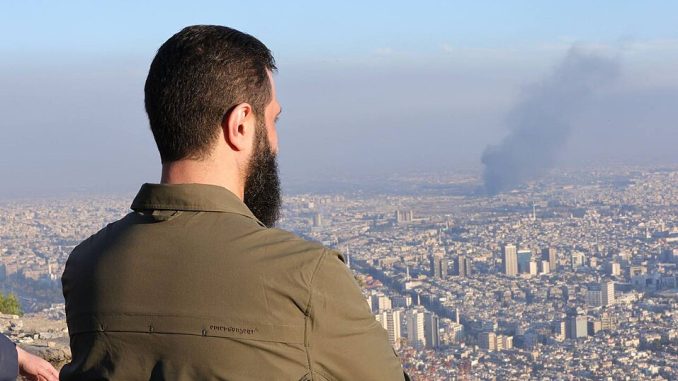 Photo by Presidency of the Syrian Arab Republic – Presidency of the Syrian Arab Republic, Public Domain, Wikipedia
Days before violence broke out in Sweida between Druze and Bedouin tribesmen, Syrian interim President Ahmed al-Sharaa was in Azerbaijan.
Azerbaijan is a rising power in the region that has not, historically, played a major role in Middle East affairs. It has preferred to build its strength and economic power slowly.
Its decision to conduct outreach to the new government in Damascus shows that Baku determined that now was the time to take further action.
Sharaa was there to discuss energy deals and other investments. It is possible he was also there to discuss Israel, because Azerbaijan and Israel are strategic partners.
However, the trip did not end with the kind of results one might expect. Rumors that Syria could join the Abraham Accords and that it was moving toward creating a new unified state have backfired in Sharaa’s face.
What happened in Sweida that led to the collapse?
There are likely several reasons for the collapse in Sweida. Firstly, Sharaa had also recently met with US envoy Tom Barrack to discuss the unification and integration of the US-backed Syrian Democratic Forces.
Barrack had appeared to scold the SDF for not moving faster to integrate. This was part of a process agreed to in March by SDF leader Mazloum Abdi and Sharaa. The US was going to draw down troops, and a unified Syria was supposed to be able to deal with extremist threats such as ISIS.
Secondly, it is plausible that, behind the scenes, some groups were working to destabilize southern Syria, while Sharaa was looking elsewhere. Some might argue that Iran and others have an interest in causing damage to a US-backed Damascus, and also in any chance of Syria patching things up.The Islamic Republic is also nonplussed with Azerbaijan. Is it plausible that Iran or its agents in Syria set off a powder keg? To believe that, one would have to buy into the claims that some Druze factions in Sweida were once pro-Assad and that they still harbor these feelings, or at the very least, that they are involved in contacts that could undermine Damascus. Some also claim these same Sweida factions are involved in the Captagon drug trade, which pro-Assad militias once dominated.
All politics are local
Yet, the Iranian conspiracy angle behind the Sweida violence does not seem to hold a lot of weight. It seems too complicated. The best explanation is also the simplest one. These political issues are local. The fact is that Druze and Bedouin tribes have chafed before in southern Syria. On July 13, another round of clashes erupted. This is at least the third round of clashes between the Druze and pro-government groups.
Ergo, this is not new. Israel has vowed to protect the Druze. Because of this, some Druze factions likely think they have power on their side. They assume that if there are clashes and the tide turns against the Druze factions, Israel will come to their aid. This means they may be willing to take more risks.
Israel has demanded that southern Syria be demilitarized. This power vacuum allows armed groups and factions to dominate the countryside. Attempts to reduce tensions take longer because Damascus cannot deploy heavier forces. That does not mean that Syria is not responsible for security. It can dispatch personnel on trucks to staff checkpoints. It has the support of the people of Daraa and the tribes. The Druze are more complex – some factions prefer Damascus while others do not.
What was Sharaa thinking when reports came in about the clashes?
He has mismanaged this in the past. Despite his apparent good choices in foreign policy in the region, balancing various countries, he seems to struggle with tactical decisions relating to local groups. SHARAA CAME out of Hay?at Tahrir al-Sham, an armed group that ran Idlib. Under his former nom de guerre, Abu Mohammed al-Julani, he successfully navigated local politics and tribal groups. He once served prison time in Iraq.So Sharaa has a lot of experience. Some of the experience had to do with working with extremist groups. Nevertheless, he was able to channel that to create a successful unified HTS army in Idlib that overthrew the Assad regime. One does not simply overthrow a 50-year-old regime. Clearly, it takes some acumen.
On the other hand, revolutionaries who come to power often struggle to rein in the revolution. Consider the Bolshevik Revolution in 1917. Russia fell into a half-decade civil war that included numerous “White Army” factions fighting the “Reds” and many foreign countries intervening.
Syria has already gone through 14 years of civil war with numerous fronts and factions, with countries intervening. So, wasn’t Sharaa already an expert in this? Wasn’t he steeled by war?
This raises serious questions about Sharaa’s ability to control the conflict in Sweida. US Secretary of State Marco Rubio issued a tough statement on Saturday that highlights this inconsistency in Damascus.
“The rape and slaughter of innocent people, which has and is still occurring, must end,” Rubio said. If authorities in Damascus want to preserve any chance of achieving a unified, inclusive, and peaceful Syria free of ISIS and of Iranian control, they must help end this calamity by using their security forces to prevent ISIS and any other violent jihadists from entering the area and carrying out massacres, he added.
“And they must hold accountable and bring to justice anyone guilty of atrocities, including those in their own ranks,” Rubio said. “Furthermore, the fighting between Druze and Bedouin groups inside the perimeter must also stop immediately.”
It appears that there is now concern in Washington that Damascus is unable to hold things together. Israel has played a complex role in this. By demanding demilitarization in southern Syria, Israel has helped fuel the chances that there will be a power vacuum. During the Sweida crisis, Israel was quick to begin airstrikes on July 14 and 15. These grew to include a large strike on central Damascus.
The government in Damascus appears to have responded to the strikes by withdrawing its limited security forces from areas near Sweida. The result was that thousands of Bedouin then mobilized to fight. They brought trucks and weapons from home. The Bedouin were fueled by videos circulating online that showed Bedouin being killed by Druze.
Whether the videos were all confirmed is unclear, but the effect was evident. Bedouin tribes put aside their differences and went to fight. Damascus only reined them in on Friday and Saturday. As such, Syria demonstrated that it could stand by and allow fighting to continue.
Damascus is between a rock and a hard place. Sharaa wants to appease groups that worked with HTS to defeat the Assad regime. His natural feelings are toward those Sunni Arabs in Syria who made up the bulk of his fighters.
However, he has also tried to have half the ministers in his government come from other groups not linked to the HTS. The top ministers in the government are all HTS members. That means that the tendency in Damascus is to side with groups like the Bedouin.
Sharaa’s tendency is to focus on issues such as foreign affairs, where there are expected gains. There are diminishing returns in southern Syria, and only unfavorable options remain for Damascus.
When Damascus intervenes, it is accused of suppressing the Druze. When it does not intervene, it is accused of fueling attacks. Both may be true. However, the reality is that someone will need to come up with a solution that enables peace, rather than more rounds of violence.


@Peloni Post disapeared.
It’s back. Thanks
To Frantzman
You call for a solution for peace. The solution is there already and has been from the seventh century. That is to repress the jihad and never let them have a whiff of power…in the course of this the American boss class, Trump or Biden, must be exposed very sharply. Trump must be fought down the line. He is a bully and his relationship with Israel and Netanyahu is one of a bully to his slave.
Here Rubio extends this trump theme
“Furthermore, the fighting between Druze and Bedouin groups inside the perimeter must also stop immediately.”
Really Rubin. Where is the equivalence?
This is the continuation of Trump… complete lack of principle
There cannot be a strategy to win from this. Such statements must be attacked immediately by Israel
It is when the Israeli government fails to act, and be completely proactive on every front, especially in fighting the jihad, on behalf of minorities, that bottom feeders like Carlson see their opportunity.
The way is already clear. It’s a matter of having it done.
Carlson is a lowlife continually being given an opening by inadequate Israeli bosses leaders.
from Syria- What’s happening to Druze women