
Rafael Medoff
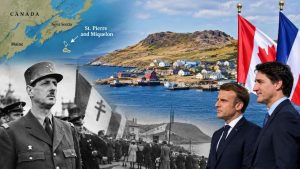 Image created via AI.
Two tiny islands near Nova Scotia and Maine are back in the spotlight, after largely disappearing from public view for more than eighty years.
The islands, St. Pierre and Miquenon, are suddenly attracting tourists, because a Canadian television series set there has become a big hit. In addition, the prime minister of Canada and the president of France held a first-ever meeting there last week, as a kind of symbolic thumbing of their noses at the United States.
A recent New York Times feature about the islands noted that the last time St. Pierre and Miquenon attracted much attention was back in 1941. The islands long have been a French colonial possession, so when the Nazis installed the puppet Vichy regime as the rulers of France, the Vichyites also became the rulers of France’s overseas territories.
On December 24, 1941, the Free French—the government-in-exile headed by General Charles de Gaulle—sent a naval force that ousted the islands’ Vichyite rulers. A plebiscite held the following day found 98% of the islands’ inhabitants supported the overthrow of the Vichyites.
According to last week’s Times article, De Gaulle’s action “upset the US government over what it perceived as interference in North America.”
Not quite.
If the concern really was over “interference in North America,” then the Roosevelt administration could have protested the change from democratic rule to fascist Vichy rule there as a threat to America. The real problem, in fact, was that FDR had a policy of appeasing Vichy, in the hope that it would persuade the Vichyites to be less pro-Nazi.
But appeasing dictators never works.
The most notorious example of that appeasement policy toward Vichy was the Roosevelt administration’s mistreatment of Holocaust rescuer Varian Fry. In 1940-1941, he smuggled more than 2,000 refugee artists, scientists and scholars—most of them Jews—out of Vichy France, until the Nazis and the Vichyites complained to Washington about Fry’s activities. Secretary of State Cordell Hull responded by canceling Fry’s passport, forcing him to leave France.
That’s why the Roosevelt administration denounced De Gaulle’s “arbitrary” action in St. Pierre and Miquenon in 1941. That’s why the US ridiculed the liberating force as “the so-called Free French,” making it clear that it regarded Vichy, not the resistance, as the legitimate rulers of the two islands.
Vichy officials praised Roosevelt’s stance on the islands as “a severe lesson to the dissidents.” A group of prominent American liberal intellectuals, on the other hand, denounced the administration’s policy of “appeasing undemocratic and pro-Axis governments.”
De Gaulle refused to budge from the islands, and FDR eventually dropped the issue.
But Roosevelt’s policy of appeasing Vichy continued even after the US entered the war. Thus following the Allies’ liberation of North Africa from the Nazis in November 1942, President Roosevelt agreed to leave Vichyite Admiral Francois Darlan in power.
As a result, thousands of Moroccan and Algerian Jews whom the Vichyites had imprisoned in slave labor camps were kept there until the summer of 1943—and the anti-Jewish laws that the Vichyites had imposed in North Africa were not completely abolished until October 1943, nearly a year after the region was liberated.
**A short commentary from the Facebook page of Dr. Rafael Medoff, historian and author:


Leave a Reply
You must be logged in to post a comment.