
The absence of leadership is leading to questions about who might be the real decision maker in Tehran now. One name being mentioned is Ali Larijani. Who is Larijani, and why does he matter?
By SETH J. FRANTZMAN |
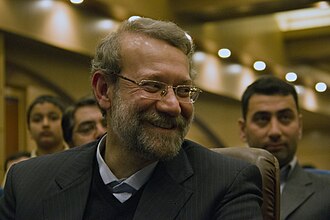 Ali Larijani. Photo by Mostafameraji – Own work, CC BY-SA 4.0, Wikipedia
The absence of leadership is leading to questions about who might be the real decision maker in Tehran now. One name being mentioned is Ali Larijani. Who is Larijani, and why does he matter? To understand this, we need to understand the current power vacuum in Tehran.
Larijani is seen as a key figure today in Iran. Due to the uncertainty about what comes next, it may be that someone steps in from behind the scenes. Rudaw media in Iraq noted that “Iran’s constitution does not explicitly foresee the killing of the supreme leader. Instead, it outlines a mechanism for selecting a successor in the event of death, resignation, dismissal, or incapacity.
“Under Article 107 of the Constitution of the Islamic Republic of Iran, the supreme leader is chosen by the Assembly of Experts, which also holds the authority to dismiss him. A candidate must secure a two-thirds majority vote of the assembly’s members to be appointed.”
Regardless of the process, many reports seem to imply that Larijani may hold the keys to power behind the throne.
Larijani rising star in Iranian politics
The Jordanian think tank Politics and Society Institute noted on February 23 that “it is perhaps from precisely this vantage point that the name of Ali Larijani surfaces in contemporary analyses –not because he is the strongest contender but because he may be the most suited to a specific function: managing equilibrium should the ground beneath the system begin to tremble.”
This report mentioned that the Larijani family is from Damavand in northern Iran. He was actually born in Najaf in Iraq in 1957, when his father was there.
The report noted that “Larijani’s father, Grand Ayatollah Mirza Hashim Amoli, was a respected jurist, granting his sons early scholarly legitimacy. His brothers have occupied influential positions: Sadiq Larijani, a jurist and former head of the judiciary as well as a member of key constitutional bodies – and at times mentioned among potential successors to Supreme Leader Ali Khamenei.”
It then said, “Larijani holds a PhD in philosophy, a background reflected in his political style-measured rhetoric, deliberative decision-making, and a preference for layered solutions.”
Turkey’s TRT noted in 2022, “When Hassan Rouhani rose to power in 2013, Ali Larijani did everything he could to help the new president’s agenda. He famously gave the 290 members of Majlis [the legislature] only 20 minutes to discuss the 2015 nuclear agreement, which Rouhani’s government had reached with world powers. Even with Rouhani out of the office and the Majlis controlling the hardline faction, Ali Larijani chose to stay in the political power’s center.”
However, Larijani is not just a man by himself. TRT argued that his family is what really matters. “The Larijani family network is arguably the most influential web of power intersected across the upper echelon of the regime.”
If Larijani survives the current conflict, it’s possible that he and his family could play an important role in the future of the regime if it survives or comes to some kind of deal with the White House.


“Under Article 107 of the Constitution of the Islamic Republic of Iran, the supreme leader is chosen by the Assembly of Experts, which also holds the authority to dismiss him.”
So “The Assembly of Experts” picks someone to run the country as “The Supreme Leader” but if in a few weeks the guy is a dud, “The Assembly of Experts” picks someone else.
Question: Do these Muslim clowns seem to be “experts” at a damn thing? The country is like the KKK run by a “Grand Wizard.”