
PELONI: While Netanyahu cut his trip to the US very short, apparently not even able to meet with Pres. Trump, the few hours he spent in the US included more than just delivering the speech to the UNGA…
| Published: September 25, 2026
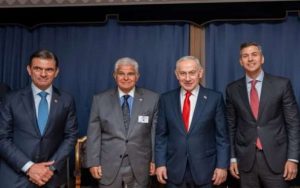 From left to right: Bolivian President Rodrigo Paz, Panamanian President José Raúl Mulino, Israeli PM Benjamin Netanyahu, and Paraguayan President Santiago Peña. (Photo: x.com/PresidenciaPy)
Israeli Prime Minister Benjamin Netanyahu’s brief trip to New York to address the UN General Assembly did not include a meeting with U.S. President Donald Trump. But on a visit measured in hours, those he did meet with pointed to a broader trend in Israeli diplomacy: not toward traditional world powers, but toward reciprocity.
“Many world leaders requested to meet with the Prime Minister during the visit, but due to a tight schedule and the need to return before the onset of Sukkot, the Prime Minister was only able to accommodate some of them,” the Prime Minister’s Office (PMO) said ahead of Netanyahu’s trip. Israeli media outlets reported that Netanyahu ultimately spent six hours in New York, with security concerns and protests also complicating his visit.
Among the meetings that made it onto Netanyahu’s schedule, those with four Latin American leaders stood out. He met separately with Argentine President Javier Milei, one of Israel’s closest allies in the region. In his UN address, he accused the organization itself of repeatedly acting against Israel while remaining silent in the face of Islamist terrorism and the genocide of Christians in Africa.
Netanyahu and Milei reportedly discussed bilateral cooperation and what the prime minister called “the positive strategic shift for Israel taking place in Latin America,” including opportunities to expand the Isaac Accords.
In a video of the meeting, Netanyahu can be heard congratulating Milei for his “masterful” economic breakthroughs and praising him for “standing up for the truth,” adding: “That’s why you support Israel, because we share this common heritage of justice and speaking the truth.”
Netanyahu then met jointly with the presidents of Paraguay, Panama and Bolivia, thanking them for supporting Israel’s security and “standing beside it in the international arena.”
He described Latin American countries as “important partners in the struggle against terror elements led by Iran and its proxies,” and encouraged their leaders to withdraw from the International Criminal Court.
Days earlier, under President Abelardo de la Espriella, Colombia formally withdrew its intervention in South Africa’s case against Israel at the International Court of Justice. Colombia had joined the case in April 2024 under the previous administration of Gustavo Petro. The new administration has restored relations with Israel and moved to deepen ties, becoming only the second country after the U.S. to recognize Israeli sovereignty over the Golan Heights.
On Thursday, Colombia announced it had severed diplomatic relations with Iran, citing alleged ties between Tehran and international terrorist and “narcoterrorist” groups threatening Colombia’s security. The statement also pointed to human-rights violations, attacks on countries outside the Middle East conflict, the closure of the Strait of Hormuz and interference with international monitoring of Iran’s nuclear program.
A similar diplomatic reversal unfolded in Slovenia, another country whose leader Netanyahu met on the sidelines of the UN General Assembly. Netanyahu congratulated Prime Minister Janez Janša on the opening of Israel’s first embassy in Ljubljana, saying his government had helped bring about “a turnaround in bilateral relations,” and inviting Janša to visit Israel.
With Greece, the focus was on an already expanding partnership, as Netanyahu met with Prime Minister Kyriakos Mitsotakis to discuss the Greek procurement of Israeli defense systems, energy cooperation and plans for another trilateral summit with Cyprus.
But the reciprocity runs in both directions.
Earlier this month, Israeli Foreign Minister Gideon Sa’ar announced a series of countermeasures against the United Kingdom after London announced trade sanctions related to Judea and Samaria, also known internationally as the West Bank.
Israel ordered the British Consulate in Jerusalem closed, removed British representatives from the International Gaza Support Center (IGSC) in Kiryat Gat, ended British training of Palestinian Authority security forces and barred a group of its elected officials and other nationals from entering Israel over involvement in antisemitic and anti-Israel activity.
Spain and the Netherlands have likewise been barred from the IGSC in response to measures described as “anti-Israel.”
Netanyahu’s few hours in New York reflected this apparent policy of cooperation with governments moving closer to Israel, and tangible consequences for those moving in the opposite direction.


Leave a Reply
You must be logged in to post a comment.