
Peloni: The crash of a plane carrying Libya’s Army Chief of Staff, Ground Forces Chief, Head of Military Manufacturing, and Adviser to the Chief of Staff seems highly suspicious. Were Turkish demands in Libya too well refused by Gen. Al-Haddad?
Lt. Gen. Mohammed Al-Haddad, Libya’s Army Chief, was killed in a plane crash in Turkey on December 23. His death marks a significant loss for the Libyan military and its efforts toward unity.
By SETH J. FRANTZMAN |
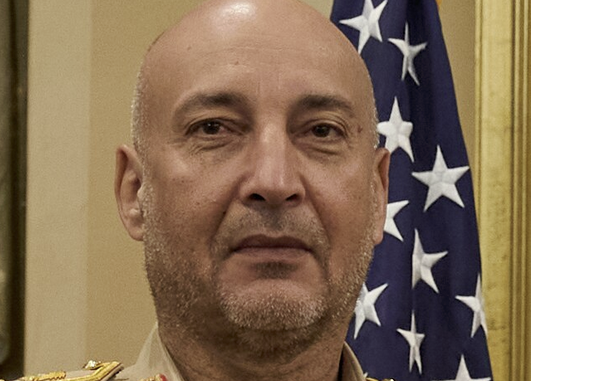 By U.S. Marine Corps photo by Cpl. Addysyn Tobar – This image was released by the United States Marine Corps with the ID 240628-M-MW994-1017 (next).This tag does not indicate the copyright status of the attached work. A normal copyright tag is still required. See Commons:Licensing. Public Domain, Wikipedia
The Libyan army’s chief of staff, Lt.-Gen. Mohammed Ali Ahmed al-Haddad, was killed in a plane crash in Turkey on Tuesday. He was there for discussions along with a team from Libya
“The other four passengers on board were identified as al-Haddad’s adviser Mohammed al-Asawi Diab, Maj.-Gen. Al-Fitouri Ghraibil, adviser Mahmoud al-Qatiwi, and photographer Mohammed Omar Ahmed Mahjoub,” German news channel Deutsche Welle (DW) reported. “Turkish authorities said the plane’s three crew members were also killed in the crash.”
The plane was flying to Tripoli from Ankara.
UAE-based news site Al-Ain News reported: “The plane crash over the skies of the Turkish capital, Ankara, has brought the name of [Lt.-Gen.] Mohammed Ali al-Haddad back to the forefront of the Libyan scene.”
Haddad was the chief of staff of Libya’s Government of National Unity (GNU), which is based in Tripoli, the report said.
Libya is a divided country and has been at civil war since the fall of the dictator Muammar Gaddafi in 2011. Eastern Libya is run by Khalifa Haftar and the House of Representatives, which is based in Benghazi. Western Libya is run by the GNU, which enjoys more international recognition.<
Western Libya’s government has been a close partner of Turkey, while Haftar has generally been closer to Egypt and some other countries.
After the death of Haddad, Haftar issued a statement of condolence.
“In a statement released by the armed forces in eastern Libya, Haftar was quoted as expressing ‘deep sorrow over this tragic loss’ and conveyed his condolences to the late general’s family, tribe, city and ‘to all the Libyan people,’” Turkish state-run news agency Anadolu Agency reported.
The Benghazi-based House of Representatives also issued a condolence message and said there would be three days of mourning for those lost in the flight, the report said.
‘One of the most prominent military leaders in Libya in recent years’
Al-Ain News reported: “Mohammed Ali al-Haddad is considered one of the most prominent military leaders in Libya in recent years, as he assumed the position of chief of the General Staff of the Libyan Army since 2021, by decision of the Presidential Council, after being promoted to the rank of Lieutenant-General.”
Haddad had been serving “as the commander of the Central Defense Zone and a member of the Joint Operations Room in the Western Region,” the report said, adding that he had been tasked with “overseeing efforts to unify the military establishment and end the state of division, following the ceasefire agreement in October 2020.”
The ceasefire took place between the Tripoli government and Haftar’s forces. Turkish support had helped Tripoli beat back a Haftar offensive in 2019.
HADDAD HAD played a key role in a joint military committee that included representatives from western Libya, Al-Ain News reported. This was called the 5+5 Committee.
Over the years, reports indicated that Haddad had played a key role discussing developments in the country.
“Divided Libya’s military rivals discuss army reunification in Paris,” London-based newspaper Arab Weekly reported in 2023, adding that “the meetings were attended by Chief of General Staff of the Government of National Unity (GNU), [Lt.-Gen.] Mohamed al-Haddad and Libyan National Army (LNA) Chief of Staff [Maj.-Gen.] Abdelrazak al-Nadori.”
After Haddad’s death, there had been “discussions about appointing either Haddad or Fitouri Gharibil as Libya’s next commander-in-chief, with the rank of field marshal, a topic under debate for several months,” Turkish news site Turkiye Today reported.
There was controversy about Turkey extending its military role in western Libya, the report said. Ankara had backed Tripoli in 2019 in exchange for a deal about maritime rights, but Libya has not always been pleased with this.
“Haddad opposed any continued foreign military intervention in Libya,” Turkiye Today reported.
As such, Haddad appears to have been at odds with Ankara’s policies.
Al-Ain News reported: “Al-Haddad participated in a series of meetings with the chief of staff of the Libyan Army under the General Command at the time, [Lt.-Gen.] Abdul Razzaq Al-Nadhuri, under regional and international auspices, most notably the Cairo and Rome meetings, which focused on emphasizing the unity of Libyan territory and forming a joint force to protect the borders.”
“Haddad had cultivated extensive military relationships at both the regional and international levels, especially with [Turkey], which is one of the most prominent of these relationships,” the report said.
He signed an agreement with Italy in 2023 to have Libyan special forces trained by Rome.
“In July 2024 he met with leaders from the US Africa Command (AFRICOM) to discuss supporting the unification of the Libyan army and strengthening border security,” Al-Ain News reported, adding that Haddad had also traveled to Moscow in 2021 for talks.
Malta’s Minister for Home Affairs, Security, and Employment, Byron Camilleri, wrote on X that he was “deeply saddened by the tragic passing of General Mohammed Al-Haddad. Through our various meetings in Libya, we built an excellent relationship based on mutual respect and a commitment to regional stability. My heartfelt condolences to his family and the Libyan people.”


Very interesting news, but no details about what happened or why. The intro comment that General Al-Haddad may have refused Turkish demands “too well” is the probable cause. I guess, since this was not a regular air-line flight, it will not be investigated so thoroughly.
@dreuveni
It is being investigated currently with a great deal of interest. The Turkish bloggers are already claiming it was Israel who blew up the plane. Unfortunately, the plane crashed in Turkey, leaving Erdogan free to place his finger upon the scales as much as it serves his purpose as the black box has been recovered and is being analyzed.
The loss of Gen. Al Haddad, regardless of how this plane went down, will have the effect of providing Erdogan a measure of relief, if not complete victory, in his desires to have a greater role in Libya and Libya’s gas.