
Independence Day 2025 means we should celebrate Israel’s rebirth while honoring its ongoing struggles.
By GIL TROY | APRIL 30, 2025
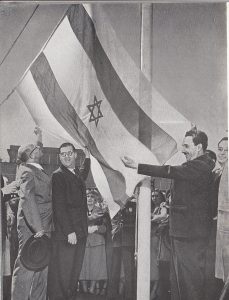 By Unknown author – The Israel Internet Association via the PikiWiki – Israel free image collection project, Public Domain
As we approach Independence Day, I repeat my annual call for every Jew and Israel-lover to mark the birth of the state by eating ice cream for breakfast. Despite our current challenges, let’s taste the sweetness of having a reborn Jewish nation, while our kids mark this day as a memorable break from routine.
While some old-time immigrants never had ice cream until they reached Israel, many religious Jews relish how easy it is to find kosher ice cream on our local streets, without feeling like targets abroad. And even though we are reeling from another searing Remembrance Day, as 59 hostages still languish in Hamas captivity, we must celebrate now more than ever.
Last week, as I visited the blue-tinged centers of anti-Trump resistance – suburban Maryland, New York City, and Boston – my optimism about life, and life in Israel, provoked two contrasting reactions. Many thanked me for saluting Israel’s resilient, optimistic young heroes, who seem far more upbeat about their lives, and the world, than their blue-state American peers. Hard to believe, but in late October 2023, polls showed 66% of Israelis “optimistic,” even while fearing for their safety and mistrusting the political leadership.
Israel on Independence Day
Others were more skeptical. Among pro-Zionist liberal Jews, the constant pounding the media inflicts on them about the Gaza “genocide,” “settler violence,” and Prime Minister Benjamin Netanyahu’s divisiveness and alleged corruption, is compounded daily with their hourly despair about President Donald Trump’s latest assault on their conception of what America should be. Across the spectrum, many ardent pro-Israel patriots abroad somehow feel it’s disloyal to enjoy life too much after Hamas’s October 7 mega-atrocity.
To these people, Left and Right, I noted how much safer Israel is this Independence Day. Last year, so many feared Hezbollah and were still unnerved by Iran’s 320-missile barrage.
Most Israelis were confident we would eventually beat Hezbollah, but assumed we would endure weeks without water and electricity after sustaining serious missile damage, especially in Tel Aviv.
Beyond the objective strategic improvements – Hezbollah has been crushed, Iran’s key defenses have been stripped, Syria’s Assad regime is gone, and Hamas has been further degraded – many Israelis are leading far more normal lives than they did a year ago. Much fighting remains to be done and new leaders must be found. But the overwhelming majority of Israelis are better off than they were last year, as most of us appreciate the meaningful, connected, rooted, purposeful lives we live daily.
All of us keep absorbing two realities simultaneously. Every day is Remembrance Day.
We mourn, champion whatever strategy we trust to free the hostages, and sweat our divisions and challenges. We also fight like hell, however we can, against our evil enemies, on the battlefront and in the ongoing ideological combat.
Still, not only can we lighten up – we must rejoice! Otherwise, we give our enemies the power I will never concede to them: the power to rob us of our joy.
As we celebrate the human-shaped miracles of last year and the last 77 years – a paradox far beyond this column’s scope – let’s live the contradiction epitomized by two speeches prime minister David Ben-Gurion delivered before he boldly defied the conventional wisdom and declared Israel’s establishment in May 1948.
In January 1948, addressing Mapai’s Central Committee, he articulated the focus we need today, too. “There is now nothing more important than war needs, and nothing equal to war needs,” he declared. “There are no exceptions. That is the great terror and great misfortune embedded in every war. War is a cruel and jealous Moloch [god that demands child sacrifice] who knows neither compassion nor compromise.”
This focus, Ben-Gurion suggested, comes to Zionists, like other liberal democrats, “precisely because for us war is not a goal in itself. We see war as a terrible accursed misfortune and resort to war only when we have no other choice.”
Even then, Israel’s already-legendary leader yearned for the positives that drive us – and elude our enemies, forever blinded by blood-lust: “a vision of life, a vision of national rebirth, of independence, equality, and peace – for the Jewish nation and all peoples of the world.”
Four years earlier, articulating “The Imperatives of the Jewish Revolution,” Ben-Gurion showed that despite his 100% focus on winning the war, he was equally intent on building the Jewish state. In words all should read between licking our vanilla-and-blueberry cones, he thundered: “The meaning of the Jewish revolution is contained in one word – independence! Independence for the Jewish people in its homeland!”
Independence, he explained, “means more than political and economic freedom; it involves also the spiritual, moral, and intellectual realms, and, in essence, it is independence in the heart, in sentiment, and in will.”
Thinking ahead to us, inspiring us, he insisted: “The Jewish revolution against our historic destiny must be a prolonged and continuing struggle, an enlistment of our own generation and even of those to come.” The “road to success” he charted, was not only “through seizure of power, but by girding ourselves with unyielding tenacity for changing our national destiny.”
All of us, in Israel and abroad, are living our 1948 moment. We should live Ben-Gurion’s paradoxes, girding ourselves to defeat the enemy, and keep strengthening Israel. This week, especially, we must keep mixing our tears of mourning and joy. Trust that fusion to create the strong, historic cement that has been the secret to Zionist success and blessed us with the great gift of Jewish independence, and of this democratic-Jewish state.
The writer, a senior fellow in Zionist thought at the Jewish People Policy Institute, is an American presidential historian. His latest books, To Resist the Academic Intifada: Letters to My Students on Defending the Zionist Dream and The Essential Guide to October 7th and its Aftermath, were recently published.


I had initially quipped that the elevators in the NY subway system must have been designed as Shabbat elevators. 😀
https://www.facebook.com/share/r/1A7N8tNNHN/
https://www.mountvernon.org/library/digitalhistory/digital-encyclopedia/article/ice-cream