
| Published: September 26, 2026
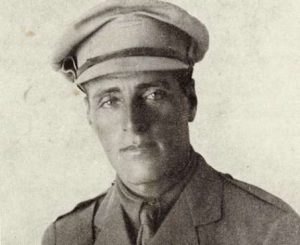 By Unknown author – Nli.org, Public Domain, Link
If you wanted to make up a fictional military hero for a country, someone who would be enshrined in that country’s memory for generations, you wouldn’t invent a one-armed socialist, vegetarian pacifist dentist. But reality seldom follows our preconceived ideas of what heroes should look like.
Let me introduce you to Yosef Trumpeldor (1880-1920). National military hero of the State of Israel, whose heroic death defending Tel Hai in 1920 became forever associated with the Jewish struggle to hold the far north, and whose last words, “It is good to die for our country,” inspired generations of Israelis.
Born in Russia in 1880, Trumpeldor was simultaneously a committed Zionist, a loyal subject of the Tsar, and – under Tolstoy’s influence – a vegetarian pacifist. Yet when drafted in 1902, he was determined to disprove antisemitic stereotypes of Jews as weak and disloyal.
And that cost him an arm.
In 1904, he was injured during the Battle of Port Arthur in the Russo-Japanese War, and the doctors had to amputate his left arm above the elbow. He insisted on returning to battle. “I have one hand left, but it is my right hand.” His bravery earned him promotions and decorations.
In 1905, the Japanese conquered Port Arthur. As a prisoner of war in Japan, he organized his fellow Jewish prisoners and established a Zionist association. It was there that he developed plans for socialist agricultural communes in the Land of Israel – years before Degania, the first kibbutz, was established.
Back in Russia, the decorated veteran was offered the chance to continue a military career. He declined. His sights were now on the Land of Israel. In 1912, he finally immigrated, working the fields of Degania with one arm until World War I interrupted his life as a pioneer.
As a Russian citizen in Ottoman Palestine, Trumpeldor had to accept Ottoman citizenship and military service or leave. He chose exile in Alexandria, where he met Ze’ev Jabotinsky. Together they proposed a Jewish combat unit to help Britain conquer Palestine. Britain instead created the Zion Mule Corps, which served at Gallipoli, where Trumpeldor was wounded again.
After Gallipoli, the Brits dissolved the corps, so Trumpeldor and Jabotinsky went to London to advocate for the establishment of the Jewish Legion. It eventually succeeded, but Trumpeldor could not participate due to his missing arm, so in 1917 he went back to Russia, where he tried to help Jews defend their homes during the tumultuous Bolshevik revolution, and encouraged them to move to Israel. Finally, in 1919 he returned to Israel, now under British rule.
Just a few months later, David Ben-Gurion asked Trumpeldor to go to the settlement of Tel Hai to organize its defense and report on the developments. World War I was over, and the former Ottoman Empire had been carved up between the Brits and the French. Tel Hai, Metula, Hamara, and Kfar Giladi were in an unclear border area, designated to become part of French Syria rather than British Palestine. The Jewish settlements refused to evacuate, wanting to secure Jewish presence near the vital water sources of the Sea of Galilee.
The French had not secured sovereignty yet, though, and didn’t have enough military presence. The area was in a limbo-state of anarchy. Bedouin gangs used the situation to extort money, attack Christian villages, and make the area unsafe. Initially, they had left the Jewish settlements alone, but by 1919, the settlements were under frequent attack.
Trumpeldor arranged the defenses and communicated with the leadership about the urgent need for reinforcements and supplies. In January, they destroyed and burned Hamara, and in February 1920, Trumpeldor warned that the Arabs intended to destroy all Jewish settlements in the area.
On March 1, 1920, a large group of armed Arabs arrived at Tel Hai and demanded entry to search for French soldiers. Trumpeldor allowed several of them inside. During the search, a confrontation broke out over one defender’s pistol; a shot was fired, and within moments the courtyard erupted into a gunfight. Trumpeldor was shot and mortally wounded.
As the defenders of Tel Hai were evacuated to Kfar Giladi, Trumpeldor allegedly said his last words, “It is good to die for our country,” perhaps quoting a well-known Latin proverb. The Hebrew version of the phrase became an electrifying inspiration for the Zionist movement and inspired generations to come.
The Tel Hai incident did not by itself determine the border. But Trumpeldor died defending Jewish settlements while that border was still being negotiated. Existing Jewish settlements in the area became one of the arguments for keeping the Galilee Panhandle inside British Palestine, and the eventual border placed Metula, Kfar Giladi and Tel Hai on the Palestine side. This was the border that eventually became the Israel-Lebanon border.
Trumpeldor’s legacy in Israeli history was thus forever enshrined. He was the man who died for his country 28 years before the country even existed. The Revisionist Zionist youth movement Betar, which developed under his friend Jabotinsky’s leadership, was named Brit Yosef Trumpeldor in his honor. Both sides of the Israeli political spectrum claim Trumpeldor as one of theirs. The left, because he was an outspoken socialist, and the right, because he worked with Jabotinsky.
And when the time came to establish an Israeli city just south of Metula, it was decided to name it in honor of Yosef Trumpeldor and the other seven defenders of Tel Hai, and it was named “The City of the Eight.” In Hebrew – Kiryat Shmona.

Leave a Reply
You must be logged in to post a comment.