
PELONI: As expected, the Peace Processors will have their way, no matter the coming costs in Jewish blood.
The US-backed Board of Peace is reportedly preparing to dramatically increase efforts to implement its Gaza plan after the upcoming Knesset election and American midterm elections.
By World Israel News Staff | Oct 12, 2026
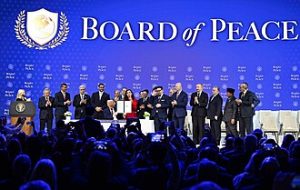 Board of Peace Charter Announcement and Signing Ceremony January 2026. By President.az, CC BY 4.0, Wikipedia
President Donald Trump’s Board of Peace is preparing to intensify efforts to implement its Gaza reconstruction and governance plan after the upcoming elections in Israel and the United States, according to a new report published by The Telegraph, following months of preparations that have yet to produce major changes on the ground.
Officials familiar with the initiative expect limited visible progress before Israel’s October 27 election and the November 3 US midterm elections, but anticipate a renewed American diplomatic push in November.
“There is movement. There’s a lot going on,” one official involved in the initiative said, emphasizing that preparations were continuing despite the absence of major developments.
The officials said substantial groundwork had been completed over the past six months, including preparations for the deployment of a Palestinian technocratic administration, an international stabilization force, and a new Palestinian police force.
The planned Palestinian administration has already been assembled and is awaiting authorization to enter Gaza, while the international force is reportedly preparing for deployment. Initial recruits have also been selected for the new police force.
The Board of Peace is tasked with overseeing the implementation of Trump’s 20-point Gaza peace initiative, which produced a ceasefire in October 2025 and secured the release of the remaining Israeli hostages.
However, negotiations over Hamas’s disarmament, the withdrawal of Israeli forces, and the establishment of alternative governing institutions have repeatedly stalled.
Hamas has agreed in principle to a disarmament framework involving the gradual surrender of its weapons in exchange for a phased Israeli withdrawal. Israel has resisted implementing the arrangement without stronger guarantees that Hamas will be fully disarmed.
The Board of Peace unveiled a $2.45 billion, six-month recovery program in September, comprising 66 projects intended to restore essential services and begin rebuilding Gaza’s infrastructure.
The proposal includes temporary housing, rubble removal, hospital repairs, economic recovery measures, and the deployment of international security personnel. The broader reconstruction effort is expected to require tens of billions of dollars.
Nickolay Mladenov, the Board of Peace’s high representative for Gaza, acknowledged the difficulties in moving the initiative forward during the September presentation.
“Our goal is to get through the next stage of actually moving from planning to implementation,” Mladenov said.
The board’s preparations have also come under scrutiny following an investigation into the private financial interests of several senior figures involved in the initiative, including Trump’s son-in-law Jared Kushner, special envoy Steve Witkoff, and financier Marc Rowan.
The investigation examined connections between investment firms associated with board members and businesses operating in Israel, including defense contractors.
Among the relationships highlighted was the investment by Kushner’s Affinity Partners in Phoenix Financial, an Israeli financial services company whose investment portfolios have included holdings in Smart Shooter, a defense technology manufacturer recently awarded a US military contract worth up to $150 million.
The investment exposure is indirect, and no evidence has been presented that Kushner or other Board of Peace members influenced the contract award.
Officials associated with the board rejected suggestions that private commercial interests were influencing its decisions.
“We literally have never had a single discussion at any point about business interests,” one official said.
In a separate statement, the Board of Peace defended Kushner’s investment arrangements, emphasizing that Affinity holds only a minority stake in Phoenix and does not control the companies in its investment portfolios.
“There was no Board of Peace involvement, no Board of Peace decision, and zero demonstrated personal benefit,” the organization said.

Leave a Reply
You must be logged in to post a comment.