
Peloni: America has a Qatar problem, a Turkey problem and a Muslim Brotherhood problem. The Trump administration believes that they can leverage profits over the ideology which drives these entities, and in this they are gravely mistaken. This issue must be addressed at home, but so too, it must be adressed in the region. The center of Centcom should be relocated elsewhere, and the forces concentrated there should be dispersed. Qatar is no ally, and its infiltration of Western agencies, its indoctrination of Western education, and its propaganda promoted by its media empire in Al Jazeera demonstrates this fact.
Natalie Ecanow
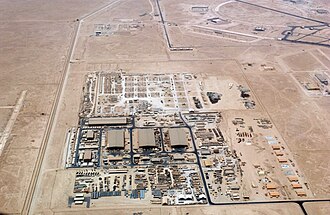 An aerial overhead view of “Ops Town” at at Al Udeid Air Base (AB), Al Rayyan Province, Qatar (QAT), taken from a US Air Force (USAF) KC-135 Stratotanker during Operation IRAQI FREEDOM.. Photo by US gov – ResearchArchive.gov, Public Domain, Wikipedia
It’s been a busy week at Al Udeid Air Base in Qatar. On January 14, the U.S. military started evacuating some troops from America’s largest base in the Persian Gulf region in anticipation of potential strikes against Iran. The U.S. Embassy in Doha also advised staff to “limit non-essential travel” to Al Udeid. However, the skies over Iran remained quiet, and U.S. troops began returning to the base on January 15. Al Udeid hosts approximately 10,000 troops and is home to U.S. Central Command’s (CENTCOM) forward headquarters.
One day before issuing these advisories, the U.S. inaugurated an air defense operations cell at Al Udeid to “enhance integrated air and missile defense.” CENTCOM Commander Adm. Brad Cooper said that the “cell will improve how regional forces coordinate and share air and missile defense responsibilities across the Middle East.” While improving coordination on regional security is laudable, it is a mistake to saturate Qatar with U.S. military infrastructure.
Al Udeid Is in Iran’s Crosshairs
While the threat against the U.S. base may not have materialized this week, it did last summer. In June, Iran launched a ballistic missile attack against Al Udeid after the U.S. carried out strikes against Iran’s nuclear program. The United States and Qatar successfully defended against the attack. A congressional report accompanying the National Defense Authorization Act for 2026 acknowledged “the risk posed by the Islamic Republic of Iran’s missile and drone capabilities to Al Udeid Air Base.”
Beyond Geography, Qatar Stands With Iran
As protests against the Iranian regime swelled, Qatar’s prime minister discussed “advancing bilateral cooperation” between Doha and Tehran during a phone call on January 13 with the secretary of Iran’s Supreme National Security Council. He had a similar conversation on January 15 with Iran’s foreign minister.
Meanwhile, Doha launched a full-court press to convince the United States to hold its fire. Former Qatari Prime Minister Hamad bin Jassim bin Jaber Al-Thani said on January 13 that, “We disagree with Iran on many issues,” but that the Trump administration, not the Iranian regime, must turn down the temperature in the region. “There must be a unified Gulf position, if possible, to try to persuade America to enter into serious and short negotiations to end the crisis and tension,” he said. A Saudi source told the media that Saudi Arabia, Qatar, and Oman “led a long, frantic, diplomatic last-minute effort to convince President Trump to give Iran a chance to show good intention.”
It’s a Mistake To Place All of America’s Eggs in Qatar’s Basket
Qatar has indicated more than once that it doesn’t want the United States to launch attacks against Iran from Al Udeid Air Base. Moreover, by concentrating American military assets in Qatar, the United States grants Doha leverage over American decision making — a reality made more dangerous by Qatar’s warm relationship with the Islamic Republic. To mitigate the risks of concentrating American military elements at Al Udeid, the Pentagon should replicate elsewhere in the region some of the capabilities and functions housed at the base.
Natalie Ecanow is a senior research analyst at the Foundation for Defense of Democracies (FDD). For more analysis from Natalie and FDD, please subscribe HERE. Follow Natalie on X @NatalieEcanow. Follow FDD on X @FDD. FDD is a Washington, DC-based, nonpartisan research institute focusing on foreign policy and national security.


As a simple minded man in Toronto, I can’t for the life of me, understand why the US has a large military base in Qatar. Are the top US generals and minister of defence OK with this? Is this just for political reasons?
I was hoping that once Trump came into office, he would move that base asap. Perhaps to a reliable ally like Israel. Keeping US military personnel and equipment in your enemy’s backyard is just plain nuts. Qatar can’t and must not be trusted.
That the use of Al Udeid Air Base has so many strings attached was actually new for me. From the USAF point of view, it is nonsense to use (and pay for) an airbase where you are limited in the missions you can fly from it. In this case, the obvious option is to move somewhere else, which is what we have been saying (without the background info) for quite a while now. Having to fly the bombing missions from Guam instead of Qatar is OK, I guess, but if the result is to be attacked with missiles from across the street (figuratively speaking) is anything but useful, even if the US attacks came from Guam. The only open question is which country nearby would like to welcome the USAF to build their new home in the middle east.
We Don’t Need qatar
https://substack.com/@lel817/p-184716038
Qatar built Al Udeid Air Base in 1996, and the U.S. began using it in late 2001 under President George W. Bush, initially for operations in Afghanistan, with significant expansion and commitment under later administrations like President Trump’s, deepening the relationship.
Built while Clinton was in office, but not for the US.
Qatar allegedly made a $1 mil donation to the Clinton Foundation for a short period of time with Bill. Trump obviously was gifted much more by the Qataris.
What a small donation can cause — long term!!