
Peloni: The borderline with Lebanon needs to be extended northwards. The active and continued threat from Hezbollah attacks has been demonstrated to be real and ongoing, and internationally imposed ceasefires have simultaneously failed to mature into anything more than a pause between missile barrages without Hezbollah surrendering a single rifle or rocket, demonstrating that peaceful conditions are not possible under the current arrangement.
IDF kills Iranian Quds Force commander leading Hezbollah’s rearmament
| Published: March 3, 2026
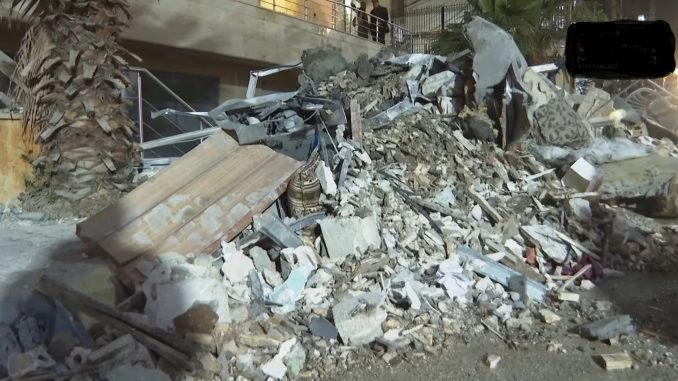 Hezbollah Command Center attacked. March 3, 2026. Screengrab via Youtube
The Israel Defense Forces (IDF) entered Lebanese territory on Tuesday, in an operation aimed at seizing high ground that could be used by Hezbollah to fire on Israeli communities.
The new operation followed the entry of Hezbollah into the war on Monday, when it fired rockets and drones at northern Israel as a reaction to the assassination of Iran’s Supreme Leader, Ali Khamenei, who was the group’s biggest backer and spiritual leader.
Defense Minister Israel Katz stated Tuesday morning that he and Prime Minister Benjamin Netanyahu “authorized the IDF to advance and take control of additional strategic high ground in Lebanon in order to prevent fire toward Israeli border communities.”
The Israeli operation follows the dramatic statement by the Lebanese government, which outlawed Hezbollah’s military activities in the country.
The Israeli Air Force completed a wave of airstrikes against Hezbollah military assets in Beirut a short while ago, the IDF announces.
According to the IDF, the strikes hit weapon depots, command centers, and "satellite communications" equipment belonging to Hezbollah's… pic.twitter.com/kDhZKtdvQx
— Emanuel (Mannie) Fabian (@manniefabian) March 3, 2026
Israeli army officials had stated repeatedly in recent days that the decision to evacuate northern Israel after Hezbollah attacked on Oct. 8, 2023, was a mistake that would not be repeated.
The IDF operation is aimed at preventing another situation where terrorists can fire down into Israeli towns from the higher hills on the Lebanese side of the border, as had happened for nearly two years in 2023-24.
“To prevent the possibility of direct-line fire at Israeli communities, the Prime Minister and I have approved the IDF’s advance to seize additional commanding terrain in Lebanon and defend the border communities from there. We promised security for the Galilee communities — and that is what we will deliver,” Katz affirmed.
The IDF said in a statement that “IDF soldiers are operating in southern Lebanon and are positioned at several points near the border area as part of an enhanced forward defense posture.”
Following Hezbollah’s entry into the war, on March 3rd, the IDF reinforced its defensive deployment along the line of contact. Additional IDF forces entered the line-of-contact area in southern Lebanon and took control of dominant locations. This is in addition to the five areas… pic.twitter.com/k5hYn6GBvg
— Israel-Alma (@Israel_Alma_org) March 3, 2026
Following the ceasefire with Hezbollah at the end of 2024, IDF soldiers continued to hold five strategic points on the Lebanese border. Now, the Israeli military apparently seized additional territory.
On Monday, the IDF had called on residents of some 50 villages, most of them in southern Lebanon, to evacuate.
In January, the Lebanese army had declared southern Lebanon to be empty of any Hezbollah presence, claiming to have established its full control over the area. On Tuesday, troops of the Lebanese Armed Forces vacated dozens of posts across southern Lebanon, according to Lebanese media reports, amid the advance of Israeli troops into the area.
This followed reports that Lebanese President Joseph Aoun ordered the army to avoid clashes with the IDF, noting he didn’t want to endanger the lives of his soldiers over the decision of Hezbollah to drag the country into a war with Israel.
??? ?????? ???????? ???????? ????? ??????? ?"? ????? ????? ??"? ???? ??????.
???? ?????? ??????? (??? ????, ?? ??? ????? ????? ???? ????? ?? ?????)
??? ???? ????? ????? ??? ?'??? ?????? pic.twitter.com/YJ1LNffiHw— Ben Tzion Macales (@BenTzionMacales) March 2, 2026
“The IDF is working to create an additional layer of security for residents of northern Israel. The IDF is conducting targeted strikes against Hezbollah terrorist infrastructure in order to remove threats and prevent infiltration attempts into Israeli territory,” the IDF statement added.
“The Hezbollah terrorist organization chose to attack Israel on behalf of the Iranian regime, and it will bear the consequences of its actions. The IDF will not allow harm to Israeli civilians and will continue to act to defend the State of Israel and its citizens.”
Ahead of the ground incursion, the Israeli Air Force conducted large waves of airstrikes against Hezbollah targets across Lebanon, striking its propaganda outlets, banking system, and terror commanders.
As part of these strikes, the Israeli Navy eliminated Reza Khazaei, head of Hezbollah’s weapons build-up and the Chief of Staff of the Lebanon Corps in the Iranian Quds Force.
Khazaei “was considered a key actor in the buildup of Hezbollah’s capabilities. He was responsible for the communication between the Hezbollah terrorist organization and the Iranian regime, in particular, ensuring that Iranian supplies met the needs of Hezbollah,” the IDF said.
He led the build-up of “the military capability and equipment of Hezbollah and the implementation of the capacity-building plans and rehabilitation” of Hezbollah after its degradation by Israel, by advancing weapon smuggling programs and overseeing the group’s weapons manufacturing programs on Lebanese soil.
The IDF also killed the commander of the Palestinian Islamic Jihad in the Lebanon sector, Abu Hamza Rami, in Beirut. The IDF said Rami was a veteran terrorist responsible for “hundreds of terrorist attacks against IDF troops and Israeli civilians.”
“Recently, Rami continued to advance numerous terrorist attacks on behalf of the organization from within Lebanon, including training Nukhba terrorists, recruiting terrorists, and procuring weapons,” the IDF said, and also took part in operations against Israel during the war against Hezbollah in 2024.
“His elimination constitutes a severe degradation of the Palestinian Islamic Jihad’s ability to carry out terror operations against the State of Israel and its citizens. The IDF will continue to operate to thwart any threat posed to the State of Israel,” the IDF said.
Meanwhile, the military also said it intercepted two drones launched at Israel by Hezbollah early in the morning. Later Tuesday, the terror group launched additional drone attacks in northern Israel.
Israpundit is entirely dependent on readers support. Please help me continue educating people with the truth about what is going on in Israel and around the world.


Ardie Geldman
https://m.facebook.com/story.php?story_fbid=pfbid0uF7PWnWASRpxrGQxsMv77iw71U2PSWeMhbzzEtsX1TgVUV6f5LCgPG9fHKQFxk4Hl&id=545522241
I would guess Israel again clears all civilians out of everything below Litani River and at least for tying being moves the border to there. However, Israel will now after finishing the IRGC along with the USA will complete the job on the Hezis.