
While the world clamors for a Palestine governed by the terrorist group Hamas Israel makes inroads with Somaliland — a peaceful, stable state in North Africa.
Am Thinker | January 20, 2026
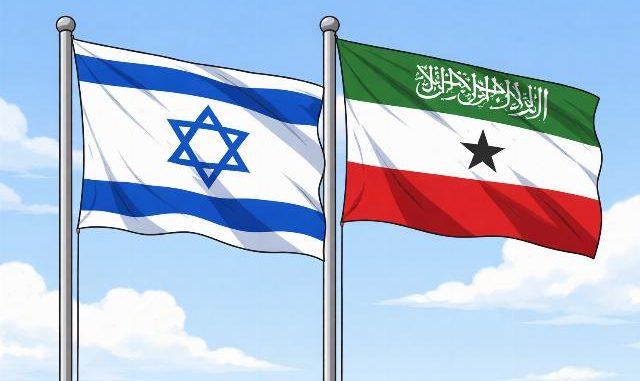 Image generated by ChatGPT.
While the world clamors for a Palestine governed by the terrorist group Hamas, it has, for more than three decades, overlooked Somaliland — a peaceful, stable state in North Africa. In December last year, Israel became the first country to recognize Somaliland since it separated from Somalia in 1991. Beyond diplomacy, Israel has formed strategic ties with Somaliland, whose coast overlooks the Bab-el-Mandeb Strait, a chokepoint between the Red Sea and the Indian Ocean, through which $1 trillion in global shipping passes annually.
Israel is not prone to knee-jerk reactions. Therefore, this should not be mistaken as a response to countries like the U.S., Canada, Portugal, and Australia recognizing Palestine. In fact, after Israel’s successful multifront response to the October 7 massacre, it has gradually expanded its influence throughout the Middle East and North Africa. I’ll revisit the Somaliland initiative after examining the broader context.
The Jewish state, known for its military, technology, weapons, diplomacy, and espionage skills, has effectively used these assets. Israel has formed military and intelligence alliances with the UAE, created a trilateral military cooperation plan with Greece and Cyprus, and established a defense partnership with Morocco. It has also built intelligence links with a South Yemeni separatist group, which could be useful in combating the Iran- and Russia-backed Houthis, who have attacked Israel with missiles and drones and targeted Ben Gurion Airport and shipping in the Red Sea. Israeli support for the oppressed Druze community in Syria has also been gratefully acknowledged by their leaders.
Cooperation with the UAE: Since the signing of the U.S.-brokered Abraham Accords in 2020, Israel, the UAE, and Bahrain have participated in numerous joint military, naval, and air exercises. More importantly, Israel has supplied the UAE with the Barak and SPYDER air defense systems. Last year, Israel and the UAE reached an agreement on a tech transfer and production deal for Hermes 900 UAVs, which can stay airborne for 30 hours, reach altitudes of 30,000 feet, and carry 300 kilos of payload to perform reconnaissance, surveillance, and electronic warfare missions.
Greece and Cyprus: Israel has maintained a geopolitical partnership with Greece and Cyprus since 2010. However, after the 10th Trilateral Summit held in Jerusalem last December, the relationship has shifted from “symbolic diplomacy to strategic consolidation,” which opponents are calling “a Mediterranean NATO in the making.” A new formalized military agreement means more military and naval exercises and training, in addition to existing missile, air, and drone defense deals worth billions of dollars. This development responds to regional tensions caused by Turkey, which has frequently threatened to use military force against all three countries. The prime ministers of Israel and Greece and the president of Cyprus have also discussed collaborating on offshore natural gas and linking their underwater electrical grids.
Backing Morocco: Israel views Morocco as its most important ally in Africa as it expands its military influence across the continent, shifting regional security dynamics. Morocco, in turn, values Israeli partnership in establishing itself as a major regional security player and countering an existential threat from Algeria over the contested mineral-rich Western Sahara region (which Rabat refers to as Moroccan Sahara). In November last year, the U.N. recognized Morocco’s plan for the region, but Israel has recognized it as sovereign Moroccan territory since 2023. On January 2, Israel and Morocco signed a joint military plan in Tel Aviv, agreeing on joint training, strategic planning, and defense industry collaboration. This only enhances a 2020 MoU between the two countries that includes arms deals and intelligence sharing.
The Houthi Question: Since their emergence in the 1990s, the Houthis—or Ansar Allah, a terrorist group made up of Shia-Zaidi members, who represent 40% of Yemen’s population—have been linked to Hezbollah and Hamas. Supported and supplied by Iran and Russia, they have repeatedly targeted Israel, which has responded with strikes against Houthi leaders, ports, and infrastructure. There are fears in Israel that if the Gaza ceasefire falls apart, the Houthis will renew attacks in the Red Sea and the wider region.
The STC approached Israeli officials with a proposal to recognize Israel in exchange for Israeli support for an independent state in southern Yemen. They argued this would be crucial for securing shipping lanes in the Gulf of Aden and Bab al-Mandeb, countering Iranian arms supplies to the Houthis, and fighting terror cells linked to the Muslim Brotherhood. However, the fact that the UAE partnered with Israel, and a secessionist group looked to Israel for support, underscores the Jewish state’s growing recognition as a key strategic and intelligence ally in the region. Additionally, once established, intelligence contacts typically remain active.
Winning Druze gratitude: On January 13, Sheikh Hikmat al-Hijri, the spiritual leader of the Druze people (an ethno-religious minority) in Syria, said in an interview that Israel was “the only country in the world that intervened militarily and saved us from genocide as it was happening.” He credited Israeli airstrikes of July 2025 with ending a massacre in which roughly 2,000 Druze were killed in the Suwayda province by armed Bedouin groups. President Ahmed al-Sharaa’s government, which al-Hijri describes as “an ISIS-style government,” has actively sided with Bedouin militias, though he swears to protect the minorities.
“We see ourselves as an inseparable part of Israel’s strategic framework, as an arm that has allied with Israel. The relationship is international and substantial; Israel is the only responsible and capable actor for future arrangements,” said al-Hijri. High praise indeed, and a grateful acknowledgment of Israel’s willingness and ability to act decisively for its allies.
The UAE has heavily invested in Somaliland, developing infrastructure including military facilities and constructing a strategic deep-water port in Berbera. Israel is likely to follow suit, and recognition of Somaliland is just the beginning. Reflecting the mood in Somaliland, President Abdirahman Mohammed Abdullahi stated that his country would join the Abraham Accord, suggesting military and defense cooperation is imminent. Interestingly, Jews have lived, traded, and practiced Judaism on the Somali Peninsula for centuries, and traces of their presence remain visible today.
Since October 7, Israel has been fighting a war on seven fronts — Gaza, Lebanon, Syria, West Bank (Judea and Samaria), Iraq, Yemen, and Iran. Despite the heavy damage, including loss of life, displacement, regional instability, economic hardships, and international isolation, the citizens and soldiers of Israel have fought back bravely. The fight has also demonstrated Israel’s military strength and its ability to innovate in defense, intelligence gathering, and reconnaissance. It is this strength that has earned Israel strategic alliances.


Leave a Reply
You must be logged in to post a comment.