
by Majid Rafizadeh • Gatestone Institute • February 14, 2026
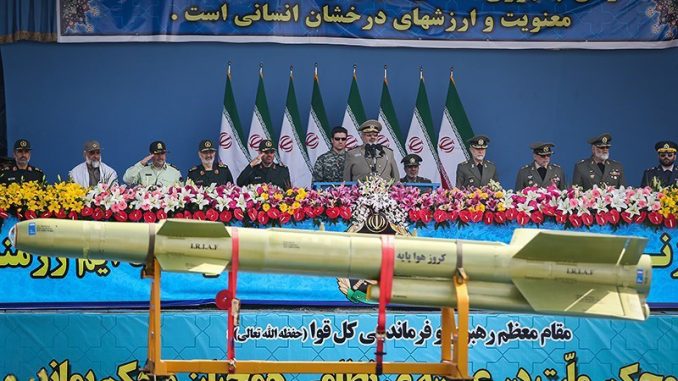 If Iran can drag negotiations across months and years, it no doubt hopes to reach a moment when U.S. pressure weakens, priorities shift, or its leadership changes. In that sense, diplomacy becomes a defensive weapon, an end in itself. Pictured:Iranian Airborne Cruise Missile (By Tasnim News Agency, CC BY 4.0, Wikipedia
- If Iran can drag negotiations across months and years, it no doubt hopes to reach a moment when U.S. pressure weakens, priorities shift, or its leadership changes. In that sense, diplomacy becomes a defensive weapon, an end in itself.
- Iran’s regime has refined its tactics, learned its opponents’ weaknesses, and mastered the art of procedural diplomacy: how to slow talks without collapsing them, how to offer symbolic concessions while protecting core interests, and how to appear reasonable while remaining fundamentally intransigent.
- For the mullahs, President Barack Obama’s 2015 “nuclear deal” was a triumph…. Obama’s illegitimate Joint Comprehensive Plan of Action (JCPOA), rather than permanently dismantling Iran’s nuclear capabilities, enshrined them. The deal conveniently contained sunset clauses with expiration dates, so that restrictions on Iran’s nuclear program would magically vanish – poof! — four months ago, on October 18, 2025, in fact.
- Iran, however, does appear to appreciate that, for the moment at least, it cannot win a direct military confrontation with the United States, especially under a president who has not demonstrated a helpful fear of escalation.
- Every day that talks continue without decisive pressure is a day the regime can use to strengthen its rule. It can import and build more deadly weapons, refine its ballistic missiles, reinforce its regional proxy militias, and tighten its grip internally.
- Time overwhelmingly favors the Iranian regime. Even just the act of sitting across the negotiating table, for Iranian officials, signifies recognition and endurance.
- For ordinary, unarmed Iranians, however, who have suffered the regime’s savagery – its mass murder, blindings, rapes, mass arrests, and deadly crackdowns, seeing their rulers treated as legitimate diplomatic interlocutors has to be unbearably demoralizing. It sends the message that the countries of the West are willing to engage with those who oppress them, and — as long as the comfort of foreigners is at stake — actually leave their tormentors in place.
- Beyond immediate tactics, Iran’s approach must be understood as part of a much larger messianic project. This is a regime that sees itself as engaged in a major religious-historical mission. Its leaders believe they are guardians of a revolutionary system with religious and ideological foundations that transcend generations, uprisings and even the visage of Trump.
- The regime is willing to absorb blows, retreat temporarily, and compromise tactically if, in doing so, it believes its long-term survival is secured.
- The central danger is that the longer negotiation process drags on… the greater the risk of consolidating the very system that the process claims to moderate. Every additional day Iran buys through talks is another day the regime survives, adapts, prepares for war.
- If the Trump administration’s goal is to prevent the Iranian regime from emerging more brutal and more entrenched, the greatest mistake would be to give it what it really wants: time to wait out Trump.
Iranian leaders have emerged from their latest contacts with the Trump administration sounding upbeat, even enthusiastic. Senior officials have described the talks as a “good start,” constructive engagement, and delight at the prospect of continuing negotiations. Iranian Foreign Minister Abbas Araghchi’s tone has been deliberately reassuring, projecting calm confidence and a sense that diplomacy is moving in the perfect direction.
From the Iranian regime’s perspective, any talks are preferable to sanctions, sustained military pressure, the threat of escalation, and the prospect that US President Donald J. Trump might choose confrontation over an agreement.
Trump, for his part, has repeatedly emphasized that he prefers a deal, but that “all options” remain on the table.


https://m.facebook.com/groups/1101209617517090/permalink/1703319837306062/?
Iran played the hapless Obambam and Lurch like a fiddle. OI hope Trump won’t do the same.
Message to Mr. Trump. In certain circumstances there are only two options: deal or no deal.
“All options” is an undefinable term because we (and most other living humans) have no idea what the “all” represents.