
Peloni: As Trump waffles on all but the demand on the nuclear file, regime change in Iran is the only potential fix for the region, for the world, and for the US.
The entire autocratic theocracy has got to be removed, as well as its terror proxies and the abysmal treatment of its diverse citizenry.
Sarah N. Stern | Feb 24, 2026
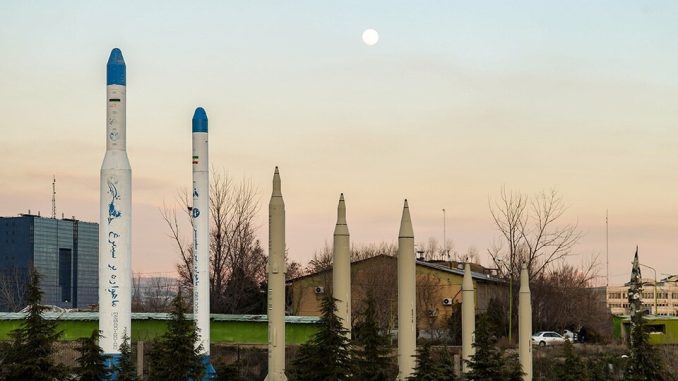 Some outputs of Iran’s Missile Program (Photo By Fars Media Corporation, CC BY 4.0, Wikipedia)
Will the United States be standing on the right side of history when it comes to Iran? If not, there will forever be a black stain on this sad chapter.
Remember that on Jan. 13, U.S. President Donald Trump exhorted the Iranian protesters to “Keep protesting. Take over your institutions. Help is on its way.”
Remember also that on Feb. 13, Trump spoke at Fort Bragg, N.C., where he said “all options are on the table,” but regime change would be “the best thing that could happen.”
Reports indicate that at least 30,000 to 40,000 idealistic protesters have been brutally murdered by the Islamic Republic in the past two months. Many were as young as 15. Reports verify that students who had been shot were sent to the hospital to be suffocated or strangled.
Today, they are out on the streets again. From where do they derive such tremendous courage?
Today, the USS Gerald R. Ford, the world’s most sophisticated aircraft carrier, is racing to the region to join the USS Abraham Lincoln, ahead of the nuclear talks scheduled for Feb. 26 in Geneva.
The scope of dialogue is worrisome. The fact that the Islamic Republic wants to limit its portfolio to the nuclear file is quite problematic. The entire autocratic theocracy has got to be removed, as well as its terror proxies and the abysmal treatment of its diverse citizenry.
The Islamic Republic is thought to have 5,000 missiles, or about 20% of its original arsenal, after the 12-day war last June with Israel and the United States, and after two years of supporting its terror proxies against the Jewish state and two separate attacks on Israel with barrages of missiles. Still, that can cause a great deal of damage if directed toward U.S. military bases in the area and again, if launched at the Jewish state.
The Houthis in Yemen are poised to support the Islamic Republic. In Lebanon, Hezbollah’s military arsenal is considered much greater than that of the Lebanese Armed Forces. Hamas, although much defanged, still has control of roughly half of the Gaza Strip.
Gulf States, such as Saudi Arabia, the United Arab Emirates and Qatar, although there has been a 14th-century rivalry against Shia Islam, have been pursuing a policy of diplomacy and de-escalation. They fear that a war with Iran could wreak havoc on their oil supplies, their economic stability and on Riyadh’s vaunted “Vision 2030.”
This weekend, U.S. special envoy to the Middle East Steve Witkoff expressed the president’s “curiosity” that such an amazing display of firepower into the region has not moved the Islamic Republic to “capitulate.”
This underscores a real misunderstanding of the Middle East, religious dogma and tribal loyalties. Not everything is transactional. There are certain regnant ideologies that people feel are worth fighting and dying for.
The 1979 Islamic Revolution established the wilayat al-fiqih, the “governance of the jurist,” with the Supreme Leader, the ayatollah on the top. Military entities like the Islamic Revolutionary Guard Corps and the Basij, and many among the religious establishment truly believe that Muhammad al-Mahdi—the Twelfth Imam—will bring a just, orderly society to the world if everyone simply submits to their version of Islam (which means submission).
Iran comprises a multifarious society of Persians, Azeris, Kurds, Lurs, Baluchis, Turkmen and Arabs. Many are striving for their own ethnic identities. Still more are yearning for secularism and freedom from this repressive regime.
Meanwhile, Israel is preparing for all kinds of scenarios, with the goal of a future Middle East where the threat of Iran does not hang over its head. The country is exhausted after two-and-a-half years of military conflict, but Israeli Prime Minister Benjamin Netanyahu says it is strong and prepared for what may come.
History is not linear, and it is not cyclical. It is replete with drama and unintended consequences.


And to take her last para one step further there ain’t no “right side of history” that the doltish former president Obama has referred to. There is only history. And it hasn’t ended.