
Secretary Rubio warns about Iranian threat to US, says failure to discuss ballistic missiles ‘a big problem’
| Published: February 26, 2026
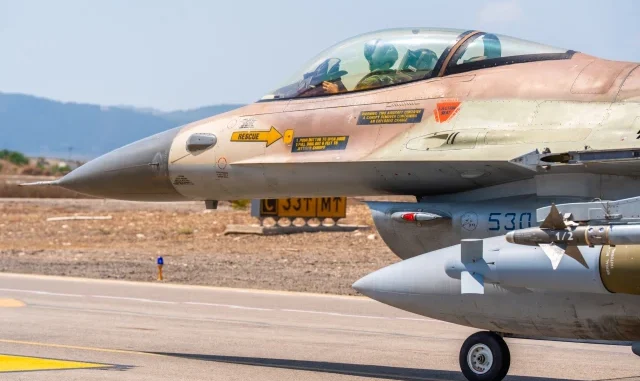 IAF fighter jet taking off for a strike, September 16, 2025. (Photo: IDF)
Senior White House advisors prefer that Israel leads strikes on Iran, with the U.S. only getting involved after Iran responds, Politico reported on Wednesday.
The advisors are said to prefer an Israeli initiative due to the domestic political response. They believe that the American populace would be more supportive of a U.S. military action in Iran if the American forces or an ally were struck first.
Politico cited a recent poll conducted in the U.S., which showed American voters favor regime change in Iran, but are not willing to risk any U.S. soldiers to accomplish such a feat.
One of the anonymous sources, who was involved in the White House discussions, told Politico, “There’s thinking in and around the administration that the politics are a lot better if the Israelis go first and alone and the Iranians retaliate against us, and give us more reason to take action.”
While the U.S. and Iran are due to host a third round of negotiations in Geneva on Thursday, the White House does not expect the Iranians to make any meaningful concessions, according to recent reports.
Iranian Foreign Minister Abbas Araghchi arrived in Geneva on Wednesday, ahead of the third round of negotiations.
Meanwhile, U.S. special envoy Steve Witkoff, who will represent the American side, along with Trump advisor Jared Kushner, recently said the deal cannot include any “sunset” clauses regarding Iran’s nuclear program.
“We start with the Iranians with the premise that there is no sunset provision. Whether we get a deal or not, our premise is: you have to behave for the rest of your lives,” Witkoff reportedly said at the AIPAC event in Washington earlier this week.
Vice President JD Vance, who is reported to oppose U.S. military action in Iran, said that “Iran cannot have a nuclear weapon.”
“The principle is very simple: Iran cannot have a nuclear weapon,” Vance told reporters on Wednesday. “If they try to rebuild a nuclear weapon, that causes problems for us. In fact, we’ve seen evidence that they have tried to do exactly that.”
The United States sees evidence that Iran is trying to rebuild its nuclear program after US-led strikes against Iranian nuclear sites last June, Vice President JD Vance said https://t.co/LbvkqNQO1p pic.twitter.com/IRYTgqZEW1
— Reuters (@Reuters) February 26, 2026
Meanwhile, Iran has continued to resist U.S. efforts to expand the negotiations beyond the nuclear program. However, U.S. Secretary of State Marco Rubio warned on Wednesday that the Islamic Republic remains “a very grave threat” for the U.S. and its allies.
Speaking in the Caribbean island nation of Saint Kitts and Nevis, Secretary Rubio said, “I want everyone to know that Iran poses a very grave threat to the United States and has for a very long time.”
Rubio also addressed Iran’s nuclear program, noting that the regime has been trying to rehabilitate its facilities.
“First and foremost, after their nuclear program was obliterated, they were told not to try to restart it. And here they are, you can see them always trying to rebuild elements of it. They’re not enriching right now, but they’re trying to get to the point where they ultimately can,” he stated.
“The other thing I would point you to, however, is that Iran possesses a very large number of ballistic missiles, particularly short-range ballistic missiles that threaten the United States and our bases in the region, and our partners in the region, and all of our bases in the UAE, in Qatar, in Bahrain. And they also possess naval assets that threaten shipping and try to threaten the US Navy,” Rubio also pointed out.
Secretary Rubio said that Iran “refuses to talk about ballistic missiles,” stating, “that’s a big problem.”
U.S. Secretary of State Marco Rubio on Iran:
“Iran refuses to talk about the ballistic missiles. That is a big problem.” pic.twitter.com/HQOaJCXp0L
— Open Source Intel (@Osint613) February 25, 2026
“So I want everybody to understand that, and beyond just the nuclear program, they possess these conventional weapons that are solely designed to attack America and attack Americans if they so choose to do so,” he added.


Rubio is right as far as the Iranian behavior is concerned.
Expecting Israel to lead the charge in the hope that the Iranians will feel themselves provoked enough to attack US forces near them is not a useful approach to solving the problem of ABC (Atomic, Biological, Chemical) weapons in Iranian hands. The Iranians, knowing that the US are itching for target practice, would be very careful not to let any missile get even close to the US forces.
Getting Israel to attack Iran first can only mean that Israeli civilians are being knowingly put in the line of fire to accommodate the US. I would suggest that if Israel does attack Iran first, it will be with due cause and fatal for the Iranian regime. They will probably be careful not to kill too many Iranian civilians. There will probably be no need for the US to come along at the end of the fight to claim the victory as their own. This would be shameful behavior on the part of the USA.
The final part of the equation is the Iranian weaponry. If they have rockets tipped with ABC warheads , Israel would most likely prefer to destroy them before they can be fired off. This could lead to contamination of those parts of Iran where these warheads are being prepared for their missions. The eventual contamination could trigger the US to try to avoid this kind of situation for the benefit of their “allies” in the gulf. We’ve been here before.
At the end of the day, the USA should either do the dirty deed or get out of the way.
I think they should “get out of the way”. Israel has far more knowledge about that part of the world than does the US. There would be no wasted ammo…
In other words, Israel should have its own deadlines, no matter what.