
Why Operation Epic Fury Is the Opening Act of the Indo-Pacific Century
Zineb Riboua | Beyond the Ideological | Feb 28, 2026
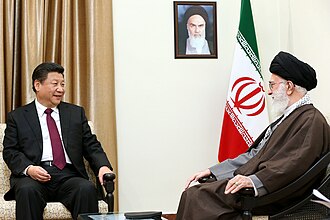 Xi Jinping meets with the Supreme Leader of the Islamic Revolution, Ali Khamenei. January 23, 2016. Photo by Khamenei.ir, CC BY 4.0, Wikipedia
Iran is most often discussed as a nonproliferation problem, a sponsor of terrorism, a regional spoiler. Each of these framings captures a real problem, but none captures what matters most. The nuclear file, the militia archipelago stretching from Lebanon to Yemen, the question of Gulf security architecture: these only acquire their full meaning when read against the backdrop of Chinese grand strategy.
In fact, Beijing has spent years and billions of dollars building Iran into a structural asset. Everything that follows in the Middle East flows from this fact. Which is why Operation Epic Fury is the first American military campaign that threatens to sever that asset. By striking Iran directly, the Trump administration is dismantling, whether by design or by consequence, a pillar of China’s regional architecture.
The urgency of saying so plainly has never been greater. In June 2025, Israel launched Operation Rising Lion, a 12-day campaign of precision strikes that destroyed Iranian enrichment facilities, killed over 30 senior commanders and a dozen nuclear scientists, and drew the United States into direct strikes on 3 nuclear sites. The Islamic Republic’s deterrent mythology, cultivated over four decades, collapsed within a fortnight. In late December, the largest protests since 1979 erupted across all 31 provinces, fueled by economic freefall and a population that no longer believed in the regime’s strength. The government responded in January 2026 with massacres that killed thousands, prompting the European Union to designate the IRGC as a terrorist organization and further increasing the isolation of the regime.


An excellent article describing a much broader picture than we normally consider. This is recommended reading!!
This means that China has been financing Hamas and all the other terrorists.
On the other hand, they have been trying to get a good foothold in Israel too. It seems that they have too much money to spend.
On the other hand, relabeling their freight carriers and similar tactics could be a weakness to be considered. I wonder what they would say if the US were to block the straights of Hormuz? All those Chinese tankers would, at the very least, be exposed to identification and probably to confiscation. That might wake up a few people!
The Saudis, now that they are switching sides, may decide to change partners and work with other people. They have deep enough pockets to deal with others about their modernized infrastructure. They must be aware that China is risky.
The discussion about the potential war with China would drive the Chinese into Russian arms for their oil. That is the real issue the US cannot fix. The real two-front war would be with China and Russia. Iran would be left in the dust. Calculations about Taiwan will fade away when TSMC has factories elsewhere. Right now, they are the best, but soon they will be one amongst equals.
The Iranian commercial carriers with missile launchers are a neglected subject so far, or have they been monitored and may be heading to the bottom of the seas sometime soon? There may be other countries with a similar flotilla out there.
The situation as described towards the end of the article is one that requires constant US attention, unless this pillar of Chinese policy is brought so far down that it cannot recover. As the article describes, the US has tied up a large portion of its forces in the middle east rather than in the west Pacific. This is what needs to be fixed.