
From the 1953 coup to the Islamic Revolution, Washington helped create the regime it now confronts—and stopping halfway will only guarantee a worse war later.
Michel Benchimol
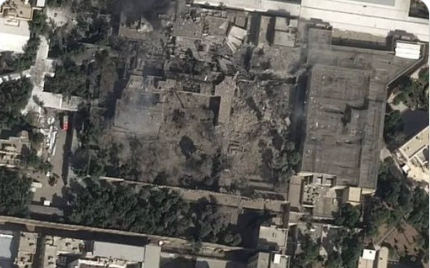 Blast site where Khamenei and dozens of the Iranian leadership were eliminated. Screengrab via X
Teaser
The missiles flying across the Middle East today are the delayed consequences of decisions made decades ago in Washington and Tehran. If this war ends halfway, the next one will be far worse.
For decades the West tried to manage Iran with sanctions, negotiations, and carefully calibrated retaliation. None of it worked.
The regime in Tehran spent those same decades building missiles, militias, and a regional proxy army designed to challenge American power and threaten Israel.
Now the shadow war is over—and the bill for seventy years of miscalculation has finally come due.
On February 28, 2026, the United States and Israel finally stopped pretending. After years of cyber attacks, assassinations, proxy battles, and deniable strikes, the long shadow war with Iran erupted into open conflict.
Missiles now fly across the region—from Iranian territory toward Israeli cities, from Hezbollah positions in Lebanon toward American bases in Iraq and the Gulf. Shipping in the Strait of Hormuz is under threat, oil markets are shaking, and the Middle East once again stands on the edge of a wider war.
But this conflict did not begin in 2026. In many ways, it began more than seventy years ago.
1953: The Coup That Poisoned the Well
In 1953 the United States and Britain overthrew Iran’s elected prime minister, Mohammad Mossadegh, after he nationalized the country’s oil industry. Through a CIA–MI6 operation known as Operation Ajax, politicians were bribed, mobs were hired, the press was manipulated, and the army was pushed into action. The Shah returned to power as a Western?backed ruler.
Strategically, it looked like a Cold War win. Historically, it was a disaster.
For millions of Iranians, the coup proved that the United States would destroy their democracy when Western economic interests were at stake. The resentment created in 1953 simmered for a generation—and exploded when the Shah’s regime finally collapsed.
Carter and the Islamic Revolution
By the late 1970s Iran was still a pro?Western ally, but the Shah’s regime was weakening under economic strain, repression, and growing unrest. The crisis was serious, but not yet hopeless.
Instead of firmly backing the monarchy or managing a controlled transition, the Carter administration publicly criticized the Shah on human rights while sending increasingly mixed signals about American support. To Iran’s revolutionary opposition—Islamists, radicals, and militant clerics—this uncertainty looked like opportunity.
As protests intensified and the regime faltered, Washington misread the movement gathering around Ayatollah Ruhollah Khomeini. Many in the U.S. policy establishment convinced themselves that the clerics could be accommodated and that an Islamic government might stabilize Iran while preserving Western interests.
In reality, the revolution was never about moderation or coexistence. It was about replacing a pro?Western monarchy with an ideological regime built on hostility to the United States and Israel. By the time Washington understood that, the Islamic Republic had already seized power.
What the Revolution Did to Iran
The revolution did not liberate Iran. It consumed it.
Khomeini’s regime quickly purged secular and liberal allies, executed thousands in revolutionary tribunals, crushed political opposition, and transformed a relatively modernizing society into a rigid religious state. Women were forced into compulsory veiling, dissent was criminalized, and universities and media were brought under ideological control.
Then came the Iran?Iraq War—eight years of slaughter that killed hundreds of thousands and militarized the Islamic Republic. The Revolutionary Guard emerged not only as a military force but as the ideological backbone and economic empire of the regime.
Instead of building a normal nation?state, Iran’s rulers focused on repression at home and revolutionary expansion abroad.
Iran’s Network of Proxy Warfare
Over the next four decades Iran built an extensive network of proxy forces across the Middle East.
Hezbollah in Lebanon became Tehran’s most powerful partner. Hamas and Palestinian Islamic Jihad received funding, training, and weapons. Shiite militias spread across Iraq and Syria. The Houthis emerged as another Iranian?aligned force in Yemen.
Through the Revolutionary Guard’s Quds Force, these groups became instruments of Iranian strategy. They attacked Israeli and Jewish targets, struck American forces, launched rockets into cities, and harassed shipping in the Persian Gulf whenever Tehran wanted leverage.
What appears today as a regional war is actually the activation of a network Iran has spent forty years building.
Why the War Is Happening Now
Many Americans understandably ask why the United States is now at war with Iran.
The answer is largely strategic.
For decades Iran steadily expanded its missile arsenal, strengthened its proxy network, and advanced its nuclear capabilities. Its drones and rockets threatened American troops and regional allies, while its forces repeatedly challenged shipping routes in the Gulf.
Eventually Washington concluded that sanctions, negotiations, and limited retaliation were not changing the strategic trajectory. Waiting longer would only mean confronting a stronger Iran—possibly one protected by nuclear weapons.
The military objective is therefore straightforward: degrade Iran’s missile and drone capabilities, weaken its naval power, disrupt its nuclear infrastructure, and hit the proxy network that allows Tehran to wage war while denying direct responsibility.
The problem is that Washington has struggled to explain this clearly. Instead of presenting a defined mission, the war has been wrapped in shifting rhetoric about democracy, oil markets, human rights, and “regional stability”—leaving many Americans unsure why the conflict is happening at all.
The Danger of Stopping Halfway
Now that open war has begun, the greatest danger may not be escalation—but hesitation.
Israeli strikes have reached deep inside Iran. Iranian missiles and drones have hit Israeli cities and American positions across the region. The United States has launched major attacks on Kharg Island, Iran’s primary oil export terminal, and warned that further infrastructure could be targeted.
Officially, the objective remains “limited”: weaken Iran’s military capabilities and disrupt its nuclear program. But wars rarely stay neatly contained once they begin.
If the conflict stops before Iran’s military and proxy capabilities are truly broken, the regime will claim survival as victory. The lesson Tehran will draw is the same one it learned in 1979: America eventually loses the will to finish what it starts.
That conclusion would accelerate Iran’s nuclear ambitions, embolden its regional proxies, and weaken American deterrence across the Middle East. Meanwhile the global oil market would remain permanently vulnerable to a hostile regime sitting astride the Strait of Hormuz.
If You Start the War, You Finish It
History has a cruel way of collecting its debts.
In 1953 the United States helped overthrow Iran’s democracy, convincing millions of Iranians that Washington would sacrifice their freedom for strategic convenience. In 1979 American hesitation helped deliver the country to a revolutionary regime built on hostility to the West.
The war unfolding today is the accumulated bill for those choices.
Now that the United States and Israel have moved from shadow conflict to open confrontation, there are only two real outcomes: either Iran’s capacity to destabilize the region and threaten the world with nuclear blackmail is decisively broken—or we stop halfway, declare a fragile victory, and guarantee that the next war will be larger, deadlier, and far harder to win.
History has already shown what happens when the West hesitates with regimes like this. The only question now is whether we intend to finish the war—or schedule the next one.


Apparently it goes farther back than this, but war with Iran was certainly in the cards from 1979, when the US Embassy was stormed and our diplomatic staff was taken and held hostage for 444 days. What followed was a 46-year string of weak US presidents who were AFRAID to confront the Ayatollahs. He’s not perfect, but thank G_d for Donald Trump. We have had very few presidents who “don’t take no shit” from a rogue regime like that. Maybe the tide is turning, but I’m not betting my social security check on it.