
Peloni: When reading this important essay by Hugh Fitzgerald, please take note of the fact that Washington’s interest in this war have always been motivated by its China policy. When doing so, as Haviv Rettig Gur recently noted, you will grasp many things which would otherwise never be apparent.
Old hatreds, new propaganda from Beijing.
by
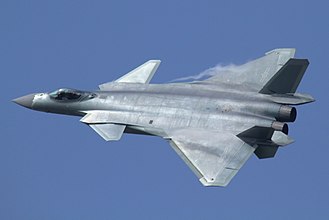 Flypast of the Chengdu J-20 during the opening of Airshow China in Zhuhai. Photo by Alert5 – Own work, CC BY-SA 4.0, Wikipedia
It used to be said that China was one of the very few places on earth that had never experienced antisemitism. That proud boast can no longer be made. At the direction of Xi Jinping, China has turned up the volume of its official Israel-hatred, for reasons of state, including the desire to win Arab favor and contracts, and because the Chinese figure that if Israel is a loyal and effective ally of the United States, then it must perforce be understood to be an enemy of China. More on China’s display of state-encouraged antisemitism can be found here: “China Unleashes ‘Antisemitic Wave’ Amid Gaza Conflict, New Report Shows,” by David Michael Swindle, Algemeiner, February 24, 2026:
The Chinese Communist Party has embraced overt antisemitic messaging in its domestic propaganda in recent years, according to a new report which ties the move to both geopolitical rivalry with the United States and efforts to curry favor with Arab and Muslim countries hostile to Israel.
The Jewish People Policy Institute (JPPI), a prominent think tank based in Israel, documents in the report how China’s authoritarian government has deliberately cultivated antisemitism among the population and internationally as a strategy….
Writing in The Jerusalem Post, Wald identifies at least three factors driving China’s shift toward anti-Zionism.
The first is economic, with Israel walking back its relationship with China under US pressure.
“Israel, admonished by the United States, made Chinese investments, particularly in hi-tech and infrastructure projects, more difficult,” he writes. “The Chinese expressed their resentment quite openly.”
The second is geopolitical. “China was in the midst of expanding its presence in the Arab Middle East, offering major economic cooperation and long-lasting political ties,” Wald explains. “A harder attitude against Israel was a cheap sweetener for such offers.”
The Arab market for Chinese goods and services — 400 million people, trillions of dollars in sovereign wealth funds, the plan of Crown Prince Mohammed bin Salman to build four vast new cities in Saudi Arabia at a cost of more than a trillion dollars that has foreign contractors and other businessmen salivating — dwarfs that of tiny Israel. It makes perfect economic sense for China to distance itself from Israel as it embraces the Arabs.
The third is the perception that, due to internal issues, Israel has grown weaker: “Israel’s domestic crisis eroded its ‘strongman’ image in Chinese eyes. A country wracked by mass demonstrations and numerous ineffective elections could no longer be taken as seriously as it had been.”…
This perception is wrong. One of the main prompters of those mass demonstrations was fury over the failure of the government to bring home the hostages. Those demonstrations have ended. Israel is [a] democracy, and Israelis are quick to go out on the streets to protest this or promote that — judicial reform, the prime minister’s trial for accepting champagne and cigars, the attempt to make the Haredis subject to the draft. But the Chinese have wrongly interpreted these demonstrations as a sign of weakness. In fact, they are the sign of a healthy democracy, something the Chinese have no experience of. Israel is now stronger than it has ever been militarily, having fought a seven-front war and emerged victorious against Hamas in Gaza, Hezbollah in Lebanon, the Houthis in Yemen, the Syrians under Assad and then under Ahmed al-Sharaa, the militias in Iraq, and the Islamic Revolutionary Guards Corps (IRGC) in Iran. And we hear every week of some advance in weaponry by Israeli scientists, such as the laser-based Iron Beam anti-missile defense system.
This month, for example, a Chinese military attaché in Tehran presented Brigadier General Bahman Behmard, commander of the Iranian Air Force, with a scale model of China’s J-20 fifth-generation stealth fighter. Even though no official contract was announced, experts interpreted the Chinese gesture as a sharp warning to the US and its ally Israel amid mounting fears of renewed conflict in the Middle East….
Presumably, the Chinese military attaché’s delivery of a scale model of the J-20 stealth fighter to the head of Iran’s air force conveys the message that in time, the real J-20s will be delivered to Tehran. China is the largest importer of Iranian oil, with nearly 90 percent of Iran’s crude and condensate exports going to Beijing. China’s military ties to Iran are closer than they have ever been. China and Iran now routinely hold joint naval drills in the Gulf, and Iran buys much of its weaponry from China, which has become Iran’s major supplier of anti-ship missiles, missile-related technology, and guidance systems.
Closer to home, Beijing has also lambasted the Jewish state for its increasingly close ties with Taiwan. China considers Taiwan, a nearby island run by a democratic government, as a renegade Chinese province that must be reunited with the mainland — by force, if necessary….
Israel recognizes its kinship to Taiwan. Taiwan is, like Israel, a small democratic state, facing an enormous enemy that wants to take over all of its territory, and that survives due to its advanced technology and its close ties with the United States.
That same month, the Institute for National Security Studies (INSS), an Israeli think tank, released a report examining how China has increasingly used state media and covert campaigns to spread anti-Israel and antisemitic narratives in the US. The effort includes the promotion of conspiracy theories about “Jewish control” of politics, the economy, and the media.
The Chinese are content to resurrect the oldest antisemitic tropes, about a sinister cabal of rich and powerful Jews — in some versions, they “own all the banks,” and in others, “control all the media” — and to spread these antisemitic conspiracy theories around the world through Chinese state media.
The powerful Chinese media keep repeating their antisemitic claims about the Jewish state and Jews so often that many, both in China and in their global audience, end up believing them. The Chinese have an old saying for that technique: “Three men make a tiger” (????, s?n rén chéng h?). That means “If a falsehood is repeated often enough, it will be believed.” And that, alas, is true.


The best this report can do to bolster its accusation agains the Chinese of antisemitism is to cite attempts to “spread anti-Israel and antisemitic narratives in the US.” It would help if the report included actual quotes and sources found nowhere here.