
By Pamela Geller |
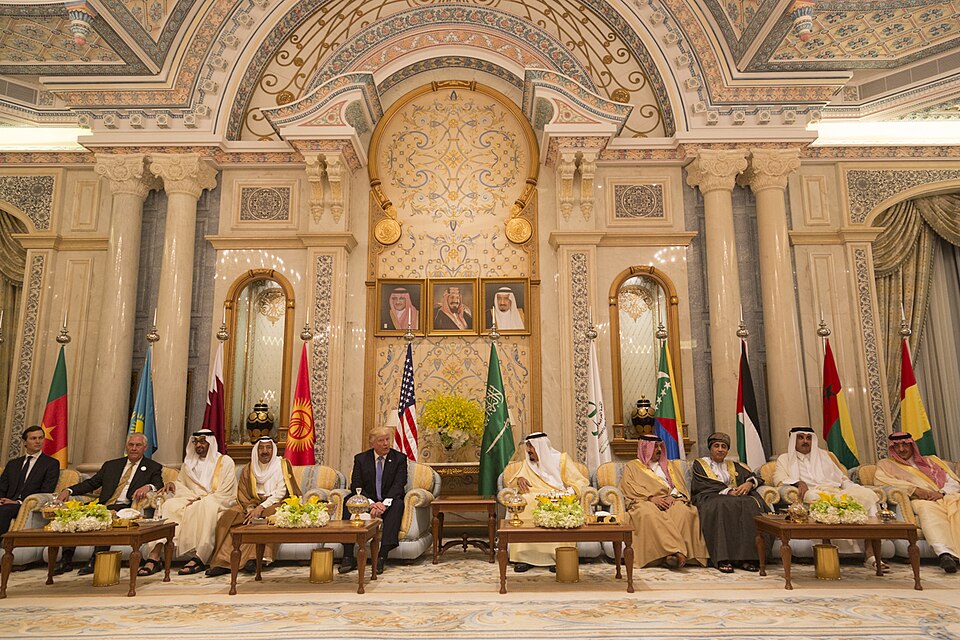 President Donald Trump and King Salman bin Abdulaziz Al Saud of Saudi Arabia attend the meeting of the Leaders of the Cooperation Council for the Arab States of the Gulf Countries, Sunday, May 21, 2017, at the King Abdulaziz Conference Center in Riyadh, Saudi Arabia. (Official White House Photo by Shealah Craighead)
Once again the wisdom and the bravery of President Trump shifts the balance toward a force for good.
With their economies on the line, Gulf states press US to neutralize Iran for good
After initially opposing the US-Israeli war, Washington’s allies now realize that stopping too soon could allow Tehran to keep holding the region to ransom
By Samia Nakhoul, Times of Israe, March 16, 2026;
At the same time, these sources and five Western and Arab diplomats said Washington was pressing Gulf states to join the US-Israeli war. According to three of them, US President Donald Trump wants to show regional backing for the campaign, to bolster its international legitimacy as well as support at home.“There is a wide feeling across the Gulf that Iran has crossed every red line with every Gulf country,” said Abdulaziz Sager, chairman of the Saudi-based Gulf Research Center and familiar with government thinking.
“At first we defended them and opposed the war,” he said. “But once they began directing strikes at us, they became an enemy. There is no other way to classify them.”
Tehran has already demonstrated its reach, attacking airports, ports, oil facilities and commercial hubs in the six Gulf states with missiles and drones while also attacking Israel and disrupting shipping through the Strait of Hormuz — the artery carrying about a fifth of global oil and underpinning Gulf economies.
The attacks have reinforced Gulf fears that leaving Iran with any significant offensive weaponry or arms manufacturing capacity could embolden it to hold the region’s energy lifeline hostage whenever tensions rise.
As the war entered its third week, with US and Israeli airstrikes intensifying and Iran firing at US bases and civilian targets across the Gulf, a Gulf source said the prevailing mood among leaders was unmistakable: that Trump should comprehensively degrade Iran’s military capacity.The alternative, the source said, was living under constant threat. Unless Iran was severely weakened, he said, it would continue to hold the region to ransom.
Predominantly Shi’ite Muslim Iran has often viewed its Sunni Arab Gulf neighbors – close allies of the US that host American military bases – with deep suspicion, even if relations with Qatar and Oman have generally been less fraught.
Over the years, Iran and its regional allies have been accused of attacks on Gulf energy installations, not least a 2019 strike on Saudi Arabia’s Abqaiq and Khurais oil facilities – for which Iran denied responsibility – that halved Saudi output and rattled energy markets.
For Gulf leaders, inaction is now the greater risk.
The effect of Iran’s attacks this month goes far beyond specific material damage, not only disrupting oil flows but damaging a hard-won image of stability and security that has underpinned Gulf countries’ attempts to expand trade and tourism and rely less on fossil fuel exports.
“If the Americans pull out before the task is complete, we’ll be left to confront Iran on our own,” Sager said.
Gulf fears of triggering wider warIn response to questions about those concerns, the White House said the US was “crushing [Iran’s] ability to shoot these weapons or produce more,” and that Trump was “in close contact with our partners in the Middle East.”
Of the Gulf countries, only the United Arab Emirates responded. It said that it “does not seek to be drawn into conflicts or escalation” but affirmed its right to “take all necessary measures” to safeguard its sovereignty, security and integrity, and ensure residents’ safety.
Sources in the region said unilateral military action by any Gulf state remained off the table because only collective intervention would avoid exposing individual countries to retaliation.
Moreover, consensus is still elusive. The six members of the Gulf Cooperation Council – Bahrain, Kuwait, Qatar, Saudi Arabia, Oman and the UAE – have held just one Zoom call, and no Arab summit has been convened to discuss coordinated action.
Gulf leaders remain deeply fearful of triggering a broader, uncontrollable conflagration.
Continued…..


Thisw sort of puts the Gulf states in the same category as the Europeans; but the Europeans have been far more standoffish. If the latter keep on being so afraid of getting their hands dirty, President Trump might just let the Iranians keep control of the Straits, and let the merchant nations of Europe fend for themselves.
But of course you won’t hear anyone saying how the Arab countries are dragging us into war.
So nobody is willing to join this war to defeat the Iranians to their own benefit? We should be figuring out either how to make them pay for it or suffer the Iranians even more. This is not the time to play ostrich or tortoise.
They should be considering how to make peace with the Iranian people instead of avoiding any responsibility, but they probably want permanent US presence and maybe even Israeli presence for the foreseeable future. Just don’t get your fingers dirty. Keep your powder dry. You may want it sometime soo if those pesky Israelis get too supercilious.
Hi, reuveni.
I had to look up the word “supercilious”. That word has never been used by anyone I know.
Yes, there is lots of congtemptuousness in the world; but it’s been above my pay grade. This is what we see in the world today:
Matt.24
[12] And because iniquity shall abound, the love of many shall wax cold.
[13] But he that shall endure unto the end, the same shall be saved.
I don’t think it’s a particulary “Israeli” trait. I think anyone can have it; but it may require eyebrows of a certain “raise-ability”
@Michael
@reuveni
Supercilious is a word I grew up knowing and using. We had a lot of old books that shaped my worldview, I guess.
“The Holocaust was an obscene period in our nation’s history. [on followup] No, not our nation’s, but in World War II. I mean, we all lived in this century. I didn’t live in this century, but in this century’s history.”
“Press conference (September 15, 1988), paraphrased in Esquire (August 1992), The New Yorker (October 10, 1988), p. 102”
https://en.wikiquote.org/wiki/Dan_Quayle
I’m trying to imagine how a debate between Kamala Harris and Dan Quayle would sound.