
Peloni: The connection between China and Iran was one of patron and proxy, but their connection was far more useful to China than this alone. China’s investment in Iran was to gain it the ability to brainstorm mechanisms which might face off and defeat Washington’s economic leverage against the Middle Kingdom, while also giving Xi the abiliity to both test and perfect these defenses against American dominance in the real world. Yet, for all its efforts and all its investments, the Chinese defenses developed in Iran have been shown to come up short during Operation Economic Fury, which again should be understood to be an operation designed and executed as a contest against China and Iran in the same moment, a concept which was first raised by the Hudson Institute’s Zineb Riboua, whose detailed analysis continues to provide clarity and focus surrounding Washington’s actions, without which, many important realities would otherwise be misunderstood or completely ignored.
Understanding the US Treasury’s latest sanctions
Zineb Riboua | Beyond the Ideological | Apr 30, 2026
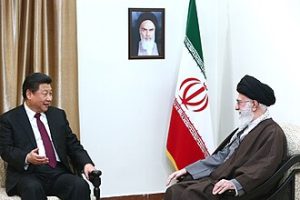 The General Secretary of the Chinese Communist Party, Xi Jinping with the Supreme Leader of the Islamic Revolution, Ali Khamenei. Photo by Khamenei.ir, CC BY 4.0, Wikipedia
“The Strait of Hormuz,” Secretary of State Marco Rubio told Fox News this week, “is an economic nuclear weapon.”
He was describing the IRGC’s core strategic intention, to hold the world’s most critical oil chokepoint as leverage over global markets and Washington itself, but Iran never got to pull that trigger.
The US Navy’s blockade of the Strait denied the IRGC that instrument before it could be used, and Operation Economic Fury now ensures the failure compounds, turning against Tehran the same economic pressure Iran spent decades positioning itself to inflict on the world.
What most ceasefire commentary has missed is that the military campaign’s pause does not mean the conflict has paused, because the economic campaign is running at full force, its targets extending from Tehran’s financial network to the Chinese industrial architecture that keeps it alive.
That architecture took decades to build.
For years, the IRGC sustained itself through shell companies, rotating vessel identities, and shadow banking corridors that kept oil revenue flowing far from formal financial channels, turning every prior sanctions round into a temporary inconvenience absorbed and rerouted within months.
Washington kept targeting individual nodes while leaving the broader network intact, which gave Tehran reasonable confidence that Epic Fury’s ceasefire, like every pause before it, would open another window for recovery.
That calculation is wrong this time, because the cost of each passing week compounds rather than eases, with Treasury’s action targeting the evasion architecture itself rather than its individual components, ensuring that what Tehran reads as time purchased is in fact institutional capacity being permanently stripped away.
That architecture survived as long as it did for one reason: China built the infrastructure to sustain it, and Xi Jinping made that a deliberate strategic choice on three levels.
First, Beijing built the financial plumbing, developing methods for shadow banking, obscuring the origins of Iranian crude, rotating ship identities, and layering payments through third-country intermediaries.


@Peloni Brilliant analysis of the structural impact of Trump’s economic warfare on China in Hormuz
https://youtu.be/g8tHBXgQiRc?si=KHHH2QEORxb8mXFu