
By | April 30, 2026
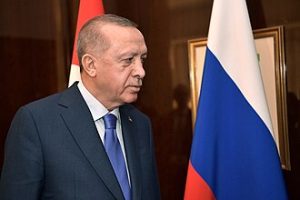 Turkish President Recep Tayyip Erdogan, Russian Presidential Executive Office, Creative Commons Attribution 4.0
Recep Tayyip Erdogan has firm views on Israel: he doesn’t like the Jewish state, and wishes it would disappear. He is convinced it practices “apartheid” at home and “genocide” abroad. He has fantasized about creating, and heading, a pan-Islamic army that would be able to defeat the IDF, so that “from the river and the sea/Palestine will be free” — which is the thinly-disguised call for Israel to disappear entirely, to be replaced by a state of “Palestine.”
Erdogan has watched with alarm Israel’s swift battering of Iran, a display of advanced weaponry, spectacular intelligence, and a brilliant and brave soldiery, made up of both battle-hardened professionals and reservists. But he is not entirely displeased at the weakening of the Islamic Republic. He wants Iran weakened, but not enough to lead to the regime’s collapse, that could mean Iranian Kurds would gain full autonomy. More on this can be found here: “As Israel becomes a dominant force in the Middle East, where does Turkey stand? – analysis,” by Amichai Stein, Jerusalem Post, April 27, 2026:
As the smoke cleared over Tehran after the beginning of the Israeli-US strikes, Turkish President Recep Tayyip Erdogan was quick to point the finger. “This all began following Netanyahu’s provocations,” the Turkish leader stated, “we feel deep sorrow and great concern.” He went further, issuing a chilling warning: “God willing, I have no doubt that Israel will pay the price for this.”
The casual observer might imagine that Turkey, fighting as it is with Iran for dominance of the region, would welcome the strike against the Islamic Republic.
However, Hay Eytan Cohen Yanarocak, a leading expert on Turkish affairs at the Jerusalem Institute for Strategy and Security, explains that Turkey has a vested interest in the survival of the current Iranian regime.
“Ankara does not want to see a new ‘surprise’ in the form of regime change,” Yanarocak notes. “They are interested in the continuation of the regime because if a revolution occurs, Turkey’s monopoly as the primary bridge between the West and the Middle East simply disappears.”
Policy expert Jonathan Adiri agrees, suggesting that Turkey prefers a crippled neighbor over a liberated one.
“Turkey wants a non-nuclear, weak Iran,” Adiri says. “They want a sort of ‘weakened virus’ in the region. An Iran that is pro-Western and working with the Americans would become a magnet for foreign investment, which would directly hurt the Turkish economy.”
Right now, Turkey sees itself as the chief Muslim interlocutor with America. It has been a member of NATO since 1952, and in the past, the Americans used the Incirlik air base to spy on the Soviets and to pre-position war planes in case of need in the region. However, in recent years, Turkey has sometimes refused to allow the Americans to use that base to attack ISIS fighters in Iraq. Right now, Turkey continues, despite Erdogan’s hysterical anti-Israel animus, to be the main bridge between the Muslim world and the West, while Iran is a confirmed enemy of the West, especially of the United States, the Islamic Republic’s “Great Satan.”
Perhaps the most potent driver of Erdogan’s anxiety is the Kurdish question. For decades, the Iranian and Turkish regimes have shared a common interest in suppressing Kurdish nationalist aspirations. A destabilized Iran could lead to the emergence of an autonomous or independent Kurdish entity on Turkey’s southern border – a prospect Erdogan finds intolerable.
According to several sources, Erdogan and other senior Turkish officials pressured US President Donald Trump not to give a green light to an Israeli operation that would have resulted in Kurdish fighters in Iran starting a rebellion against the Iranian regime.
For decades, the Israelis have had clandestine ties with Kurds in Iraq and Iran. Beginning in the 1960s, Israel provided weapons and training to Kurdish forces — known as the peshmerga — in Iraq, and it still does. Since Muslim fanatics took over Iran 47 years ago, Israel has supplied weapons intermittently to Kurdish militias in that country as well. After the American pullout of forces from Syria, Israel decided to supply weapons to Syrian Kurds in their quasi-autonomous stronghold of Rojava. Erdogan is fearful of any Kurdish separatist movement in Iran or Iraq or Syria, that if successful, might prompt the Kurds in Turkey to join forces with those other Kurds in order to realize the ancient dream of an independent Kurdistan. Turkey wants Iran to be weakened, but left strong enough to suppress the Kurdish militias inside the country.
Adira [sic] points out that Erdogan and Turkey’s Foreign Minister Hakan Fidan drew a red line with Washington regarding the use of Kurdish forces from Iraq to move against Iran.
“Erdogan told his public: ‘Case closed,’ regarding the Kurdish story,” Adiri observes. “He is deathly afraid of that box being reopened. From Ankara’s perspective, the success of a Kurdish-led or Kurdish-supported uprising in Iran would have a domino effect on Kurds in Turkey, Syria, and Iraq.”…
That is exactly what Israel would want: that “domino effect” following upon the 15 million Kurds in Iran carrying out a successful separatist uprising. After the shellacking the Islamic Revolutionary Guard Corps and the Iranian army received in recent months from Israeli and American forces, this may be the Iranian Kurds’ best chance to rise up. If they do so, they can almost certainly count on Israel’s support. The IDF could supply the Kurds with both intelligence and weapons, including missiles, drones, artillery, and likely use its fighter jets, too, in order to halt with bombs away any attempted advance by Iranian forces.


For Erdogan, the worst that could happen is if the Kurds in Turkey were to rise up and with a little help from their friends, declare autonomy. He would feel that he must beat them down by all available means.