
Peloni: Thank G_d for Nitsana Darshan-Leitner and Kent Yalowitz whose relentless efforts have been so essential in making this victory a reality.
The 1992 Anti-Terrorism Act should be revised to cover criminal liability as well.
| Published: April 6, 2026
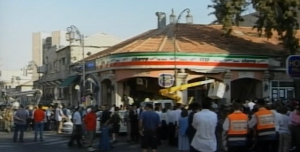 Sbarro Pizzaria Bombing. Screengrab via Youtube.
The U.S. Federal Court of Appeals in New York City has reinstated a $655.5 million judgment in a long-running lawsuit by American citizens who were victims of terrorism during the Second Intifada, which took place from late September 2000 to about 2005. The judgment obligates the Palestine Liberation Organization (PLO) and the Palestinian Authority (PA) to pay these victims, and the money is likely to come out of accounts that the PA holds in American banks.
This is one of the first big wins for victims of terrorism that follows a decision by the U.S. Supreme Court in 2025, which said American courts were authorized to consider claims against the PA and the PLO. This legal victory was the result of years of litigation that began in 2004, when a group of plaintiffs filed a lawsuit under the auspices of the 1992 Anti-Terrorism Act (ATA).
The legislation allowed American citizens or their families to sue for damages for acts of international terrorism, even if they took place abroad. There is no provision in the law for criminal liability, but there are provisions for civil damages.
The plaintiffs in this case argued that the PA and the PLO “directly or indirectly supported terrorist attacks” during the Second Intifada by providing logistical and moral support for terrorist actors; paying individuals involved in planning or carrying out attacks; and, above all, giving an incentive to attackers by promising to pay pensions to their families if they were killed or arrested.
In the challenging economic conditions in the PA-administered areas of Judea and Samaria (West Bank), this provided a source of income for many young men who struggled to find work to support their families. For some, it also offered a way to regain social standing within their communities.
One of the most important lawsuits filed in American courts under the provisions of this law was “Sokolow v. PLO /Palestinian Authority.” The U.S. Federal jury in New York heard the case and, in 2015, concluded that the PA and PLO were liable for six attacks that took place during the Second Intifada between the years 2001 and 2004. The jury awarded the plaintiffs damages amounting to $218.5, but under the provisions of the ATA, that amount was automatically tripled to $655 million.
However, in an appeal that played out from early 2016 to 2018, the U.S. Court of Appeals for the Second Circuit overturned the verdict on the grounds of “lack of personal jurisdiction.” The ruling added that because the attacks had occurred in a foreign country and the PA and PLO were foreign entities, the U.S. courts lacked jurisdiction.
The ruling created a roadblock to other similar cases, so, in 2019, the U.S. Congress passed the “Promoting Security and Justice for Victims of Terrorism Act (PSJVTA).” The law established a statutory basis for U.S. jurisdiction over the PA and PLO in terrorism cases and specifically linked this to the payment of pensions to terrorists and their families (the “pay-for-slay” program), as well as certain interactions the PA and PLO have with the United States.
The law was immediately challenged in the courts, but the U.S. Supreme Court unanimously ruled to uphold it in 2025. This led to the revival of several cases that had been dismissed over the years, and the Second Circuit Court of Appeals reinstated the original $655 million judgment in the “Sokolow v. PLO /Palestinian Authority” lawsuit.
The ruling establishes a legal precedent that could influence future cases against the PA and PLO in U.S. courts.
Lawyers Nitsana Darshan-Leitner and Kent Yalowitz, who have handled these cases for many years, described the reinstatement of the $655 million judgment as a significant development for American victims of terrorism.
Darshan-Leitner said, “Not only does it restore the ability of American victims of terrorism to obtain compensation after years of struggle, it also changes the rules of the game: from now on, U.S. courts will be able to hear cases that previously could not even be brought before them. This is a day of great victory in our determined fight to cut off the financial lifelines of terrorist organizations.”


1. This sounds too good to be true.
2. Why do all these countries contribute to the PLO if their accounts are bursting apart in the USA, including US contributions?
3. Cute that US courts have decided that the PA and the PLO are actually liable for things they have done. Sure, they say it wasn’t them, it was the terrorists, but they keep paying them pay-for-slay.
4. It is amazing that a Supreme Court anywhere was convinced that the PA and the PLO cases should be reexamined. This just means that all those overloaded courts, starting from the lowest and then working up, have a lot on their schedules. The justice systems EVERYWHERE need rejuvenations to accommodate for the workload. I would recommend compulsory lawyer work for every graduate of law school in the field of dealing with the workload of the courts.
Everywhere includes US, UN, EU and especially Israel where the courts prefer to close cases unresolved rather than hand down precedent judgements that would bring terrorists and other criminals to be dealt with properly rather than being thrown out onto the streets to wash/rinse/repeat.