
Katrina Lantos Swett & Yigal Carmon | MEMRI | April 13, 2026
 Image by AartlistDesign from Pixabay
Each year, Yom HaShoah – Holocaust and Heroism Remembrance Day – commemorates the 1943 Warsaw Ghetto Uprising. As the last living witnesses to this history rapidly disappear, this day’s importance only increases: Last year there were some 220,000 Holocaust survivors worldwide; today there are about 196,600.
This year’s Yom HaShoah comes amid an unprecedented rise in antisemitism, as the memory of the Holocaust is under attack.
An existing and deeply distressing trend has increased over the past year: Prominent neo-Nazi and antisemitic influencers continue to visit former Nazi concentration camps and other memorials to Holocaust tragedy and remembrance to desecrate and mock them, sharing videos and selfies of this activity. Several of these memorial sites have reported vandalism, verbal abuse, intimidation, and disruptive behavior, from both far-right extremists and jihadi-linked individuals – to the point where guides, reception, and administrative staff at these sites have felt so threatened that emergency panic buttons are being installed.
Oliver von Wrochem, director of the Neuengamme concentration camp memorial near Hamburg and spokesman for the association of these memorials across Germany, underlined what he called a shocking state of affairs, noting, “Across Germany, graffiti, Hitler salutes and other attacks at concentration camp memorial sites have increased massively.”
Last summer, American neo-Nazi content creator “Hermes” – real name Pijus Zemaitis – embarked on a European trip, stopping at Auschwitz, the Anne Frank House, and the infamous Wewelsburg Castle used by Himmler’s SS, and sharing videos and photos of himself mocking Holocaust victims and celebrating the Nazi regime.
A few years earlier, in 2022, Jon Minadeo, the infamous neo-Nazi livestreamer and leader of the Goyim Defense League, and his sidekick Robert Wilson, aka Aryan Bacon, visited Auschwitz to unfurl antisemitic banners ridiculing the victims and Holocaust history. The footage of their activity was then shared extensively online, by both extremist and non-extremist accounts, to the amusement of many likeminded individuals – and to the horror of others.
Just last month, on March 19, a neo-Nazi user on X (formerly Twitter) shared two photos of herself giving a Roman salute at an unidentified Holocaust museum, writing: “Meanwhile, me at a holocaust museum.”
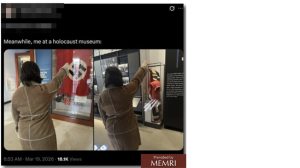 Image via MEMRI.org
As noted, this threat is not only from neo-Nazis; Islamist and jihadi-linked individuals target these sites as well. Recently, a 20-year-old Syrian man was convicted in Germany for his stabbing spree at the Memorial to the Murdered Jews of Europe, and sentenced to 13 years in prison. He had carried out the attack on behalf of ISIS.
But even as these outrageous attacks take place on memorials and places of historical significance for the Holocaust, an even more disturbing global trend has emerged – namely, the increasing use of artificial intelligence (AI) in the promulgation of antisemitism in general and Holocaust denial specifically. This is only one of the issues covered in the research of the MEMRI-Lantos Archives on Antisemitism and Holocaust Denial Project – the largest archives in the world of antisemitic content from the past quarter century in the Middle East and beyond.
This past year, the project’s research, monitoring, and translations have been devoted to how AI is being used to generate, manipulate, and disseminate distortion, ridicule, and denial of the Holocaust and its victims and to glorifying its perpetrators. It is circulated at unprecedented scale and speed, for propaganda, recruitment, and radicalization – particularly among younger audiences who lack historical knowledge.
Just as it has worked to protect its Holocaust memorials and historical sites, Germany has emerged as a leader in the fight against AI-powered antisemitism and Holocaust denial.
As one of the earliest adopters of the IHRA definition of antisemitism, Germany began supporting AI-based detection efforts, such as the Decoding Antisemitism project, in 2024. In May that year, Germany’s Federal Office for the Protection of the Constitution underlined the growing threat of AI-generated antisemitic imagery.
For International Holocaust Remembrance Day this past January 27 – the day aimed at confronting denial and distortion and safeguarding historical truth – a coalition of German Holocaust memorials, documentation centers, and historical research institutions, including memorials at former Nazi concentration camps, released an open letter. The letter sounded the alarm that the very memory that these institutions seek to protect is being eroded in real time.
This AI-generated falsified Holocaust content, they wrote, “distorts history by trivializing and kitschification,” and is designed to dilute historical facts, switch the roles of victim and perpetrator, and spread revisionist narratives. Adding that this “undermines the credibility of memorial sites, archives, museums, and research institutions,” they went on to call for decisive action to label, restrict, and remove this content. The statement went virtually unnoticed outside of Germany – but it should be read and widely disseminated.
Germany’s State Minister for Culture and Media, Wolfram Weimer, framed the fight against this use of AI in unequivocally moral terms, saying that he supported the measures called for in the letter and adding: “This is a matter of respect for the millions of people who were killed and persecuted under the Nazi regime of terror.”
Yom HaShoah recalls the darkness of the Holocaust, but also the courage and determination of the Jews of the Warsaw Ghetto who rose up to resist their Nazi oppressors. In this era of ever-growing antisemitism, we must summon similar courage and will to push back against the forces that seek to distort and deny the Holocaust. Germany is in a unique position to lead the charge in terms of AI-generated Holocaust denial. With its population of over 70 million Internet users, and significant leverage over an EU population of over 450 million, Germany has the influence and capability to pressure AI companies to take the necessary measures to prevent this dangerous development from getting further out of control. In a world where antisemitism is becoming increasingly normalized and accepted, we cannot afford to let the power – and the deception – of AI supercharge the dangerous trajectory of rising hatred for the Jewish people.
* Dr. Katrina Lantos Swett is President of the Lantos Foundation for Human Rights and Justice; Yigal Carmon is Founder and President of MEMRI.


Leave a Reply
You must be logged in to post a comment.