
Peloni: Zineb Riboua explains how Iran’s attempt to use the Strait of Hormuz as leverage has backfired after the Xi–Trump summit showed U.S.–China alignment on keeping the waterway open and preventing Iran from obtaining nuclear weapons. Whereas the relationship between China and Iran has been characterized as being an alliance, I have argued previously that the their connection was merely that of partners, where shared interests were the limit of any commitment by China for Iran. Iran’s refusal to negotiate with the US, tied to its weaponizing of the Strait of Hormuz, to its whimsical attack on the Gulf Arab nations, have all undermined China’s interests in Iran, even as Iran foolishly ignored its growing isolation from its former partner. The enforcement of US sanctions on China’s Teapot refineries was always the ultimate leverage which Trump held over the Chinese-Iranian relationship, and having now enacted this crucial measure, there can be little support for Iran coming from China.
The Strait of Hormuz Is Not Iran’s to Close
Zineb Riboua| Beyond the Ideological | May 14, 2026
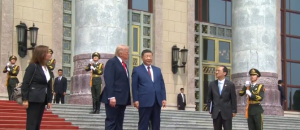 Pres. Trump meets with Pres Xi at Beijing Summit. Screengrab via X
The situation is obviously dynamic, but from reading today’s statements, here is my takeaway.
When Iran sealed the Strait of Hormuz, its genius strategists believed they held a winning hand. They expected two things: a global energy shock to force Washington into negotiations and the Gulf states to blame the disruption on US belligerence. Today, as President Trump sat across from Xi Jinping in Beijing, the first statements emerging from that summit began to reveal how thoroughly Tehran had misjudged the situation.
Diplomatic readouts on both sides are written to obscure as much as they reveal, but the White House statement from the meeting is unusually legible. The two leaders agreed that the strait must remain open to support the free flow of energy, and agreed that Iran must not acquire nuclear weapons (or, from China’s side, that Iran should have peaceful nuclear energy). Read at face value, these are bland formulations. Read against the backdrop of the past several months, they represent a significant Chinese repositioning, one Tehran will have noticed immediately.
Reports that Iranian authorities had begun allowing Chinese vessels through the strait coincided almost to the hour with the statement’s release. That synchronicity was not accidental. Tehran’s opening passage for Chinese ships is less a concession to Washington than a signal of how much ground it has lost with Beijing.
The deeper story here is what Iran’s gambit cost with its most important patron.
China had extended substantial support to the Islamic Republic through the sanctions years, sustaining Iranian oil exports through teapot refineries, enabling a shadow fleet to move Iranian crude, and providing diplomatic cover at the United Nations. That relationship carried an implicit logic whereby Beijing would absorb some international costs of the Iranian partnership because it served Chinese interests. Weaponizing the Strait of Hormuz broke that arrangement entirely.
Roughly 40-50 percent of China’s crude oil imports pass through the strait, and by threatening the waterway indiscriminately, Tehran was undermining the energy security of the one government still willing to shield it.


Leave a Reply
You must be logged in to post a comment.