
Yossi Baum | X | May 13, 2026
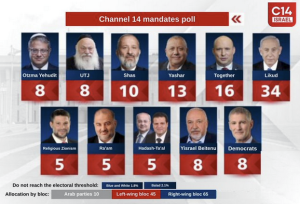 Ch 14 Election Poll from May 7, 2026. Screengrab via X
I see publications from senior figures on the right claiming that the departure of Degel HaTorah has negligible significance for the bloc. If this is a tactic intended to prevent faintheartedness in the right-wing bloc — fine. If not — then this is a very serious mistake.
Here is the full analysis:
- Degel HaTorah, currently leading the move, is worth 4 seats. Alongside it march the large Hasidic groups Gur and Vizhnitz, which add up to about another seat and a half. Total: 5–6 seats.
- The remaining parties — Porush, Belz, and Shas — will have to withstand enormous internal pressure that will portray them as “compromisers,” especially in the face of the rulings of the leading rabbis of the generation from Degel HaTorah and very senior Sephardic rabbis, while in the background there is pressure from all the heads and students of the yeshivas.
- The pressure in the Haredi street is very great. Not out of a desire to break the bloc — on the contrary, that is the painful part. The problem for the Haredi public is that it is in a state of “the waters have reached the soul”: draft evasion cases, prison, budget cuts to the bone, bans on leaving the country, and very, very soon — cancellation of the “Mechir LaMishtaken” housing program, property tax discounts, daycare centers, public transportation benefits, and more measures are expected.
- It is also difficult to “build on” Porush and Belz remaining in the right-wing camp if most of the Ashkenazi factions turn toward the left, especially in a situation of quiet support behind the scenes and support in supposedly “specific” votes (a framework that already arose during the “change [Bennett] government” period). And this is why:
Porush himself is subordinate to a large extent also to Rabbi Landau, whom he has regarded as his teacher and rabbi since studying at the Slabodka Yeshiva about 50 years ago, so that too will carry weight. If Porush also joins the majority of United Torah Judaism that leaves the bloc, it is difficult to see Belz remaining alone in the arena of support for Netanyahu.
- It should be remembered that there were already contacts of this kind during the “change government” period between the left and Porush and Belz, in exchange for about one billion shekels (!) for abstaining in the vote on the 2022 budget (attached). The framework that had already been agreed upon at the time was prevented at the last moment only because of internal pressure from the Lithuanian faction of Degel HaTorah alongside the Gur Hasidic movement. Right now the situation is reversed — they are the ones who would push Porush and Belz to cooperate with the left in exchange for budgets.
Later, another framework was formed for quiet support by Belz for the coalition in exchange for budgets for education (see the response to the post). The framework, which was backed by then-Justice Minister Sa’ar through Education Ministry Director-General Dalit Stauber, who was close to him, and which had already been written and signed, was again prevented only because of an all-out internal war waged against it by Degel HaTorah. Here too, the situation is now reversed.
In general: the Belz Hasidic movement has always been considered the leftward marker within “United Torah Judaism.” So support for the left in exchange for budgets is completely legitimate from its perspective.
- Deri: even if Deri withstands the pressure and finds some sort of appearance game to play — he will not be able to withstand a practical possibility of resolving the draft issue when the left presents one, in exchange for supporting it or “abstaining from outside.”
- Moreover: Shas is made up of a combination of “Torah scholars” and “ordinary folk.” Until now, the political pressure came only from the right-wing direction, which expected Shas to cling to Netanyahu as much as possible. Now a new situation has emerged — a separation between the Torah scholars and the ordinary folk, where the former — who are an integral part of the yeshiva world ultimately led by the Lithuanian leading rabbis of the generation — are beginning to create pressure opposite to the pressure created by the ordinary folk. It is still difficult to know the results of this clash and conflict of interests, but there is no doubt that this is a situation Shas has never faced before.
- It should be remembered that Deri was disqualified from serving as a minister in the government, and there is a strong likelihood that he would receive approval from the High Court if he supported the left. So on a personal level he certainly has reasons to try to create some form of cooperation with the left.
Bottom line: Deri is now in a predicament unlike perhaps anything he has ever experienced, and he will have great difficulty providing Netanyahu with support at a useful level, especially since his personal level of motivation is also unclear (not to mention his support for Oslo). In the end, everything depends on Haredi public opinion regarding the draft issue — and in that arena the influence of the former is immeasurably greater than Deri’s influence.
- Not to mention the chilling effect that this event has and will have on right-wing mobilization ahead of the elections, when it is clear to everyone that without the Haredim there is no possibility of a right-wing government. As a result — the opposite effect that the event creates on the willingness of the left to continue fighting with full force ahead of the elections, despite an entire term of attempts that largely ended in discouraging failures. Should one despair? No.
To conclude, I will mention that I am usually considered optimistic, if not overly optimistic. But this is not excessive optimism, just as this is not excessive pessimism. This is simply a sober reading of the situation in each matter on its own merits. Netanyahu’s security and economic plans in Iran and Gaza are taking shape under the radar, and because of that my worldview, being aware of those processes that are advancing, is optimistic.
By the same measure, the analysis of the current situation does not lead to optimism, but rather to simple and sincere concern. Nor is this some momentary and perhaps mistaken reading of the map — I have been warning about this consistently for two years (see the response to the post).
Does Netanyahu have the abilities to solve the crisis? Yes. Has he solved equally difficult problems in the past? Yes. But must everything possible be done to solve the matter, and quickly? Also yes. And the question is how engaged Netanyahu is in the event, in light of several reports about advisers in his office who do not understand the severity of the situation and who mistakenly paint a supposedly optimistic picture. And this is a serious mistake that must be brought to attention, because if this crisis is not treated in the most fundamental way possible — it is a slippery slope, as I detailed. Alongside this there is also a real problem of not insignificant support on the right for the approach of “going with the Haredim all the way” — without understanding the political implications that derive from it.
Let us hope for the best.


In regards to polls in Israel the following is a generality that holds true according my research.
Lazar Research (Dr. Menachem Lazar) polling for Maariv via Panel4All is generally regarded as more methodologically consistent and historically reliable than polls associated with Reshet 14, and broadly comparable to the mainstream Channel 12/13 pollsters—though each outlet has its own house effects.
Lazar Research (Maariv / Panel4All)
Conducts regular, methodologically transparent surveys for Maariv.
Uses representative samples of Israeli adults (e.g., 509 respondents, 4.4% MoE).
Produces stable, non?sensationalized results that track long?term trends (e.g., Likud vs. Bennett shifts, bloc stability).
Results are consistent across multiple Lazar polls over time, suggesting low volatility and minimal partisan skew.
Reshet 14 polls
No direct methodological data surfaced in the search results.
Reshet 14 is widely known (outside the search results) as a right?leaning channel, and its polls often show systematic pro?right / pro?Netanyahu house effects.
Because the search did not return Reshet 14 poll methodology or accuracy data, we cannot cite specifics—but the absence of transparent sampling details itself is meaningful.
Channel 12 / Channel 13 polls
Not directly included in the search results, but both channels typically use long?established pollsters (e.g., Midgam, Mano Geva, Panels Politics).
Historically considered part of the “mainstream” Israeli polling ecosystem with relatively stable accuracy.
So, I prefer pollsters that have proven to be more accurate. I am not concerned that the poll may show results I like or do not like.
@Rafi
Bravo on your research, thanks for sharing it. Nonetheless, for what it is worth, there are a few points I think we should parse out which has not been included in your comments.
Yes, accuracy is the best indicator of a good pollster, but that is why I raised the issue with relying on Maariv’s polls in regards to the party blocks as indicated in the article you shared.
You seem well aware of the relevance of the various polling groups, but in regard to accurate predictions about the party blocks, as indicated in the report you shared below which indicated Bibi could not form a govt per Maariv, Channel 14 was notably the most accurate of the polls as reflected in the final polling before the last election, not Channel 12, Channel 13, or Maariv all of which had last minute polling results which were actually Left of reality compared to the polling from Channel 14. Just FYI.
My recollection is that regarding the individual party predictions, Channel 14 was less accurate, but in regards to who could form a govt, Channel 14 was the more reliable source.
Also, I am sure you are also aware of the fact that Channel 14 changed polling companies from Direct Polls to Filber Polls, so we will see how this affects their accuracy in the next election.
@Rafi
Is there a reason you seem to prefer quoting Maariv polls which ‘report’ among the least favorable polling for the National camp in general, not to mention Netanyahu in particular? Is your honest intent here to suggest that Netanyahu has no chance at winning based on this Leftist polling? These are serious questions if you care to answer them. Indeed, can you share similar reporting confirmed among Channel 14 polling that Bibi has no chance in the coming election, for instance? The answer is you can not.
I found it interesting that you describe Lapid yesterday as a ‘centrist’, so perhaps Maariv truly informs your own views, but whether this is true or you are simply using it to paint a one sided picture of what you yourself believe, it lacks credibility in doing so.
Indeed, if this report were honest, is it reasonable that Likud would remain with Bibi, and is it reasonable that the formation of the unimaginative anit-Bibi Likud-B party has not been formed by defectors of Bibi’s party amid his plummeting popularity?
To be fair, the stakes are high, and Bibi’s position going forward is certainly less viable than it was 5 years ago, but let us not use one sided obviously tainted anti-Bibi polling as the basis of our judgements about this and other realities. Yet, Maariv hardly reports from a standard which predicts the national trends, particularly as it relates to Bibi Netanyahu…likely you know this to be true.
I found the poll interesting. Nothing else. If you do not like it. Your right and it makes no difference to me.
Lapid has for many years been considered a centrist by most Israeli publications. One could easily make an argument that he is a leftist or a center/leftist. I am not concerned by that nor would I dispute that.
I am not a big believer in political labels, and it is not my focus of thought in the importance of things.
I am more interested in policies. I would like to see the following occur in Israel:
1. Stop the Haredi monopoly on religion and their draft evasion.
2. Write a constitution
3. Let individual cities determine if there can be public transportation on Shabbat
4. Improve the education system
5. Stop payments to sectors from public funds that do not contribute to National Defense or do public service.
6. Continue what Smotrich has done so well expanding settlement in Judea/Samaria
7. Allow the private sector more influence in development of all of Israeli real estate and work to free enterprise and away from government control
AI Overview – Google not Chat Gpt which i have found to be worse than useless. I don’t get all the hype. I’ve disabled it.
Humor: Dave Disables HAL’s brain in “2001, A Space Odyssey (1968)”
https://youtu.be/KS3h1bxmVR4?si=wtIBPLXLEdeD9uon