
Trump Has Iran on the ropes. Now he must resist the bad deal.
Mark Dubowitz | May 29, 2026
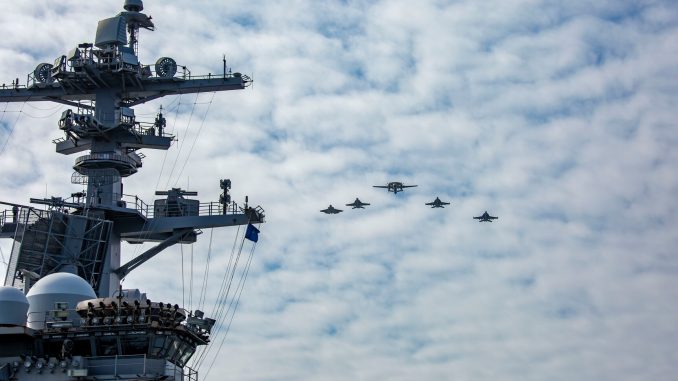 Aircrafts, attached to Carrier Air Wing 9 (CVW9) fly over the flight deck of the Nimitz-class aircraft carrier USS Abraham Lincoln. (U.S. Navy photo by Mass Communication Specialist Seaman Daniel Kimmelman) The appearance of U.S. Department of War (DoW) visual information does not imply or constitute DoW endorsement.
After two years of devastating American and Israeli strikes against Iran’s nuclear sites, missile infrastructure, air defenses, terror proxies, and regime leadership, President Donald Trump holds more leverage over the Islamic Republic than any U.S. president since the Islamists took power in 1979.
The question is whether he uses it — or trades it away.
Talk of a deal is again at fever pitch. Trump is reportedly mulling a memorandum of understanding that would extend the ceasefire by 60 days, lift the U.S. naval blockade of Iran’s ports, reopen the Strait of Hormuz, and launch formal nuclear talks.
The guns, however, are not yet silent. On Wednesday night, U.S. forces shot down four Iranian drones and struck a ground control station to preempt attacks on American troops and commercial shipping in the Strait. Tehran answered with a ballistic missile aimed at Ali Al Salem Air Base in Kuwait, intercepted by Kuwaiti air defenses. The infrastructure to resume the war Trump began in February remains in place — and no deal is better than a bad one.
The Iranians have mastered the art of negotiating with Washington. They outplayed Obama. They outplayed Biden. Each time, they preserved their nuclear pathway and pocketed billions in sanctions relief. Even now, at the regime’s weakest moment since the revolution, the mullahs retain enriched nuclear material, terror proxies, residual missile capability, and a chokehold on the global oil economy. They are losing the war.
But they believe they can still win the peace — meaning regime survival and a runway to rebuild.
Three issues will decide whether talks succeed or hand Tehran a lifeline.
First, Hormuz. The regime has been running a maritime extortion racket, charging tankers up to $2 million for “safe passage.” Any deal must end the toll, clear every Iranian mine, and forbid attacks on commercial or U.S. Navy vessels. The American blockade should come off only in phases tied to verified compliance, not all at once. If Tehran cheats, Trump must be ready to relaunch Project Freedom — the tanker-escort operation aborted earlier this year when Riyadh withheld overflight rights. The Saudis should be told, plainly, that this time they have no choice but to grant them — or we won’t defend them.
Second, the nuclear file. Iranian assurances that they “do not seek a bomb” are worthless. Only actions count. That means surrendering every kilogram of enriched uranium — not just the 970 pounds of 60-percent material entombed in the tunnels of Isfahan and Fordow, but the thousands of additional pounds enriched between two and 20%, much of it three-quarters or more of the way to weapons grade.
It means a permanent ban on enrichment and plutonium reprocessing. It means dismantling Pickaxe Mountain, the underground site Iran intends as an enrichment and centrifuge plant impervious even to the massive ordnance penetrators that destroyed the Fordow nuclear facility during Operation Midnight Hammer last June. And it means hard limits on rebuilding the missile force that threatens Israel, the Gulf, and Europe, U.S. forces across the region, and the American homeland if they rebuild their destroyed ICBM program.
Third, sanctions relief and access to frozen funds. Trump has said Iran will receive no cash and no sanctions relief up front. Good. But the principle of “no dust, no dollars” must be airtight. The war has cost Tehran between $150 and $300 billion. Will the regime now be permitted to unload the $15 billion in oil sitting in blockaded tankers? Tap the billions frozen in Qatar, Oman, and Iraq? Hand the mullahs any of that money before they verifiably dismantle their nuclear program, and the leverage Trump built with American air power vanishes overnight.
Iran still controls enriched uranium sufficient for at least 10 nuclear weapons. It can still convulse oil markets by squeezing Hormuz. And the Iranians read American politics. They see November’s midterms. They know how to drag negotiations into a season when they believe a wounded president would have less appetite for confrontation. Stalling is their best weapon.
Here is the bad deal Trump must refuse: a freeze instead of dismantlement, sanctions relief for promises, frozen funds released for goodwill, the nuclear program left dormant rather than eliminated. It is the deal the regime is built to extract — and the deal that hands the Iran problem, yet graver and closer to a bomb, to Trump’s successor, who may not have the spine to finish what Trump started.
The six-week military campaign is incomplete. The administration declined Israeli proposals to hit Iran’s energy infrastructure and to decapitate dozens more regime leaders, including Iran’s current supreme leader, Mojtaba Khamenei. If Tehran refuses real terms, the military and economic warfare campaign can be resumed. The leverage is there. The forces are in position — and President Trump can arm, support, and help unleash millions of Iranians to retake their streets and their country. The only question is whether the president who built this position has the will to use it. It is a good bet that he will.
Mark Dubowitz is chief executive of the Foundation for Defense of Democracies and the presenter of “The Iran Breakdown” podcast.


See the silver lining in the clouds! ! !
This war and shortages of fuels and fertiliser has at last made it clear the rest of us have to go into alternative energy to be independent. That will also cut the petro dollars flood on the market and cut inflationary pressures in the World economy. Alternative energyy will also cut the Petro states to size where they can no longer buy whole sectors of underfunded Western economies starting with education. Alread the Bombay – Delhi Express train runs on the bio – diesel from Jatropha and Jojoba hedge along the track.
The alternatives have already been proven with wind and solar panels and tidal lagoons to generate electricity for starters – and insulation. The problem is liquid fuels for aircraft, ships and land vehicles. This is probably simpler than it looks. Electric rail and road vehicles – at least in towns. For aircraft, ships and long distance rural vehicles remember that in World War II the Antwerp buses were run on ammonia (NH3) solution. Further this could not have been difficult to fettle because it was done in a context of war time shortages of skills, tools and materiel.
Ammonia is NH3 effectively the Hydrogen economy and when dissolved in high (100’s) volumes in water contains as much H2 as compressed H2 without the problems of its small atoms leaking through the steel needed for pressurised cylinders to store in quantity. Further it – NH3 – is a mature industrial product to make fertilisers and explosives and so we already have alll the safety legalities on the books. All we need is how to use off peak solar, tidal and wind power to adjust the Haber or other process to extract Nitrogen from the air and matchit to Hydrogen – H2 from water. The “surplus” Oxygen can be bubbled in fish ponds etc to raise cheap protein.
As a side bonus qv the Indian rail express mentioned above: there are several bio-diesl oil nut /fruit plants from which peasant farmers could be encouraged to grow their own bio-diesel and buy rotovators or small tractors to take the donkey work out of labouring their fields. The classicall olive of the Mediteranean for one, Jatropha, Jojoba and others no doubt. This would stabilise country migration to town slums and stabilise and improve local (Third World) farming and food security. The village children can help pick the nuts and the men can turn an outsize screw “meat mincer” to squeeze the oil. The bagasse can then be either put on the manure heap to return to soil, or turned into winter and cooking fuel briquettes by filling “cake tin” moulds and drying. Government may lose out on taxing diesel but recoup in consumption and income taxes on the increased rural prosperity.