
Peloni: Exceptional review of Erdogan, and how he led a revolution of radicalization over secularized Turkey.
How a nation that once embodied Western hopes for a secular Muslim democracy evolved into a religious-nationalist power challenging the very assumptions upon which NATO was built.
Michel Benchimol
![Mustafa Kemal Atatürk (1881 – 10 November 1938) was a Turkish field marshal, revolutionary statesman, author, and the founding father of the Republic of Turkey, serving as its first President from 1923 until his death in 1938. He undertook sweeping progressive reforms, which modernized Turkey into a secular, industrializing nation. Ideologically a secularist and nationalist, his policies and theories became known as Kemalism. Due to his military and political accomplishments, Atatürk is regarded as one of the most important political leaders of the 20th century. y ?ncelemeelemani - Own work, Public Domain, https://commons.wikimedia.org/w/index.php?curid=26956220 [Cropped]](https://www.israpundit.org/wp-content/uploads/2026/05/Screenshot-2026-05-31-044114-637x381.png) Mustafa Kemal Atatürk (1881 – 10 November 1938) is regarded as one of the most important political leaders of the 20th century. y ncelemeelemani – Own work, Public Domain, Wikipedia [Cropped]
Mustafa Kemal Atatürk (1881 – 10 November 1938) is regarded as one of the most important political leaders of the 20th century. y ncelemeelemani – Own work, Public Domain, Wikipedia [Cropped]
For more than seven decades, the Republic of Turkey occupied a singular and strategically vital position within the Western imagination.
It was the Muslim-majority nation that consciously chose secularism over theocracy, Europe over empire, and NATO over Moscow.
Positioned astride the fault lines separating Europe, Asia, and the Middle East, Turkey was widely celebrated as living proof that Islam, democracy, modernization, and Western strategic alignment could coexist within a single nation-state.
That Turkey no longer exists.
Under President Recep Tayyip Erdodan, the country has undergone one of the most profound ideological transformations of the modern era.
The secular republic established by Mustafa Kemal Atatürk in 1923 has steadily evolved into a centralized, religious-nationalist state increasingly hostile to many of the political, cultural, and democratic assumptions upon which the North Atlantic alliance was built.
As NATO prepares for its 2026 summit in Ankara, a profound and uncomfortable question hangs over the alliance: Can a country drifting openly toward authoritarian Islamism, suppressing dissent, purchasing advanced Russian military systems, and repeatedly undermining alliance unity still credibly claim membership within the Western democratic order?
This debate is no longer merely about foreign policy or military logistics. It is about identity, ideology, and civilization itself.
It is the story of a century-long struggle over the soul of Turkey.
The Birth of Modern Turkey: Atatürk’s Revolutionary Gamble
To understand Turkey’s modern transformation, one must first appreciate the extraordinary scale of Atatürk’s revolution.
When the Ottoman Empire collapsed following World War I, what remained was not a stable nation-state but the shattered remains of a defeated Islamic empire that had ruled vast territories across three continents for centuries.
The imperial structure had disintegrated. Much of Anatolia — the great peninsula that constitutes most of modern Turkey — was occupied by foreign powers.
Constantinople itself was under Allied control. The old Ottoman order appeared finished.
Into this vacuum stepped Mustafa Kemal Atatürk, a military commander convinced that the Ottoman system itself had doomed Turkey to stagnation, weakness, and eventual collapse.
His response was radical.
Atatürk sought not merely to reform the empire but to erase it psychologically, culturally, legally, and spiritually.
He understood that unless Turkey fundamentally severed itself from the imperial-religious structures of the Ottoman world, it would never modernize or survive in the emerging twentieth-century international system.
The reforms came with astonishing speed and revolutionary force:
- The Caliphate was abolished in 1924.
- Religious courts were dismantled.
- Sharia law was replaced with European civil codes, particularly the Swiss Civil Code.
- Islamic schools were either closed or absorbed into state authority.
- Traditional Ottoman attire, including the fez, was discouraged.
- The Arabic script was abandoned and replaced with the Latin alphabet.
- Women received civil and political rights unprecedented in much of the Muslim world at the time.
- State institutions were reorganized according to European administrative and legal models.
At the center of this revolution stood the doctrine of laiklik — Turkish state-enforced secularism.
Unlike the American concept of separation between church and state, Turkish secularism placed religion firmly under state supervision and control.
The objective was not religious pluralism in the liberal Western sense; it was to ensure that Islam could never again emerge as an independent political force capable of challenging the republic.
Atatürk understood something many Western observers consistently underestimated: within Ottoman history, political Islam had been inseparable from imperial authority.
To modernize Turkey, he believed religion had to be politically contained.
For millions of secular Turks, Atatürk became almost a sacred national figure. His portrait remains omnipresent in government offices, military institutions, schools, and public squares across the country.
Yet beneath the secular surface, another Turkey survived.
The conservative, religious, and deeply traditional identity of Anatolia — particularly central and eastern Anatolia — never disappeared. It merely retreated temporarily from political dominance while secular elites controlled the institutions of the republic.
Inönü and the Democratic Transition
After Atatürk’s death in 1938, leadership passed to Ismet Inönü, one of the founding architects of the republic.
Inönü governed during one of the most dangerous periods in modern history. Throughout most of World War II, Turkey maintained official neutrality, balancing carefully between Nazi Germany and the Soviet Union while attempting to preserve the fragile republic Atatürk had built.
Yet Inönü’s greatest contribution came after the war.
Recognizing the global shift toward democratic governance and eager to anchor Turkey firmly within the emerging Western bloc, Inönü permitted opposition parties and oversaw Turkey’s first genuinely meaningful multi-party elections.
In 1950, after losing at the ballot box, Inönü peacefully transferred power to the opposition Democrat Party.
This moment was historic not only for Turkey but for the broader Middle East. Peaceful democratic transfers of power were exceptionally rare throughout the region.
Turkey appeared to have achieved something extraordinary: a secular Muslim-majority democracy aligned with the West.
NATO Membership: Turkey Chooses the West
Turkey’s admission into NATO in 1952 represented the culmination of Atatürk’s Western strategic vision.
The Soviet threat was immediate and existential. Soviet leader Joseph Stalin demanded territorial concessions in eastern Turkey and sought joint control over the Turkish Straits — the Bosphorus and Dardanelles — which connect the Black Sea to the Mediterranean.
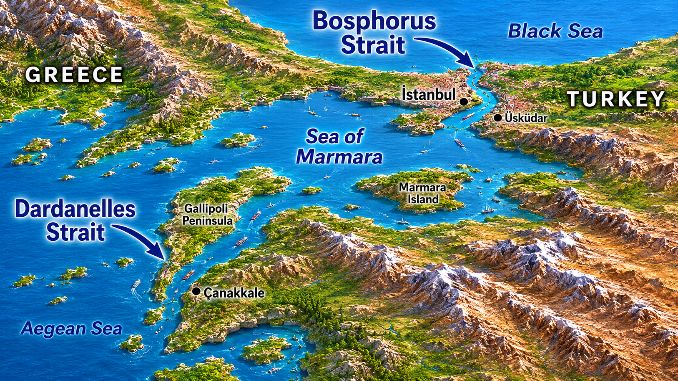 Image created by AI
For Ankara, Soviet pressure created a stark geopolitical choice: align permanently with the Western alliance or risk eventual domination by Moscow.
Turkey chose the West.
To demonstrate its commitment, Turkey dispatched approximately 15,000 troops to fight alongside U.S.-led forces during the Korean War. Turkish soldiers earned a fierce battlefield reputation, and their sacrifices helped secure Turkey’s admission into NATO on February 18, 1952.
Turkey quickly became indispensable to the alliance.
Geographically, it occupied one of the most strategic positions on earth:
- bordering the Soviet Union,
- controlling access to the Black Sea,
- and sitting at the crossroads of Europe, the Caucasus, Central Asia, and the Middle East.
Its military eventually became NATO’s second-largest force after the United States.
For decades, Washington viewed Turkey as a critical anti-Soviet fortress.
Internally, the Turkish military assumed an additional role: guardian of secularism itself.
Whenever civilian governments appeared to drift toward political Islam, the armed forces intervened. Military coups occurred in 1960, 1971, and 1980, with a further indirect intervention in 1997.
While controversial, many secular Turks viewed the military as the final institutional barrier preventing the collapse of Atatürk’s republic.
The Rise of Erdogan: The Counter-Revolution Begins
The ascent of Erdogan and the Justice and Development Party (AKP) in 2002 marked the beginning of Turkey’s ideological reversal.
Initially, Erdogan portrayed himself as a moderate conservative democrat similar to European Christian Democrats.
Western leaders enthusiastically embraced him. Many believed Turkey had discovered a successful synthesis between Islam and liberal democracy.
That interpretation proved catastrophically naive.
Over time, Erdogan systematically dismantled the secular structures that had constrained political Islam for generations.
The military — historically the guardian of secularism — was neutralized through mass prosecutions, purges, and institutional restructuring.
The judiciary gradually fell under executive influence.
Independent media organizations faced intimidation, financial pressure, arrests, censorship, or takeover by pro-government business conglomerates.
Universities and civil institutions increasingly came under political control.
The failed coup attempt of 2016 accelerated this transformation dramatically.
Erdogan used the aftermath to justify sweeping purges across:
- the military,
- judiciary,
- academia,
- media,
- and civil service.
Tens of thousands were arrested, dismissed, imprisoned, or politically marginalized.
The result was the emergence of a highly centralized presidential system in which Erdogan accumulated extraordinary personal authority.
The Islamization of the Turkish State
What distinguishes Erdogan from previous Turkish strongmen is not merely authoritarianism but ideology.
His project is civilizational in nature.
Erdogan has repeatedly argued that secular Kemalism alienated Turkey from its authentic Islamic and Ottoman roots.
His broader vision — frequently described as Neo-Ottomanism — seeks to restore Turkey’s historical identity as a dominant Muslim regional power.
This transformation has unfolded across nearly every sector of Turkish society.
Education
Perhaps nowhere is the ideological shift more visible than in education.
Thousands of secular public schools have been converted into Imam Hatip religious institutions. These schools emphasize Islamic instruction alongside conventional education and were originally designed to train clerics and religious officials.
Erdogan openly declared his ambition to raise a “pious generation.”
Critics argue the educational system is increasingly designed not to create independent citizens but ideologically loyal religious conservatives.
The Expansion of the Diyanet
Turkey’s Directorate of Religious Affairs — the Diyanet — has evolved into an enormous state apparatus wielding massive budgets and substantial political influence.
Originally created by Atatürk to subordinate religion to the secular state, the Diyanet under Erdogan transformed into an instrument for spreading state-sponsored Sunni Islamist ideology both domestically and internationally.
The institution now oversees:
- tens of thousands of mosques,
- global religious outreach programs,
- Islamic educational initiatives,
- and international religious diplomacy.
Its influence extends well beyond Turkey’s borders into Europe, Central Asia, Africa, and the broader Muslim world.
Hagia Sophia: The Symbolic Break
The reconversion of Hagia Sophia into a mosque in 2020 may have been the defining symbolic moment of Erdogan’s presidency.
Originally constructed in 537 AD as the great cathedral of the Byzantine Empire, Hagia Sophia later became one of the Ottoman Empire’s most important mosques after the conquest of Constantinople in 1453.
In 1934, Atatürk transformed Hagia Sophia into a museum as a symbolic declaration that modern Turkey belonged to a secular and Western-oriented future.
For Erdogan, reversing that decision symbolized the rejection of Kemalist secularism itself.
Supporters celebrated the move as a restoration of national sovereignty and Islamic identity.
Critics viewed it as a deliberate repudiation of Atatürk’s Western-oriented republic and a declaration that Turkey was abandoning its secular identity.
NATO’s Growing Crisis of Confidence
Turkey’s internal transformation might have remained manageable had it not coincided with increasingly confrontational foreign policies.
The greatest rupture came with Ankara’s purchase of the Russian S-400 missile defense system.
To NATO officials, this decision was astonishing.
A core NATO member had integrated advanced Russian military technology into its defense architecture — technology considered incompatible with NATO systems and potentially capable of compromising alliance security.
The consequences were immediate:
- Turkey was expelled from the F-35 fighter jet program,
- defense cooperation with the United States deteriorated,
- and trust within NATO eroded dramatically.
Many alliance officials concluded that Erdogan was pursuing a multi-directional foreign policy fundamentally incompatible with alliance cohesion.
Turkey’s Islamist Foreign Policy
Erdogan’s foreign policy increasingly reflects ideological motivations rather than purely strategic calculations.
Turkey has cultivated relationships with:
- Hamas,
- elements of the Muslim Brotherhood,
- and various Islamist factions across the region.
Ankara’s rhetoric toward Israel and the West has become progressively harsher and more confrontational.
Meanwhile, Erdogan has maintained an often ambiguous relationship with Russia, cooperating economically and diplomatically with Moscow while formally remaining within NATO.
This creates what many Western analysts view as an unprecedented geopolitical anomaly: a NATO member simultaneously functioning as ally, spoiler, and strategic wildcard.
Democracy Without Liberalism
Erdogan continues to win elections, and his supporters argue that Western criticism merely reflects elitist hostility toward conservative Muslim voters.
Critics counter that Turkey now operates under what political scientists describe as “competitive authoritarianism.”
Opposition parties technically exist, but under profoundly unequal conditions.
Key concerns include:
- overwhelming pro-government media dominance,
- politicized courts,
- arrests of journalists,
- criminal investigations against opposition leaders,
- and growing state influence over electoral institutions.
Figures such as Ekrem Imamoglu have faced repeated legal pressure widely interpreted by critics as politically motivated attempts to weaken viable opposition.
Critics therefore argue that while elections continue to occur, genuine democratic competition has been severely compromised.
Why NATO Cannot Easily Let Turkey Go
Despite all these tensions, NATO cannot easily sever ties with Turkey.
The reason is brutally simple: Turkey remains strategically indispensable.
Turkey controls access between the Black Sea and the Mediterranean through the Bosphorus and Dardanelles.
It borders:
- Syria,
- Iraq,
- Iran,
- the Caucasus,
- and the broader Russian sphere of influence.
Its military infrastructure remains deeply integrated into NATO operations.
No realistic strategic replacement exists.
This creates a profound contradiction at the center of the alliance.
NATO defines itself as an alliance of democratic states committed to liberal values and collective security.
Yet one of its most strategically important members increasingly resembles an authoritarian religious-nationalist power pursuing an independent civilizational agenda.
The Great Paradox
The tragedy — and perhaps inevitability — of modern Turkey is that both Atatürk and Erdogan represent authentic dimensions of Turkish history.
Atatürk attempted to forcibly Westernize a deeply religious post-imperial society.
Erdogan represents the political resurgence of the conservative Anatolian identity that secular elites suppressed for decades.
The struggle between these visions has shaped Turkish politics for more than a century.
The question now is whether NATO can continue pretending that this ideological conflict does not fundamentally matter.
Turkey remains militarily valuable.
But alliances are ultimately built not only on geography and weapons, but on trust, political identity, and shared assumptions about the nature of the state itself.
Increasingly, many in the West no longer believe Erdogan’s Turkey shares those assumptions.
And that may become one of the defining geopolitical fractures of the twenty-first century.
The Case for Expulsion
NATO’s founding preamble commits member states to the principles of democracy, individual liberty, and the rule of law.
Critics increasingly argue that Erdogan’s Turkey fails on all three counts.
Turkey has repeatedly used its veto power as political leverage, most notably delaying the accession of Sweden and Finland in order to extract concessions from alliance partners.
At the same time, Ankara continues purchasing Russian military systems while relying upon NATO’s collective security guarantees.
To critics, this contradiction has become intolerable.
An ally that buys weapons from the alliance’s principal adversary, manipulates democratic institutions, suppresses its secular opposition, and promotes Islamist political ideology is no longer merely a difficult partner — it becomes a strategic liability.
NATO currently lacks a formal mechanism for expelling a member state.
Yet critics argue that legal technicalities can no longer obscure political reality.
For the survival of Western collective security, they contend that NATO must eventually confront the possibility that Erdogan’s Turkey no longer belongs within the alliance it joined in 1952.
The AEI Critique and the Growing Western Debate
Much of the harshest criticism of Erdogan’s Turkey has emerged from influential Western policy institutions such as American Enterprise Institute (AEI), one of America’s most prominent conservative think tanks.
AEI has long published critical analyses regarding:
- democratic backsliding in Turkey,
- NATO tensions,
- Islamist movements,
- Turkey’s relationship with Russia,
- and Erdogan’s increasingly authoritarian rule.
Prominent figures affiliated with AEI have included:
- Dick Cheney,
- Paul Wolfowitz,
- Michael Rubin,
- and John Bolton.
Among them, Michael Rubin has emerged as one of the most outspoken critics of Erdogan’s Turkey, arguing repeatedly that Ankara has become increasingly unreliable as a NATO ally and increasingly hostile to Western democratic values.
The debate is no longer confined to academic circles.
It now sits at the very heart of the Western alliance itself.


Melissa Steinberg Brodsky on FB: