
The radicals in charge in Seoul are pushing constitutional revisions to permit their own indefinite rule.
By Nicholas Eberstadt and Lawrence Peck | WSJ | June 1, 2026 12:56 pm
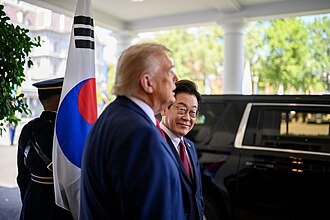 President Donald Trump greets President Lee Jae-myung of the Republic of Korea, Monday, August 25, 2025, at the West Wing entrance of the White House. By The White House – Flickr, Public Domain, Wikipedia
South Korean officials storm the command center of an American military base, seizing details about U.S. Air Force flights in the name of a domestic investigation.
South Korean legislators and prosecutors launch a criminal inquiry into a successful American company (Coupang, sometimes called the Amazon of Asia) for a seemingly accidental data breach, while local Korean (and Chinese) firms skate by for more-serious, deliberate disclosures.
A South Korean government minister publicly discloses what is alleged to be classified information about a North Korean nuclear site, effectively revealing to Pyongyang intelligence that America had shared with Seoul in confidence.
Welcome to today’s U.S.-South Korea alliance. The partnership is grappling with the unpredictable Trump administration—and also the all-too-predictable recklessness of the hard-left government in Seoul. Mr. Trump’s transactional, often peremptory approach to American allies is well-known. But the government on the other side of the alliance deserves much more attention.
The radicals in charge of South Korea today are President Lee Jae Myung and his Minju (or “Democratic”) Party. They swept to victory last June, after the disgraced former president, Yoon Suk Yeol, was impeached for a bizarre six-hour attempt to declare martial law.
South Korean journalists and foreign reporters often refer to Mr. Lee and Minju as “liberals” (and to Mr. Yoon as a “conservative”). But Minju’s far-left leaders tend to despise liberals. Critics fear their ultimate aim is to impose far-reaching legal revisions to permit their own indefinite rule—and that the country’s hard-won liberal constitution is at risk.
How far left is Minju? In 2021 it joined the celebration of the 100th anniversary of the Chinese Communist Party in Beijing. Minju raised its party banner alongside the flags of the Chinese and other communist and authoritarian parties.
Minju’s leaders cut their teeth in the struggle against Chun Doo-hwan’s military rule in the 1980s. But while South Korea’s official opposition parties were agitating for a transition to democratic constitutional governance, the politics of future Minju figures is reminiscent of the “national liberation” movement—a pro-Pyongyang, underground operation infused with North Korea’s state ideology. Those activists and their fellow travelers reviled their own imperfect government—and, by extension, the Yankees “propping up” this “puppet state”—but didn’t criticize Pyongyang’s monstrous regime.
South Korea’s current prime minister, Kim Min-seok, in 1985 participated in a student attack and takeover of the Seoul American Cultural Center for the “resistance.” He and other Minju leaders haven’t renounced their youthful activities or beliefs.
In today’s Minju-run South Korea, Americans contend with an ally that is largely unsympathetic to the alliance and wants to cooperate less, not more, with U.S. security initiatives. In the Iran war, South Korea hasn’t directly assisted in opening the Strait of Hormuz, even though more than two-thirds of the country’s oil imports pass through it. Seoul last month offered the mullahs humanitarian aid and proposed a separate diplomatic dialogue. As a sweetener, Mr. Lee publicly likened Israeli actions in Gaza to the Holocaust.
Mr. Lee and Minju have made clear they aren’t on America’s side in the China competition. During his presidential campaign, Mr. Lee declared that he didn’t care what happens to Taiwan. In April, Mr. Lee’s defense minister discussed bilateral defense cooperation with China’s ambassador to South Korea.
The centerpiece of the U.S.-South Korea alliance is the North Korean threat—but even that is a problem now. Before he won the presidency, Mr. Lee was on trial for allegedly funneling $8 million in secret funds to the North. He has denied wrongdoing. Mr. Lee is immune from prosecution while president, and he has plans to make sure he never has to face court on this charge. Plan A is a special bill, now before the National Assembly, that would dismiss his case. Plan B may be to stay in office indefinitely.
South Korea’s constitution stipulates the presidency is a one-term job. Mr. Lee has proposed amending that provision. He can’t amend the constitution without a two-thirds legislative supermajority, and he lacks one—barely. But he hope the voters give him that supermajority in the 2028 National Assembly elections. If that doesn’t work, there is always lawfare.
Mr. Lee has already empaneled special counsels to investigate the Yoon martial-law “insurrection.” If the investigators label the opposition party as somehow abetting Mr. Yoon’s action (as Minju’s party chief has urged) the Minju majority could petition the Constitutional Court to ban its members from the National Assembly—and thereby grant Mr. Lee the supermajority he needs to amend the constitution.
Mr. Lee and his party have floated proposals for making the constitution more “democratic” through further “reforms.” These changes could cement Minju’s hold on power, and effectively transform South Korea into a one-party state.
America has plenty of friends and allies in South Korea. But they aren’t in Minju. Until Washington wakes up, the threats to South Korea’s domestic freedom, and to the U.S.-South Korea alliance, will likely grow.
Mr. Eberstadt is a researcher at the American Enterprise Institute. Mr. Peck is an adviser to the North Korea Freedom Coalition.


Whoops!!! There goes Hyundai, Kia (part of Hyundai), and Samsung. Once “the left” gets its grubby hands on anything, that “anything” is doomed.