
Peloni: This course correction by the Netanyahu govt places Netanyahu directly at odds with Trump’s insistence that nothing be done to threaten the deal with Iran. Notably, Erdogan and MBS each issued statements opposing Israel’s continued presence in Lebanon, and it should be understood that when Erdogan and MBS both agree upon something, Trump will take notice of it.
A Massive Israeli Strike Is Now More Likely
Jafaj.net | 2026-06-09
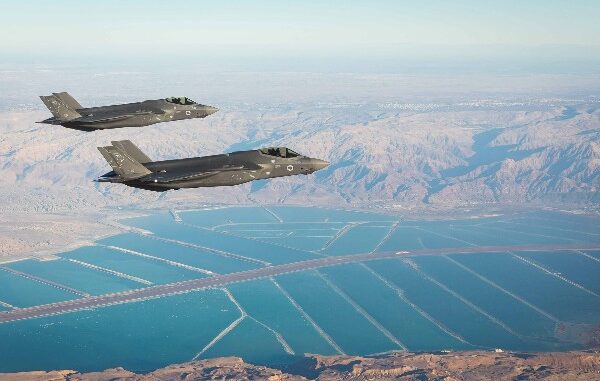 Israeli Air Force (IAF) F-35I Adir. By Source: William LewisDerivative: User:MathKnight – WikiCommons: File:230322-F-UT528-1038 – Red Flag-Nellis 23-2, 22-24 Mar, 2023.jpg, CC BY-SA 4.0, Wikipedia
1.JAFAJ has learned from an Israeli government source that U.S.-mediated talks with Lebanon aimed at reaching a ceasefire are not progressing, as the Israelis have given up hope that Hezbollah is serious. The source said Israel now believes Hezbollah was merely trying to buy time on behalf of its Iranian mentors.
2.This shift reflects a broader evolution in Israeli strategic doctrine, where diplomatic engagement is increasingly viewed not as a pathway to de-escalation, but as an adversarial tool used to regroup, rearm, and reposition forces ahead of continued conflict. As a result, negotiations are losing credibility within Israeli decision-making circles as viable instruments of conflict resolution.
3.The source also added that Israel has completely given up hope that Iran has chosen to restrain Hezbollah’s actions in Lebanon. He said that despite repeated promises by the Lebanese government and the parties negotiating with Israel, Hezbollah only says what Iran tells it to say, and in this case Iran wants the confrontation in Lebanon to continue.
4.This conclusion effectively reframes the conflict. Rather than treating Lebanon as a sovereign negotiating counterpart, Israel is increasingly viewing the situation as a direct proxy confrontation with Iran. This reclassification significantly expands the potential scope of Israeli military response, introducing the possibility that future operations may target not only Hezbollah assets, but also Iranian-linked command structures, logistical networks, and regional influence channels.
5.The source added that the Israeli cabinet is now discussing an unprecedented response to Hezbollah’s stance, leading to the annihilation of Hezbollah even if they have to go after them one by one.
6.In Israeli military terminology, the use of the term “unprecedented response” signals a departure from traditional deterrence-based operations toward a sustained degradation campaign. Such a campaign would likely include leadership decapitation strikes, expanded targeting of infrastructure tied to Hezbollah’s operational capacity, persistent intelligence-driven tracking of personnel, and broader rules of engagement in complex urban environments. This indicates that Israel is not preparing for a single retaliatory strike, but rather a prolonged and methodical military campaign.
- Comment: Despite earlier optimism by the American mediators involved in the Israel-Lebanon negotiations, and despite assurances of good intentions voiced by Lebanese officials negotiating on behalf of Hezbollah, the organization does not seem able to disobey Iranian instructions, as it is merely an Iranian proxy. Lebanon is now likely to face the conflict on a much larger scale, as Israelis are pushing for Gaza-like solutions for Hezbollah. JAFAJ has also learned that unprecedented attacks may be launched against the southern district, the Lebanese Shiite stronghold in the capital Beirut, and the Hezbollah ghetto.
8.This development introduces three critical escalation dynamics. First, any major strike on Beirut’s southern district would represent a transition into high-density urban warfare, where civilian infrastructure and militant assets are deeply intertwined, dramatically increasing both humanitarian risk and international scrutiny. Second, the likelihood of regional spillover rises sharply, as Iranian-aligned actors across Syria, Iraq, and potentially other theaters may be activated in response, transforming a localized confrontation into a multi-front conflict. Third, the failure of U.S.-mediated diplomacy followed by escalation places pressure on the United States to shift from a mediating role to a more direct strategic posture, potentially involving military positioning and expanded regional engagement.
- PROBABILITY ASSESSMENT: Based on current intelligence and posture indicators, the most likely scenario is a sustained Israeli military campaign against Hezbollah rather than a limited strike. The probability of a contained, one-time strike is assessed at approximately 30 percent, while the likelihood of a prolonged degradation campaign is assessed at 50 percent. The risk of broader regional escalation involving multiple Iranian-aligned actors is assessed at 20 percent, with the potential to increase rapidly depending on initial strike outcomes.
- INTELLIGENCE CONFIDENCE LEVEL: This assessment is based on a single Israeli government source and is therefore assigned a moderate confidence level. However, the reporting aligns with observable shifts in Israeli rhetoric, military posture, and historical response patterns, increasing its analytical credibility despite the lack of independent confirmation.
11.BOTTOM LINE: Israel has effectively concluded that diplomacy with Hezbollah, and by extension Lebanon, has failed. The conflict is now being reframed as a direct confrontation with Iran’s regional strategy. Under this framework, a significant Israeli military operation is no longer a question of if, but when, with a sustained campaign against Hezbollah emerging as the most likely outcome.


https://youtu.be/AZOBvv2_cXY?is=jTZNWmeDashqbnW0
The time is now well overdue to eradicate Iran’s IRGC, Hezbollah, and the Houthis.
Also it is time to hit hard the tyrants in Turkey and Syria -namely Erdogan and MBS.
Then Israel must reclaim the Biblical lands of the two Jewish tribes that now lie in the south of Lebanon and in Jordan namely Gad and Manasseh.