
Iranian FM tells US forces to leave Persian Gulf ‘if you want to be safe’
| Published: June 10, 2026
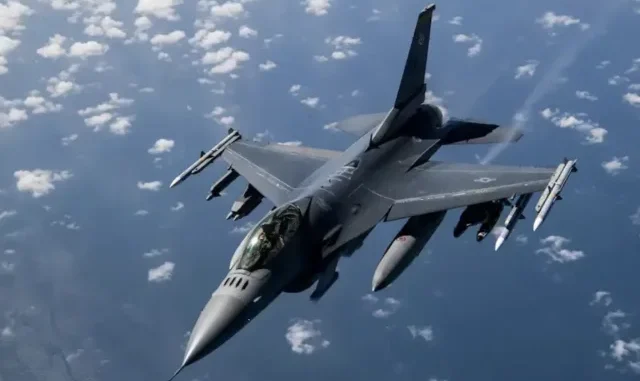 Illustrative – F-16 Falcon (Photo: US Air Force)
The United States and Iran traded airstrikes on Tuesday evening, after President Donald Trump ordered retaliatory attacks on Iran in response to the downing of a U.S. helicopter over the Persian Gulf.
After U.S. Central Command (CENTCOM) announced that its forces conducted “self-defense strikes” against Iranian targets, the Islamic Revolutionary Guard Corps (IRGC) in turn responded with attacks on a U.S. base in Jordan and 21 other targets across the Gulf region.
“U.S. Central Command forces completed self-defense strikes against Iran, June 9, at the Commander in Chief’s direction in response to yesterday’s downing of a U.S. Army Apache helicopter,” CENTCOM said in a statement.
The military command said its forces “struck Iranian air defense, ground control stations, and surveillance radar sites near the Strait of Hormuz with precision munitions,” describing the action as “a proportional response to recent attacks on U.S. forces and international commercial ships transiting regional waters.”
Shortly afterwards, the IRGC announced it would launch retaliatory attacks on U.S. targets.
U.S. Central Command (CENTCOM) forces began launching self-defense strikes against Iran at 5 p.m. ET today at the Commander in Chief’s direction, in response to yesterday’s downing of a U.S. Army Apache helicopter. The mission is a proportional response to unjustified Iranian…
— U.S. Central Command (@CENTCOM) June 9, 2026
“The warmongering U.S. regime attacked several points in Jask, Sirik and Qeshm early this morning under false pretexts, damaging a telecommunications mast in Sirik and destroying two water tanks in the city,” the IRGC said in a statement released to Iranian media.
The Kuwaiti military confirmed that its air defense systems engaged “hostile aerial targets” shortly after the IRGC said it targeted its Ali Al Salem base with attack drones.
Around the same time, air raid sirens sounded over Bahrain, with several reports of ballistic missile interceptions and at least one impact reported on social media. Those reports came shortly after the IRGC said it targeted four sites, including the U.S. al-Azraq base, using ballistic missiles.
Jordanian armed forces later reported the interception of five Iranian ballistic missiles launched toward the al-Azraq area in Jordan.
The exchange of fire marked the most intense round of hostilities between the U.S. and Iran since the start of the ceasefire in mid-April.
Iranian Foreign Minister Abbas Araghchi said U.S. forces should “leave our region if you want to be safe,” in a post on social media.
In another post, Araghchi said that Iran prefers diplomacy, but is ready to use force.
“Iran prefers the language of diplomacy,” Araghchi wrote on ?. “However, as our Brave Warriors have shown to the world, we know how to speak other languages too.”
The hostilities began early on Tuesday morning, when a U.S. Apache attack helicopter was downed by an Iranian attack drone, an anonymous official told Reuters.
NEW: Here's a look at the massive U.S. military presence now spread across the Middle East.
According to U.S. Navy officials, nearly 20,000 American sailors and Marines are currently at sea aboard two aircraft carriers — USS Abraham Lincoln and USS George H.W. Bush — along with… pic.twitter.com/et59Lq8i2v
— Fox News (@FoxNews) June 9, 2026
The two helicopter pilots were later rescued by a naval autonomous surface vessel.
Iranian state media denied that any offensive military operation had been carried out in the Persian Gulf.
Earlier on Tuesday, President Trump posted on Truth Social that “the United States must, of necessity, respond to this attack.”
“I have just been informed by our Great Military that last night the Iranians shot down one of our highly sophisticated Apache Helicopters while patrolling over the Strait of Hormuz,” Trump wrote. “There were two pilots involved, both are safe and uninjured.”
In a conversation with ABC News Chief Washington Correspondent Jonathan Karl, Trump said, “I think it’s very important to respond. They shot down a helicopter, and we are responding as we speak.”
“This is a response to what they did they did with our helicopter last night, and I believe the response should be very strong, very powerful, and that’s what this one is.”
Despite the exchange of fire, the U.S. President also stated that the strikes should not interfere with ongoing negotiations between the two nations.
Vice President JD Vance repeated Trump’s claim that a deal with Iran and the U.S. is “very close,” while also admitting that negotiations could still take months.
“Look, I think that the deal could happen in the next week, but the deal could also happen months from now,” Vance said in an interview with CBS News.
He also reiterated that the deal is focusing solely on Iran’s nuclear program.
“Right now, I feel that we are in a position to get a deal that is good for the United States economically and that really does deal with the Iranian nuclear program, not just now, not just while Donald Trump is president, but for the long term, to where my kids can say when they’re adults, ‘Iran is not going to have a nuclear weapon,’” Vance said.
“That’s the goal of the policy. And I think we’re very close to achieving that goal. But we still got some wood to chop. We’re going to keep doing it.”


Leave a Reply
You must be logged in to post a comment.