
Peloni: This is an important report. The single factor which keeps the Iranian regime in place is the lack of an armed/trained ground force in the region, ie boots on the ground to support the gains of the US-Israeli air campaign. It is interesting that while reports of the Kurds fulfilling this role have been quashed by Washington against its own interests, the Iranians continue to target and bombard the Kurds with impunity and nearly a thousand attacks on the Kurds have taken place over the past three and a half months. So, in accordance with what Yossi Baum’s sources are telling him, might Iran know something is possibly afoot in Erbil which will ultimately threaten the survival of the IRGC’s control over Iran? To be certain, the foretold outcome here makes a great deal more sense as per American interests and it would reshape the region in a profoundly significant way in America’s favor, but in Israel’s favor as well. With Iran coming to be allied with America and Israel, it would marginalize the dominance of both Turkey and Saudi Arabia in the region, all at once, but it would also create the stability necessary in the region to see the
Yossi Baum | X | June 10, 2026
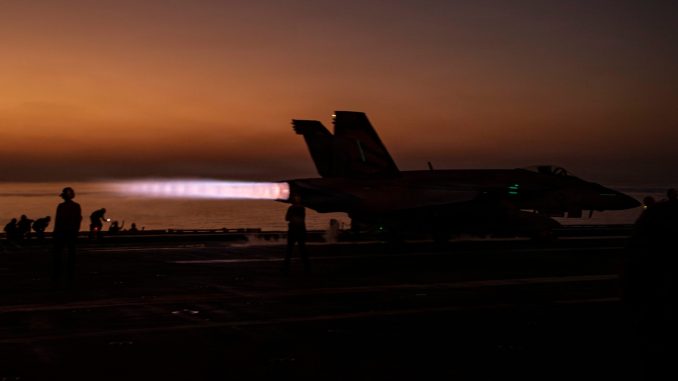 An F/A-18E Super Hornet, attached to Strike Fighter Squadron (VFA) 151, launches from the flight deck of Nimitz-class aircraft carrier USS Abraham Lincoln (CVN 72) in the Arabian Sea, Feb. 15, 2026. (U.S. Navy photo by Mass Communication Specialist 2nd Class Nathaly Cruz) Media.defense.gov
The attacks in Iran – where is this heading:
- Iran is not rushing to attack Israel; it did not attack last night either. Although it is not clear how long Iran will be able to overcome the urge to attack Israel, it is clear that it fears doing so, and it is forced to direct its anger only toward the Gulf states, and at most Jordan.
- It knows very well that Israel is eager for battle, and unlike the limited and clearly defined American strikes, Israel is prepared to strike across the entire theater. And it does not want to give Israel the pretext that would also compel Trump to allow us to strike inside Iran.
- Why didn’t the U.S. attack last night the targets it is attacking today?
As Defense Secretary Hegseth said, these strikes are intended to spur Iran toward negotiations. To spur Iran means bringing it to agree to give up the enriched uranium in its possession. Yesterday, the U.S. carried out a “knock on the roof” (a warning strike). Every day that passes without progress in the negotiations, the U.S. can raise the intensity. - The timing of the strikes—after the helicopter was shot down—allows the U.S. to act legally without needing congressional approval, and by implication, to let the snowball keep rolling while nevertheless remaining for a long time in a situation where it can legally strike, since all of these actions are defined as defensive strikes.
- Even so, Trump does not want, at this stage, to return to war. At least not until the end of the World Cup in July. The dragging out of time, which is being called “negotiations for an agreement,” is intended precisely for this purpose.
- Moreover: information I am receiving indicates that the Oval Office is well aware of Netanyahu’s need to deliver a crushing blow to Iran before the elections, and is expected to cooperate with this as we move further away from July and closer to October. Trump will not easily abandon his greatest ally.
- From here, there are essentially two possibilities: first, if Iran compromises on the uranium issue; second, if it does not.
If Iran compromises, the uranium issue will be dealt with immediately according to whatever framework is agreed upon. But alongside that, the Kurds will bring Iran into a state of chaos. Anyone who thinks the Kurdish plan has been taken off the table is not up to date. In this way, Trump will gain control over Iran without a direct war—something that runs contrary to his desire for the image of a “peacemaker,” including a Nobel Prize.
If Iran does not compromise, it is possible that the U.S. will return to a full-scale war, if it is not convinced that a Kurdish uprising will solve the uranium problem.
The first option is Trump’s preferred one, and that is why he still prefers an agreement with Iran, which on the one hand means solving the uranium problem, and on the other hand allows continued destabilization inside Iran “under the table,” through the Kurds, until the regime is overthrown.
It should be emphasized that according to the information I am receiving (from sources that have proven themselves countless times), the U.S. does not intend to wait until after the midterm elections before acting to bring down the regime in Iran. The implication is that the processes being discussed, or at least some of them, will take place, as stated, even before the elections in Israel.
- One cannot help but recall that only two years ago, a war with Iran was the nightmare scenario of Israel’s residents. Since then, we have reached a situation where American strikes in Iran without Israeli participation provoke a yawn. But hey, this is not a total victory, of course not, and the change in the situation has absolutely nothing to do with Netanyahu.


Leave a Reply
You must be logged in to post a comment.