
Peloni: Netanyahu describes a radical shift in his political strategy going forward, from leading a Right wing govt to heading a broad national govt. The question remains, however, if there is any more appetite today for a broad national govt in support of Netanyahu today than there has been over the past many years. The political freedom of such a possibility would be vital to his political future, but the question remains how Bibi will gain support from any of the anti-Bibi factions.
Full Engish text for the Q&A is provided below. Topics discussed:
- IDF operational rules of engagement in Lebanon
- Strikes on Hamas and Gaza war outcomes
- Israel’s strategy against Hezbollah in Lebanon
- Security zone concept in Lebanon and border defense
- Iran as a central strategic threat
- Civil-war tensions, Israeli internal division and call for unity
- Proposed broad national unity government
- Haredi conscription and religious study exemptions
- Israel’s diplomatic relations and regional agreements
- Response to political criticism and characterization of opposition figures (Eisenkot and others)
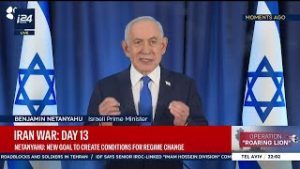 Englsih Dubbed Video Loads at Bottom [only the first portion of Q&A included in video]
Translation of the Q & A session:
Reporter (i24 News – Nad Elimelech):
Good evening, Mr. Prime Minister.
What operational freedom does Israel have, and will that freedom be maintained in the face of Hezbollah’s violations? And if Israel responds in such a way, would that endanger the continuation of the agreement from the Americans’ perspective?
And with your permission, sir, a political question as well. As we approach this coming week, in order to gain another three weeks before the Knesset is dissolved, do you intend to pass legislation that will resolve the crisis with the ultra-Orthodox parties—a Basic Law on Torah study? Just this week we saw how divided Israeli society is on this issue, in light of the national mission that you yourself spoke about just now and illustrated here with the map of IDF soldiers and the manpower shortage.
Prime Minister Netanyahu:
Our operational freedom is to eliminate every threat that endangers IDF soldiers. That is a clear directive.
I have said it, and I have repeated it: if you see a danger, act. It is not only your right to act—it is your duty to act against an immediate threat.
When the question came up as to whether this directive existed or not, I convened the Minister of Defense and the Chief of Staff and said: let’s issue another clarification and emphasize it once again.
You, the soldiers of the IDF, are to act against any threat to your lives and to your security.
As I said, over the past two weeks, under these directives, we have eliminated 200 terrorists.
And I can tell you that it is not always an immediate threat—for example, one that is physically close to you.
Take yesterday as an example. There was a threat at a much greater distance from our soldiers—not at immediate range—but they observed seven terrorists entering a house. They had not yet fired on our forces, and they had not yet organized themselves, but that house was destroyed, and those seven terrorists were eliminated.
In other words, our directive is to act against threats.
And I remind you that we are doing something else as well. As I have said, we are constantly destroying the terrorist infrastructure inside the area: the bunkers, the tunnels, and the positions above ground and below ground, because they too can endanger our forces.
Now, regarding your second question—
(clears throat)
I think there are forces among us that want to bring us closer to internal conflict. They want to intensify and deepen misunderstandings, disagreements, and the divisions among us.
I think that is a terrible mistake.
We must make every effort to solve our internal problems through understanding and broad agreement, because we have enemies outside, and they are certainly waiting for us to begin a civil war.
And I say, as Menachem Begin said: “No more civil war. There will not be one here.”
To achieve that, I intend to establish a broad national government—not a narrow government, not a left-wing government that depends on Arab parties, but a broad national government.
Because only in that way, I believe, can we reach agreements among ourselves.
What does that mean?
First of all, enough with the boycotts.
I am not boycotting anyone. I say that everyone can join. They simply need to agree to our basic principles:
-
- that Israel is the nation-state of the Jewish people;
- that we respect individual rights;
- that we have a free economy and technological strength;
- that we have the ability to defend ourselves.
And I want independence—not only the energy independence that we have achieved, and not only economic independence. I also want security independence through our own defense industries—to reduce our dependence on others.
I also want agreement on the issue of military conscription and on the judicial issue. There, too, we should try to reach broad agreements and change direction.
I believe this is possible, and I intend to do it.
Reporter (follow-up):
But aren’t you undermining that goal when ultra-Orthodox yeshivot are telling me—
Prime Minister Netanyahu:
They are sending people to me and saying, “Mr. Prime Minister, when you send people into the yeshivot and remove Torah students and take them to prison, no one will enlist.”
We have received a tremendous wave of responses from the ultra-Orthodox public. Young Haredi men want to enlist.
But when arrests are carried out inside places of Torah study, it produces the opposite result.
Not only that.
If I were to tell you that, in some European country, police were entering yeshivot, taking young men who were studying Torah, and putting them in prison—you would be shocked.
Now, from my perspective, anyone who is not studying Torah—that is where the special arrangement should apply, and there should also be sanctions there.
But anyone who is not studying Torah—then the full weight of the law can be applied to him, including arrest. That is clear.
Here, I would create a certain pause in order to reach those broad agreements.
That is what I am seeking.
And I say again: this will be my policy—to establish a broad national government and to try to reach broad understandings on all these issues.
Because we still have much to do.
After we have removed the Iranian existential threat, a broad national government can bring peace among ourselves, deal with what remains of the Iranian axis, and reap the fruits of our victory through diplomatic agreements like the one we are making with Lebanon.
And there are several more on the way.
This simply enables us to do what I promised to do on the second day of the war:
To change the face of the Middle East.
That is exactly what we are doing.
Reporter (Channel 14 – Sharya Harush):
Good evening, Mr. Prime Minister.
I would like to ask: how will you act in response to Hezbollah violations that attempt to breach this agreement and cause it to collapse?
And what guarantees have you received from both the Lebanese government and the United States that they will truly succeed in removing Hezbollah from the area?
Prime Minister Netanyahu:
Well, we already have a record.
We strike them very hard.
The moment they violate the agreement, the moment they attempt to violate it or fire at our forces, we respond with great force.
That is the greatest guarantee—our own confidence in our forces and in their actions.
That is what we are doing.
The Lebanese government still has a long way to go. It still has much to do.
This is not a simple matter.
But they have already done something significant.
The very signing of this agreement was a very courageous step because, for the first time in decades, they are essentially saying to Hezbollah—and they are saying to Iran:
“Leave here.”
“We are making peace with Israel.”
“Whether you like it or not, we want peace with the State of Israel.”
And I want to tell you that we have heard support for this among Lebanon’s Christian public, among the Druze public, among the Muslim public—even within the Shiite community.
That is a fundamental change.
And that change has come because we changed the balance of power.
Hezbollah is no longer the same Hezbollah.
Iran is no longer the same Iran.
And therefore there is now an opportunity for something entirely new to emerge.
Of course, we will judge this in practical terms.
We will evaluate the capability of the Lebanese government, and specifically the Lebanese Army, which itself needs reforms.
There are also jihadists within that army.
The Lebanese government recognizes this.
It knows it must deal with that as well.
Naturally, we will assess all of this.
But as for our own capability—you asked about that—we will respond to every attack against us, against our soldiers, against our civilians, and against our communities.
I think everyone today understands how serious we are about this.
And we will do it while operating from the existing security zone.
Reporter (Tamar Eichner):
Mr. Prime Minister, Gadi Eisenkot said in an interview with Yedioth Ahronoth that Lebanon is a political graveyard for prime ministers and that you are sinking deeper into it.
What is your response?
And another question regarding Turkey:
Tomorrow the government is expected to discuss recognizing the Armenian Genocide.
Until now, you have blocked it.
Will you allow it to pass this time?
And are you concerned about an extreme Turkish response?
Prime Minister Netanyahu:
I did not block it.
And I certainly support it.
That answers your second question.
As for your first question…
I remember one thing.
I remember what Gadi Eisenkot said—and what others said—when we were still in Gaza.
They said:
Stop.
Even while we were still there, they said not to enter Rafah, not to take control of the Philadelphi Corridor.
They said we should simply make an agreement, bring the hostages home, and then leave Gaza—leave the entire area.
And then, after two or three years, we could come back to it.
That would have meant that Deif, Haniyeh, Sinwar, and everyone else in Gaza would still have been alive and still in control.
It would also have meant that we would never have entered Lebanon.
We would not have carried out the pager operation.
We would not have eliminated Nasrallah.
We would not have destroyed 90 percent of the missile arsenal.
We would have left all of Radwan Force’s terror tunnels right here along the border.
Nor would we have taken Bint Jbeil.
Nor the Beaufort.
We would have done none of it.
So, according to the approach reflected by Gadi Eisenkot and those with him, they essentially wanted us to settle for nothing. Zero. Absolutely zero.
Today, we control close to 70 percent of the Gaza Strip. On the ground, we are crushing Hamas.
And we are present in this strong security zone in Lebanon.
Then they come and tell us that Lebanon is a political graveyard.
In other words, he would have done nothing in order to preserve his political future—so that it would not become a political graveyard. He would not have entered Lebanon. He would not have entered Rafah. Later, he would not have entered Syria, nor would he have acted in Iran. He would not have done any of the things we are doing because, according to that logic, it would be a political graveyard.
So you know what I say?
Who cares?
I do what is necessary—whether it is called a graveyard or not a graveyard.
I do what is necessary for the security and victory of the State of Israel, to push back this terrible Iranian terror axis that seeks to destroy us.
If it is necessary to enter Lebanon, we enter Lebanon.
If it is necessary to act there with great force, then we do so.
But what we are seeing is progress.
We are seeing not only security progress—although there is still more to do.
We are also seeing diplomatic progress.
Anyone who does not see that can, of course, remain attached to his own views.
But I believe the right course is the one that ensures Israel’s security and the security of the north.
The alternative would have been to leave 150,000 rockets and missiles in Lebanon, to leave the Radwan Force there with its bunkers and tunnels penetrating into our territory.
And someone said that we had destroyed seven tunnels and eliminated the entire underground threat.
I heard that—I believe it was Gadi Eisenkot who said it.
“There aren’t any more. We destroyed seven tunnels.”
There are kilometers upon kilometers of tunnels there.
Today, we are destroying them.
So I am doing what I believe is right.
I am not looking at the political question at the moment.
I am looking at the national question and our national security.
We—and the heroic soldiers of the Israel Defense Forces in Lebanon—are doing the right things.
Reporter (Danny Zaken – Israel Hayom):
Good evening, Mr. Prime Minister.
The agreement that has been signed seems to conflict, at least to some extent, with the spirit of the memorandum of understanding.
That memorandum already appears to have been shaken by Iran’s attacks on tankers, ships, and Bahrain.
Was this one of Israel’s intentions or hopes?
And since you also spoke about a broad national government, which parties would you like to see in such a government—and which parties would you not want to see?
Prime Minister Netanyahu:
From the outset, we said that we were not a party to the agreement between the United States and Iran.
But that does not mean we have no interests.
We do have interests, and we will express them.
Incidentally, regarding the central issue—the nuclear issue—I intend to send a delegation to Washington to explain what Israel’s interests are.
But I am certainly standing firm on Israel’s interests here on our own border.
From the very beginning, I made it clear that we would not leave the security zone.
I think everyone understands that.
And I think the United States understands it very well too.
The fact is that Secretary of State Marco Rubio, with whom I have held several conversations, has essentially given American support to this concept of a security zone that prevents Iran and Hezbollah from attacking us.
Now, you had another question.
Please repeat it.
Reporter (Danny Zaken):
The political question.
Since you spoke about a broad national government and broad agreements—which parties would you like to see in it, and perhaps which ones would you not?
Prime Minister Netanyahu:
Everyone who accepts the principles I spoke about.
First and foremost, recognizing Israel as the nation-state of the Jewish people.
And the other principles I mentioned.
These are straightforward principles.
Anyone willing to accept them.
In my view, there is much more unity among the people than what you see in the Knesset.
Much more.
I’ll give you another principle that I intend to promote in this broad national government.
There is no place for two states between the sea and the Jordan River.
If you had asked me three years ago, before the war, the public was divided.
In my opinion, even then the majority opposed it, but a significant minority supported it.
I think that has changed.
That provides a basis for agreement.
There is also another basis for agreement.
People do not want to see a civil war.
I am certain of that.
There are those trying to inflame tensions and deepen divisions within the public.
I want to do everything possible to calm things down.
Yesterday, someone pulled out a handgun, and I believe a woman was injured.
We do not want to get there.
I am convinced that it is possible to reach understandings—understandings based on broad agreement—in many of the areas that are currently disputed, as well as in many other issues that are not truly matters of disagreement among the people.
Prime Minister Netanyahu Closing Comments
Wait, I haven’t finished yet, please.
I noted that we have major achievements—tremendous achievements—of the State of Israel, of the Israel Defense Forces, and of the people of Israel in this war.
And I hear criticism being directed at us, saying: you have not achieved everything.
I say: truly, we have achieved a great deal.
And in some places, we achieved much more than we expected.
In Gaza, we returned all the hostages, and we ensured that Gaza will no longer be a threat to Israel.
We dismantled most of Hamas’s military capability.
A few days ago, we eliminated Izz al-Din al-Haddad.
What was the response?
Zero.
Not even a single bullet. No missile.
And yes, there are still civilian capabilities they retain; there is still work to be done.
But this is a tremendous achievement.
You cannot compare where we were on October 7th to where we are today.
In Hezbollah, as I said, we destroyed 150,000 rockets and missiles.
There are still a few thousand left.
Yes, there is still something remaining—but it is not comparable to what existed before.
The same applies to the elimination of Radwan Force, and the destruction of the entire line of bunkers and tunnels along the border, and everything we have done in eliminating thousands of terrorists.
The same is true in Iran.
We said we would remove an immediate nuclear threat—and we did.
We addressed the threat of thousands of ballistic missiles—and we did.
We reduced their capabilities, cut their production capacity, and we also created conditions for the Iranian people to eventually do what I believe will happen: to overthrow this regime.
It will not happen in a single day, but there are protests in Iran even today.
These are major achievements.
So if someone comes and says that we were willing to stop at zero, and then criticizes the government for not achieving 100 percent—saying we only achieved 80 or 90 percent—that is a joke.
It is simply not serious.
I think most of the public understands that there are enormous achievements here that must be preserved, and there are still challenges that we must work on.
Therefore, I say again:
What we need to do is to combine forces, establish a broad national government, and face the remaining challenges together, while also taking advantage of the great opportunities before us.
Thank you very much.
Moderator:
Thank you very much, Mr. Prime Minister.
Thank you.


Bibi shifts to call for Broad National Govt.