
Peloni: Recall that the American experiment rose out of the ranks of those fleeing autocratic Europe and that they entered into the making of a form of govt marked by the respect for personal dignity under the guise of a constitutional framework. Indeed, Americans have always demonstrated the pluck and ingenuity of personal identity and collective perseverance which has served the world well as the means by which the edicts of liberty and dignity might walk hand in hand. The ability to succeed in such a remarkable endeavor inspired the world to follow behind the American example, making America the pinnacle example by which liberty might be measured around the world. Though corruption and mismanagement has led to serious setbacks in American leadership in recent years, the guidelines which created this remarkable nation remains intact because the guidelines were maintained and secured over generations by the American people, themselves, rather than their leaders. As Daniel Greenfield so eloquently reminds us America is a nation of rebels, and their fight is a never ending battle to maintain power in the hands of the people and to have govt serve the people rather than the other way around.
We are a nation of rebels
by
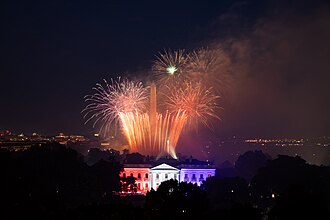 Fireworks appear above the White House North Portico lit in red-white and blue lights Saturday evening, July 4, 2020, during the Salute to America 2020, Fourth of July celebration. Photo by The White House from Washington, DC – Salute to America 2020, Public Domain, Wikipedia
With fireworks and parades, hamburgers and hot dogs, sweating bands playing Sousa marches and parades down Main Street? Will you remember the men who fell in the first war and all the following wars that were fought to preserve our political and personal independence from foreign and domestic tyrannies? Will you consider what you might have done in the days when revolution was in the air?
Those are all good things. They remind us to celebrate and what it is we are celebrating.
I sat on the warm grass beneath the shade of a spreading fig tree listening to a band run through a repertoire of everything from Yankee Doodle Dandy to Over There. An elderly disabled veteran with a flag listened intently to the orchestra and a small child clambered awkwardly up a tree as his father worriedly urged him to climb down. It could have been a scene from any century. The Fourth is timeless.
It is timeless because it is still going on. The War of Independence went on underneath that fig tree, it continues on in your town, your city and in your community on this day and on every day.
Independence Day is a commemoration, but it is not a mere commemoration. The struggle is not over.
America became America out of a hatred of powerful central government. The War of Independence was not a battle between two countries. America’s Founding Fathers started out as Englishmen who wanted to preserve their rights from a distant and out of touch government.
The War of Independence was a civil war between those who wanted a strong central government and those who wanted to govern themselves. The fundamental breach between these two worldviews led to the creation of an independent nation dedicated to the preservation of independence. This independence was not mere political independence. It was personal independence.
America as a separate nation did not yet exist. Even the Constitution that embodies its purpose was a decade, a war, a failed experiment in government and many bitter debates away.
Nations come and go. Political unions are created and dissolved. There are nations today named Egypt and Greece that have little in common with the historical entities that once bore those names. The Declaration to which those remarkable men pledged their lives, fortunes and sacred honor was not for a flag, which then still bore the Union Jack, or for the invention of yet another administrative body, but for the rights of peoples, nations and individuals to be free to exercise their personal and political rights.
The war for these things was fought, but it has not ended. It began then, but it continues today.
It is not a war against King George III. It is the ongoing struggle between the people and those who would govern them that is at the heart of our independence.
There are two visions of how men are meant to live today, just as there were in 1776. Revolutions and wars may occasionally clarify these visions, but they do not permanently resolve them. New governments are quick to adopt old tyrannies. Freedom is a popular rallying cry for rebels. But few rebels wish to be rebelled against. That is what made America unique. That is what still does.
We were not meant to be a society of sinecures for public servants. We did not come into being to be ruled by bureaucrats. Our birth of freedom was not meant to give way to the repression of a vast incomprehensible body of regulations administered by an elite political class in Washington D.C.
Americans are rebels. And if we are not rebels, then we are not Americans.
We are not a nation founded by men and women who followed the rules. It is not our capacity for obedience that makes us true Americans, but our capacity for disobedience.
The Declaration of Independence was a document of rebellion by a band of rebels. “Damned rebels” as the big government monarchists saw them. The men who signed it pledged their lives because they expected to be executed for treason. The Declaration of Independence and the Constitution were acts of rebellion against the entire order across what was then seen as the civilized world.
American greatness came about because we were willing to break the rules. It was only when we began following the rules, when as a nation we made the maintenance of the international order into our notion of the greatest good and when as individuals we accepted the endless expansion of government as a national ideal that we ceased to be great.
When we think of great Americans, from Thomas Jefferson to the Wright Brothers, from Andrew Jackson to Daniel Boone, from Theodore Roosevelt to today’s true patriots, we think of “damned rebels” who broke the rules, who did what should have been impossible and thumbed their noses at the establishments of the day. American greatness is embodied in individual initiative. That is why the Declaration of Independence places at the center of its striving, Life, Liberty and the Pursuit of Happiness.
It was for these individualistic ends of freedom that government had to be derived from the consent of the governed, that a war was fought that changed the world and it is these ends that we must celebrate.
Rebellion does not always mean muskets and cannon. Long before the War of Independence, we had become a nation of rebels who explored the wild realms of forests and streams, who forged cities out of savage lands, who argued philosophy and sought a higher purpose for their strivings, who refused to bow to their betters out of an accident of birth. And at our best, we are still rebels today.
When we dissent from the system, we rebel. When we refuse to conform, when we think differently, when we choose to live our own lives instead of living according to the dictates of our political rulers and pop culture arbiters, then we are celebrating the spirit of freedom that animates the Fourth.
When we defy the government, when we speak out against Obama and the rest of our privileged ruling class, when we demand the right to govern ourselves, when we fight to hold government accountable, when we question what we are told and the need to be told anything at all, then we are keeping that old spirit of rebellion alive. We are still fighting for our independence from government every day and every year that we choose to live as free people. That is the glorious burden of freedom.
Freedom is not handed to us. It is not secured for us by politicians. Like the Founding Fathers, we are made free by our fight for freedom. Preserving their legacy cannot be meaningfully recreated through any means other than the committed struggle for the same ideals.
This Fourth of July, celebrate by continuing to be a rebel, question and challenge the left’s worship of government. And don’t stop on the Fifth or in July. Or in any year or any decade or any century.
We here at the David Horowitz Freedom Center and at Front Page Magazine don’t.
Our family of writers, activists and commentators, and that includes you, inspired by David’s courageous spirit continue to question authority, challenge government and fight for the independence of the individual against the tyrannies of the radical left and Islamic theocracy, every day, week and month of the year.
And we welcome you to our revolution.


https://www.pbs.org/newshour/nation/rare-copy-of-declaration-of-independence-found-by-uk-national-archives-in-papers-of-captured-u-s-privateer-ship