
Peloni: When we look on as Iran persists in its need to seize the Strait of Hormuz as its own, we must question what is really taking place here? What is the real reason that Iran is attempting to overturn the norms of the High Seas in what is likely to be a no win scenario for them. Of course, it is reasonable to suggest that the Iranians are set upon a path of complete insanity so as to achieve its ideological achievement of calling forth the long sought rising of the Mahdi, but this conclusion is rendered illogical, as such a rationale would have precluded the crazy Iranians from being present at the negotiating table at all. So, no, it is not their ideology which brought them to open a new revenue stream using open piracy. Instead, the fixed resolve to keep the Strait as their own personal piggy bank cries out to the world that the economically isolated Iranian Islamic Republic is short of the most basic commodity of revenue. No matter how the negotiations go, Iran is signaling that it NEEDS stronger revenue streams than their special blend of oil might afford them in the post war period. Why might that be? While Iran was fighting a war with America and Israel, China sought out an alternate source of energy which they ironically found in the US, and they bought a good bit of it in anticipation of Iran doing something stupid. The consequence of this is that China is not in a great hurry to buy massive amounts from Iran, whose energy is now full priced rather than being priced quite low when it faced US sanctions. Unfortunately for Iran, its old buyer, China, and its potential new buyers in Asia, are both waiting to see what comes from the current negotiations, but even if Iran wins back its old buyer and new buyers in the post-negotiation period, assuming that war is avoided (unlikely IMO), Iran will be competing on the open market for any sales it does receive, and recalling that very few refineries can handle the crude oil sailing out of Kharg Island, the best case scenarios do not provide Iran with as strong a revenue stream as they might anticipate needing to maintain their ranks and to return Iran to its former state of, well, what it was before the war. Meanwhile the malcontents within the Iranian public are still malcontented, making Iran’s need of stabilizing its long decrepit economy all the more important. So Iran needs a new revenue stream beyond the sale of its energy products, which is why it is obsessed with nationalizing the international causeway of the Strait of Hormuz as its solution to financing its way back towards stability.
Iranian officials threaten US, western nations over military presence in Hormuz
| Published: July 5, 2026
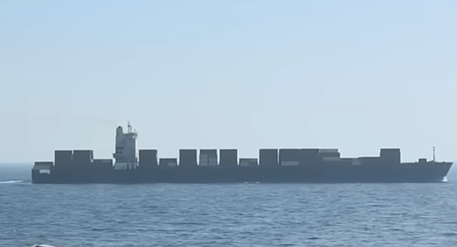 Tanker being guided thru Strait of Hormuz. Screengrab via Youtube
Iran’s ambassador to China reaffirmed that his country plans to charge transit fees for vessels traversing the Strait of Hormuz after the end of the 60-day period defined by the Memorandum of Understanding.
The Iranian ambassador also said that “friendly” nations could receive “special treatment,” without specifying what that would entail.
Speaking at the World Peace Forum in Beijing, Iranian Ambassador Abdolreza Rahmani Fazli said his country is working with Oman on new arrangements for the strait, but affirmed it would charge “service fees” for use of the waterway.
“As a country where the Hormuz is part of its territorial waters, we will definitely charge service fees,” Ambassador Fazli said in translated remarks, while denying that such fees would be a “toll.”
Fazli said the proposed fees would cover services related to securing safe passage, monitoring ship movements, and addressing the environmental impact from the heavy maritime traffic.
Fazli also indicated that Iran could give favorable treatment to nations it considers supportive.
“We will definitely consider special treatment for the countries that were friendly to us and stood by us during the hard times,” he said.
He also said that China would likely receive such special treatment, saying, “We will definitely have special considerations for China, because China is a friendly country.”
Under the 60-day period of the Memorandum of Understanding, commercial ships are to be allowed to transit the strait without payment of any fees. The U.S. has insisted that the final agreement between the two nations will not allow Iran to charge any transit fees for use of the strait, calling it an international waterway.
The announcement of fee imposition comes after sharp statements from Iranian Deputy Foreign Minister Kazem Gharibabadi, who rejected the involvement of foreign military powers in the strait.
“The Strait of Hormuz is not a theater for the military display of extra-regional powers, Gharibabadi wrote on ?. “Iran, as the responsible power and guarantor of the Strait’s security, warns with sensitivity to any military movement in this waterway.”
“The security of Hormuz lies with the coastal states; the crisis-makers will be held accountable for the consequences of their adventurism; this is a serious warning,” Gharibabadi continued.
The statement came after a joint declaration by outgoing British Prime Minister Keir Starmer and French President Emmanuel Macron, saying the two had reached an agreement with Oman “to ensure that its sovereign territorial waters are safe for navigation.”
Calling Hormuz “a vital artery for the global economy,” the statement said the two nations “stand ready to deploy the wider Multinational Military Mission to support freedom of navigation in the Strait of Hormuz.”
At the same time, Macron wrote on X that France had deployed minesweeping equipment to the Middle East, including two minesweeping ships.
The French force is accompanied by two warships and a maritime reconnaissance plane, Macron wrote, saying the forces “are ready to contribute, alongside our partners, to the full resumption of navigation and to ensure the safety of traffic in the Strait of Hormuz.”
Two days earlier, Gharibabadi said that “Hormuz is defined under Iran’s command, not CENTCOM,” in response to a regional defense meeting conducted by U.S. Central Command in Bahrain, along with 12 other regional nations.
“The region’s security will be ensured through the end of interventions and the U.S. withdrawal from the area, respect for countries’ sovereignty, and acceptance of new geopolitical realities—not under the military umbrella of America,” Gharibabadi said.
Meanwhile, over the weekend, Iranian Parliament Speaker Mohammad Bagher Ghalibaf said his country has reached an agreement with the Gulf state of Oman to regulate traffic in the strait.
Ghalibaf also claimed that Israel is “seeking to disrupt” the U.S.-Iran MoU.
“The Israelis are undoubtedly seeking to disrupt the Iran-U.S. Memorandum of Understanding,” Ghalibaf said, “but the deterrent power of the Islamic Republic of Iran in the region will prevent them from starting a war again.”
Negotiations between the U.S. and Iran have been stalled for several days. Last week, U.S. envoys went to Qatar, after President Donald Trump claimed that Iran begged for a meeting, which Iranian officials denied.
The U.S. envoys met with Qatari mediators, but did not engage with Iranian negotiators.
In remarks at a 4th of July celebration at Mount Rushmore, in Keystone, South Dakota, Trump claimed that Iran is “dying to settle,” but claimed he “gave them a week off for a funeral,” referring to the funeral for former Supreme Leader Ali Khamenei, who was killed by Israeli strikes at the outset of the fighting on Feb. 28.


@peloni, I quite agree with your summary. However, if the Iranians insist on spoiling things in the Straits of Hormuz and maybe even in the Bab al Mandeb, the countries of the Arabian Peninsula are the most affected since they can’t sell anything. I would expect them, now that the USA is out of the way and Israel is currently not defending itself from Iranian missiles, to get involved with the IRGC and put them in their place. It is far past time for them to do so. Actually, their behavior is like NATO partners that wait for the USA to do the heavy lifting before demanding their seat at the table. They have spent so much on US equipment that they should have no trouble following the US and Israeli examples. Those that refused fly-over permission can fly themselves. The Qataris can mediate…
@dreuveni
Nice comparison of the Gulf states to NATO. Unfortunately , I don’t expect much out of either of them. But we will see.