
Update: Im Tirtu: Officials in the Hashemite Kingdom of Jordan are being forced to consider the restoration of full diplomatic relations with Israel (which were downgraded by Jordan after October 7) following the expiration of Israel’s 2021 agreement to double its 50 million cubic meter annual water commitments to the Hashemite Kingdom, according to a Kan News report.
Israel still supplies the initial 50 million annual cubic meters of water to Jordan mandated in their 1994 peace agreement, with Energy Minister Eli Cohen holding steadfast against renewing the 2021 doubling of water provisions until full diplomatic relations are restored.
All Israel News Staff | Published: July 7, 2026
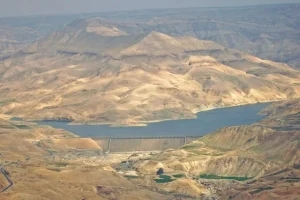 Mujib Dam and reservoir at the head of Wadi Mujib, Jordan. (Photo: Daniel Case/Wikimedia Commons)
Israel and Jordan are at odds over a longstanding water-sharing agreement, with Jerusalem signaling it intends to reduce water exports to its eastern neighbor unless diplomatic relations improve – a dispute that is testing one of Israel’s most important regional partnerships.
The disagreement centers on a 2021 agreement under which Israel doubled the amount of water it supplies Jordan from 50 million to 100 million cubic meters annually.
Israeli officials now say they intend to return to the original allocation, while Jordan is pressing Israel to maintain the larger supply and linking any improvement in bilateral ties to restoring the agreement.
The dispute comes despite decades of strategic cooperation between the two countries. Israel and Jordan maintained quiet contacts even before Israel’s establishment in 1948 and formalized their relationship with a US-brokered peace treaty in 1994, which included Israel’s commitment to supply Jordan with 50 million cubic meters of fresh water each year.
Israeli officials argue that extensions of the 2021 agreement were conditioned on Jordan taking steps to curb anti-Israel rhetoric and restore full diplomatic engagement with Jerusalem, which has been scaled back since the outbreak of the Swords of Iron war.
Jordan’s King Abdullah has reportedly made clear that any improvement in relations – including a public meeting with Prime Minister Benjamin Netanyahu – depends on Israel continuing to provide the full 100 million cubic meters annually.
According to Ynet, Jordan earned goodwill in Israel by participating in allied efforts to intercept Iranian drones launched toward Israel during recent rounds of conflict.
Energy Minister Eli Cohen took that cooperation, along with pressure from the United States, into account when he approved six-month extensions of the expanded water agreement through the end of 2025.
At the same time, Jordanian Foreign Minister Ayman Safadi has been one of Israel’s most outspoken regional critics, prompting some Israeli officials to argue that Jerusalem should take a firmer stance.
The issue could become a focal point at a possible regional summit later this year hosted by the United Arab Emirates. Israeli officials have signaled interest in attending and suggested that water cooperation with Jordan could feature prominently in any discussions.
“Jordan needs the water, but when you help your neighbors, you expect warmer relations, one Israeli official told Ynet. “If there is a meeting, everything will be on the table – normalization, water, and strengthening bilateral ties.”
Domestic concerns are also shaping Israel’s position. Many Israelis were alarmed after officials announced that precipitation levels at the end of 2025 were the lowest recorded in a century.
Although Israel supplements its natural water supply through desalination, some policymakers argue that current conditions make it increasingly difficult to justify exporting additional water.
At the same time, Israeli officials continue to discuss longer-term solutions that could benefit both countries.
One proposal would involve constructing an additional desalination plant on the Red Sea to supply water to Israel and Jordan, while another envisions a large solar energy project in the Jordanian desert to provide electricity to both countries.
Both initiatives are expected to rely on financing from the United Arab Emirates, with diplomatic backing from the United States.


“Please verify: “decades of strategic cooperation between the two countries. Israel and Jordan maintained quiet contacts even before Israel’s establishment in 1948 “
But seriously, I have trouble imagining how that might have worked, especially during Jordan’s British-led war of annihilation and subsequent ethnic cleansing of the Jews of Yesha.
@Sebastien
Trans Jordan’s illegal seizure of what was clearly cis Jordan lands left it isolated diplomatically. NO ONE recognized their illegal seizure of the land, and their theft of that land led to them having to actually re-title the name of their own country from the Hashemite Kingdom of Trans Jordan to the Hashemite Kingdom of Jordan while also retitling the name of their conquest from Judea and Samaria to the West Bank, which was a wholely manufactured term that was never used to describe that territory previous to the Abdullah’s great betrayal. This ruse was meant to give him some propaganda support in describing his ill gotten gains, but, again, no one in the entire world was fooled.
So old Abdullah was looking for a way to do the right thing, something which he wanted to do in 1948, but due to the fact that he was caught between the Grand Mufti and the British, was convinced that he had no ability to do. Recall that he had entered into a bargain going back to the formation of the Emirate of Jordan, which called for his recognition of the Jewish state. There were diplomatic and economic purposes which supported him doing so.
He changed his mind of course, and was involved in secret talks with the fledgling state of Israel to actually come out of the cold and repair the damage he had done in the years following the 1948 war. These talks are why the Islamists killed him, symbolically shooting him on the steps of the Al Aqsa Mosque on July 20, 1951, exactly 2 years to the day after the end of Israel’s war of independence which ended on July 20, 1949.
The British were dealing with shifts in pre 1948 policies and post 1949 policies while Abdullah was hoping to gain access to the Mediterranean Sea. But it all came to nothing with the death of Abdullah, which was the primary motivation which originally led to Abdullah going to war in 1948 with the Jewish State. One of the the curious ironies of history.