
G_d Forbid!

Peloni: Leon Kushner provides an important context to the discussion on US VP Vance.  This was posted as a response to a recent interview with Ambassador Yoram Ettinger on this subject but it provides too good a reflection of Vance to not earn its own post.

Leon Kushner
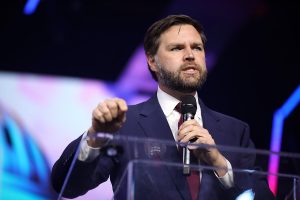
By Gage Skidmore from Surprise, AZ, United States of America - J. D. Vance, CC BY-SA 2.0, https://commons.wikimedia.org/w/index.php?curid=149633353Photo by Gage Skidmore from Surprise, AZ, United States of America – J. D. Vance, CC BY-SA 2.0, Wikipedia 

I have much respect for ambassador Ettinger. I love how he always tries to explain how the US benefits from the ‘aid’ it sends to Israel. I totally agree of course.

But on his interpretation of Vance vis a vis Israel and Jews – I disagree, though not entirely. He’s right about Vance’s lack of foreign policy knowledge and worse, his ignorance regarding the Muslim mind set. If in fact he is taking his cues from the old State Department’s anti-Israel foreign policy, then we are in trouble.

But how does Ettinger explain Vance’s comments some months ago at a Turning Point USA event when a young Tucker Carlson fan asked: Why are we supporting Israel anyways? His nonsensical response was telling. He went into an unhinged diatribe about how Jews and Christians differ, sighting how one group believes in Jesus and the other does not. Have you noticed that he never uses the term Judeo-Christian values but instead only uses the term Christian values. He took a page directly from Obama’s presidency. Divide the public. Obama was a master deceiver at this. He did it with Blacks vs Whites, Jews vs Christians, rich vs poor, etc.

Most important, we all know that it was thanks to his ‘good friend’ Tucker who got him the job as VP. When asked about Tucker’s obscene Jew/Israel hatred he replied that although they might disagree on certain issues, Tucker remains a very good, close friend! That would be like saying that although I disagree with some of Hitler’s policies (like murdering 6 million Jews in the most horrific way), we share a love of German shepherd’s so we remain good friends.

The fact that he refuses to condemn his ‘friend’ for his blatant, overt antisemitism is the most disturbing issue and it has nothing to do with foreign policy or ignorance thereof.

I compare him to his friend Tucker, Kanye West, Candace Owens, Megan Kelly and others on the right who slowly but surely turned on us. We all had hopes and wishes at the beginning that they are our friends who just needed more explaining. Believe me, I held the same hopes for Vance. But as I predicted in my blog post: https://leonupsidedown.blogspot.com/2025/12/antisemitism-from-right-jd-vance.html

that unless Vance is confronted both publicly by members of the Republican party (Congress, cabinet members and citizens) and privately by his boss (Trump), his subliminal Jew hatred will become more overt and obvious.

I also want to note that I think Vance is viewed as the best contender for the Republican nomination. He is very articulate and checks all the boxes for your average conservative citizen to choose. The fact that many Republicans in Congress oppose his foreign policy is near moot.

If someone asked me what I thought about him as the next US president I would respond simply with: G-d forbid!


July 5, 2026 | 15 Comments »

Leave a Reply

15 Comments / 15 Comments

  1. Amen, so would I Leon! Joan Swirsky has writtens three articles on Vance and his antisemitism, and she’ll probably have another one out soon that is loaded. We all know about this guy and who his puppetmaster is…Peter Thiel. Thanks for writing this. I’m not fond of Rubio either despite him being the man of many jobs. Politicians change with the wind. He has stood for Israel which makes me happy, but will that change. I sure don’t like his CIA connections…

    I think we’ll be stuck with one of them. We certainly cannot have Cackles or Newscum in our White House.

    • what does peter thiel think about israel

      +3 Peter Thiel broadly supports Israel and its military actions, stating that his general bias is to defer to the country and the Israel Defense Forces (IDF) rather than second-guess their decisions.Thiel has argued that the Middle East should not be micromanaged by Western observers and believes that broad Israeli strategy is generally in the right. This stance is closely tied to his business interests; he is the co-founder of Palantir Technologies, a data-mining and AI company that signed a strategic cooperation agreement to provide services to the Israeli Defense Ministry for war-related missions. As a result of these ties, Thiel’s appearances have faced protests and pushback from pro-Palestinian groups.

      • did vance and thiel part on bad tes

        +8 No, J.D. Vance and Peter Thiel did not part on bad terms. Thiel has been one of Vance’s most significant benefactors and strongest political allies, and the two maintain an aligned relationship.Their history includes the following key ties:Career Mentorship: Thiel hired Vance at his global investment firm, Founders Fund, in 2017.Political Backing: Thiel injected millions into Vance’s initial political career. He notably donated $15 million to a super PAC supporting Vance’s 2022 Ohio Senate run.Ongoing Connection: Thiel was considered a key architect in helping Vance secure the vice-presidential ticket. Thiel publicly noted that he never dictated how Vance should act or vote.

        • so why does thiel support vance

          +1 Billionaire venture capitalist Peter Thiel has supported JD Vance because they share a strong ideological alignment, rooted in a mutual skepticism of Enlightenment optimism, the established political order, and big tech regulation. Thiel is Vance’s most prominent benefactor, having hired him at his investment firm in 2017 and later pouring $15 million into Vance’s successful 2022 Ohio Senate campaign.Thiel’s investment in Vance is driven by several key factors:Ideological Alignment: Both men are deeply critical of mainstream institutions, the modern corporate establishment, and globalization. They share aligned views on shifting away from traditional democracy toward a political philosophy that challenges Enlightenment ideals.Policy Perspectives: Vance’s political platform aligns closely with Thiel’s techno-capitalist and populist worldview, including skepticism toward U.S. foreign intervention, the federal regulatory state, and monopolies in the technology and higher education sectors.Political Influence: By backing Vance, Thiel gains a direct pipeline into the highest levels of U.S. politics. Thiel and his network view Vance as a protege capable of carrying their “New Right” vision forward, promoting conservative populism, and securing representation for Silicon Valley dissidents in Washington D.C..

          • what on earth does this mean, some kind of fascism? “shifting away from traditional democracy toward a political philosophy that challenges Enlightenment ideals.Policy Perspectives: Vance’s political platform aligns closely with Thiel’s techno-capitalist and populist worldview, including skepticism toward U.S. foreign intervention, the federal regulatory state, and monopolies in the technology and higher education sectors. “

            +10 This philosophy outlines a shift toward technocracy and authoritarianism rather than traditional fascism. It advocates replacing democratic institutions with highly efficient, centralized corporate leadership and opposes the core principles of the Enlightenment—such as egalitarianism, universal human rights, and the belief that society naturally progresses toward freedom and reason.Key Components of this PhilosophyTechno-Capitalist Worldview: Promotes the idea that society should be governed like a highly efficient tech startup. It favors rule by scientific and technological experts over democratic consensus, viewing liberal democracy as sluggish, chaotic, and overly bureaucratic.Anti-Democracy (The “Dark Enlightenment”): Explores alternatives to democratic rule. Some thinkers within this movement, such as Curtis Yarvin, advocate for replacing elected governments with a powerful executive or a “CEO” monarch who rules without the interference of courts or civil servants.Institutional Skepticism: Targets existing power structures, specifically opposing federal regulations, established universities, and government intervention, while viewing corporate monopolies as engines of innovation.How it Differs from Traditional DemocracyTraditional democracies are built on checks and balances, public representation, and the fundamental idea that all citizens possess equal rights. This ideology argues that human nature is fundamentally competitive and that societal order can only be achieved by concentrating power at the top.To explore more on the intellectual roots and specific thinkers shaping this platform, you can review coverage on the Dark Enlightenment or read analyses of Peter Thiel’s political influence on platforms like Vanity Fair and Britannica.

              • I’m reminded of:

                katharine hepburn spencer tracy fascism movie

                +1 The 1942 drama Keeper of the Flame features Katharine Hepburn and Spencer Tracy investigating homegrown American fascism. In the film, Tracy plays a reporter who uncovers that a celebrated, deceased war hero was actually a fascist sympathizer manipulating the public, while Hepburn plays the secretive widow.

  2. It doesn’t sound good at all with J.D.V. but we need to be sure that the show we are seeing is correct. We know that Trump and Netanyahu are not always pointing us at their true intents or purposes. J.D.V. is also on the cast.

  3. “Have you noticed that he never uses the term Judeo-Christian values but instead only uses the term Christian values?”
    I have, and that speaks volumes about Vance’s feelings for Jews. He is also an ignoramus about the Founding Fathers being Christians. The principal author of the Declaration of Independence was not. I have his Jefferson Bible in which he edited out of the New Testament all the miracles. For Jefferson, Jesus was a preacher of ethical humanity but not divine, not the Messiah of the Jews. Indeed, he rejected the very concept of a messiah for Christian and Jews. I personally spent several years reading the correspondence of Jefferson and contemporaries e.g. Ben Franklin, George Washington, and while they refer to the Supreme Being, the Omnipotent One, etc., you never come across words about Jesus.
    Also worth noting is Jefferson’s friend, journalist and political theorist Tom Paine, whose “Common Sense” ignited the war in 1775, after which he went to Paris to experience the French Revolution from within where he was arrested, threatened with the guillotine and while imprisoned, wrote “The Age of Reason,” a nickname he invented for the times, which was virtually a rejection of Christianity and Judaism.

  4. vance catholicism

    +4 JD Vance converted to Catholicism in 2019, taking Saint Augustine as his patron saint. Raised in a nominally Christian and Pentecostal environment, he experienced an “angry atheist” phase in college before returning to faith. He explores his spiritual journey in his book, Communion: Finding My Way Back to Faith.Vance has described Catholicism as a stabilizing worldview that helped him make sense of the structural and moral issues facing American families. His faith has directly influenced his public policy positions and often positions him as a prominent, traditionalist voice in conservative American politics. However, his political positions have occasionally sparked friction with Vatican leadership.Key Aspects of Vance’s FaithFamily: Although he is an observant Catholic, his wife, Usha Vance, is Hindu. They have decided to raise their three children as Christians.Influences: Vance credits philosophers like Saint Augustine with helping him dismantle his earlier intellectual skepticism and teaching him humility.Political Tension: Vance’s blending of his Catholic faith with his right-wing political approach has led to public disagreements with Pope Francis over issues such as immigration.Vance details the evolution of his spirituality and the influence of the Church on his life, such as in his essay for the Catholic magazine The Lamp. Read more about his conversion journey in the EWTN News feature or explore his book, Communion, at The Atlantic’s coverage.

    • what did saint augustine say about jews

      +6 Saint Augustine established the foundational Christian “doctrine of witness” regarding Jews, asserting they should be subjugated and exiled but spared from annihilation. He argued their survival and dispersion serve as providential proof of Christianity, as they preserve the Old Testament prophecies that authenticate Jesus.Augustine’s views on Jews and Judaism were defined by this theological framework, which balances severe theological supersessionism with a defense of their physical preservation:The Doctrine of Witness: Drawing on Psalm 59 (“Slay them not… scatter them”) and the story of Cain, Augustine argued that Jews must survive in exile. He posited that their continued existence, while humiliated and dispersed, acts as living proof of the truth of Christianity.”Book-Bearers”: Augustine viewed the Jewish people as “librarians” who carried the Hebrew Scriptures. He believed they were spiritually blind to their own texts, but that their continued use of these books validated the Christian claim that Jesus was the prophesied Messiah.Rejection of Forced Conversion: Unlike some other Church Fathers of his era, Augustine opposed the forced conversion or the mass slaughter of Jewish populations. He argued that their adherence to the Torah was divinely willed to preserve the authenticity of their shared sacred history.Supersessionism: While he respected the historical roots of Judaism, he firmly believed that the “Old Covenant” had been superseded by the “New Covenant.” He argued that the Jewish people lost their privileged status as God’s chosen people due to their rejection of Christ, a theme he frequently explored in works like Contra Faustum.Augustine’s dual approach—condemning Jews theologically while protecting them physically—defined official Church policy throughout the Middle Ages, shaping how Christian societies interacted with Jewish communities.