
Peloni: Don’t look for any miracles shifting the dominance of Hezbollah to the LAF simply because the US is increasing its already significant payments to Lebanon. Hezbollah’s support in the country is mirrored in its support in the Lebanese armed forces. Even as that support might be less than it was as judged solely by public statements of Lebanese influencers, including from some within the Shia-Hezbollah supporting community in Lebanon, has Hezbollah lost its own influence on the LAF? Well, I would argue that such a forlorn hope will once again be met with serious disappointment, even as the LAF is once again the recipient of massive infusions of American cash and arms. Once again, the Reaganesque adage of ‘Trust but Verify’ should be shorted to simply ‘Verify’ as the Lebanese have demonstrated as recently as January that they are untrustworthy as ever when they then laughably claimed that South Lebanon had been demilitarized. The predictability of the Lebanese failing to address their Iran problem in the form of Hezbollah will persist until such time as someone eliminates the real source of Hezbollah’s power, which is in Iran. You can not eliminate this influence by simply outspending the Iranians in Lebanon.
Until such time as Islamist control in Iran is eliminated, the buffer in Lebanon will remain a clear victory, even as it comes with Trump’s support for preventing any targeting of Hezbollah’s headquarters in Beirut which is not permitted under this current agreement, which calls to question if this was the real purpose behind both Trump’s linkage of Lebanon to Iran, and the subsequent US mediated negotiations which led to the mediating of some of the consequences of that linkage.
By
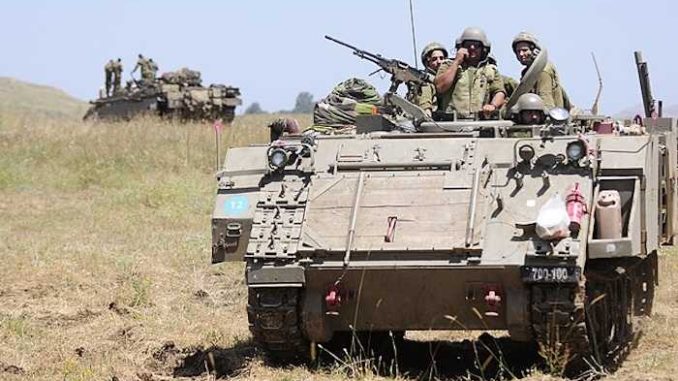 Israel Defense Forces,
Israel Defense Forces, Creative Commons Attribution-Share Alike 2.0
While Iranian negotiators appear to be running circles around Trump’s negotiators Steve Witkoff and Jared Kushner in Doha, the agreement just hammered out between Lebanon, Israel, and the U.S. is a clear win for Israel, for Lebanese patriots, and for the United States. More on this achievement can be found here: “How Beirut signed a deal legitimising Israeli military presence on Lebanese soil,” by Jonathan Spyer, The Jewish Chronicle, June 29, 2026:
The 14-point Trilateral Framework agreement signed this week by Israel, Lebanon and the United States represents a notable diplomatic achievement. This is so not because it paves the way toward full diplomatic relations or towards normalisation between Beirut and Jerusalem. It doesn’t. The formidable obstacles to this goal remain in place. Indeed, beyond the world of declarations they are hardly impacted by the agreement.
The signing of the framework is nevertheless important because it provides diplomatic and strategic breathing space for Israel to continue to act in Lebanon where necessary against the Iranian proxy Hezbollah organisation, which intends to continue its war against the Jewish state. In the wake of the recent US Memorandum of Understanding with Iran, this is no small achievement. Indeed, the very different nature of these two documents seems to be an indicator of widely differing perspectives toward both Israel and the broader Middle East at the top level of the US administration.
The Trilateral Framework calls in its second clause on the government of Lebanon to “commit to a reciprocal, sequenced process, with clear conditions, whereby the Lebanese Armed Forces (LAF) will restore effective sovereign authority over all Lebanese territory, pending the verified disarmament of non-state armed groups and dismantlement of associated infrastructure, enabling the Israel Defense Forces (IDF) to progressively redeploy out of the Lebanese territory.”
The LAF is to proceed in stages, both in disarming Hezbollah troops and in then pushing them from one part of the country to another, squeezing Hezbollah into ever smaller spaces. As the Lebanese Army does so, and only after the IDF has satisfied itself that Hezbollah has indeed been disarmed and pushed out of an area, will the IDF pull back from that area. It is not enough for the Lebanese government to claim that Hezbollah has been disarmed in a particular area; the IDF will conduct its own investigation to verify that claim. If the IDF verifies the claim, and only then, will the IDF turn over territory to the LAF.
The agreement envisages the creation of two “pilot zones” where this process will commence. No time line is set for the completion of the process whereby the LAF achieves “full military and security control within Lebanon in accordance with security arrangements, agreed upon within the framework of negotiations,” and implements “the disarmament of all non-state armed groups and exercise effective authority across Lebanon.” Similarly, no time line is set by which Israel must withdraw from the areas it has recently conquered in Lebanon. Rather, the document conditions Israeli withdrawals on the Lebanese government achieving this goal, while setting no deadline by which time it must do so.
In practice, what this means is that if the Lebanese government and armed forces fail to achieve this goal, the US commits by the framework agreement not to pressure Israel to withdraw.
This is most important. The Lebanese government will be receiving more infusions of military aid from the U.S., in order to help it disarm Hezbollah. There is no set time by which it must start to disarm Hezbollah in order to receive such aid and no set time, either, by which the IDF will withdraw from those parts of Lebanon that it currently controls. It will do so, in stages, when it — not Lebanon and not the U.S. — believes Hezbollah has been fully disarmed in a certain area.
This suits Israel’s purposes well, and this is the agreement’s bottom line. What the agreement does effectively is to deem the Israeli military presence on Lebanese soil permissible and legitimate, for as long as non-state armed groups are also present in Lebanon.
The Hezbollah leadership has grasped the implications – and bitterly opposes it. One of the organisation’s representatives in parliament, Hussein al-Haj Hassan, declared that “This is not an agreement. This is a surrender. We do not recognise the agreement. It will not be implemented.”
The Americans are prepared to provide both financing and, especially, weapons to the LAF, so that it can take on Hezbollah and win. Until now, Hezbollah has both outfunded and outgunned Beirut. That will no longer be the case. Both President Joseph Aoun and Prime Minister Nawaf Salam realize that before Lebanon can again be made prosperous, free from the threat of IDF attacks on its Hezbollah-linked infrastructure, and able to begin rebuilding the country, it will have to crush Hezbollah. They are determined to do so. The agreement provides it with both the license, and the means — from the Americans and others — to do so.
Israel, Lebanon,and the United States are all on the same page: they all want to see Hezbollah completely disarmed and its political echelon dismantled. The Americans have promised Lebanon both money and weapons in quantities sufficient to allow it to defeat Hezbollah. The Christian president and Sunni Muslim prime minister of Lebanon no longer share their predecessors’ fear of Hezbollah. They are well aware that the IDF has ravaged Hezbollah, losing thousands of men and 90% of its prewar arsenal of rockets and missiles. They know that the the Sunni regime in Damascus has now shut off the weapons pipeline from Iran through Syria to Lebanon. And Israel has emerged from this Framework Agreement with America’s assurance that Washington will make no further attempt to pressure it to leave the parts of Lebanon that the IDF has occupied. Israel will alone determine when to leave, based on its own judgment of whether, and where, Hezbollah can be declared “fully disarmed.”


The future of Lebanon should not be to become part of Israel, it is to be a friendly neighbor. That is something worth fighting for rather than the expansionistic declarations of other states that always bring up the libel that Israel wants to colonize everything.
Kedar weighs in
https://www.youtube.com/live/NzKYvg5TN5k?is=vYltZoEUkNsZP62l