
Reform Movement President, Rick Jacobs, speaks for radical American Ashkenazis, not the entire Jewish People. He sits on the board of the New Israel Fund and on the rabbinic cabinet of J Street, both antagonistic to the Jewish State.
Ronn Torossian | July 8, 22026
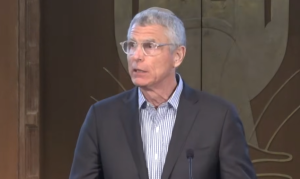 Reform Movement President, Rick Jacobs. Screengrab via Youtube.
Reform Movement President, Rick Jacobs, came to Israel this week to tell Israelis what’s wrong with Israel. The leader of the Union for Reform Judaism (URJ) warned on Ynet that Knesset legislation is pushing American Jews away, that bipartisan support for Israel is fraying, that restoring it may be “enormous, perhaps impossible.” Jacobs is right that bipartisan support is fraying, and he could have added that Reform Movement support for the Jewish state has always been ambivalent.
Jacobs has sat on the international board of the New Israel Fund (NIF) – an organization which supports a boycott of the Jewish State – since 1992. He sits on the rabbinic cabinet of J Street, an organization which in April published a policy document calling for the phase-out of U.S. direct military aid to Israel – Iron Dome funding included – beginning in 2028. This during a seven-front existential war. During which Iranian ballistic missiles hit Israeli cities when the Iron Dome failed.
Israelis across the political map don’t see eye to eye with wealthy foreign progressives. Diaspora liberal Jews pose a danger to the Jewish state – and since Israelis are unaware of his role, Jacobs doesn’t face protests when he lands at Ben Gurion.
Israel’s ambassador to Washington, Yechiel Leiter, put it plainly: “J Street is a cancer within the Jewish community. The worst thing about J Street is it’s duplicitous. How can you be pro-Israel and advocate for an arms embargo on a state that’s fighting a seven-front war against Iranian proxies?”
The Reform Movement, not necessarily its rank and file, is blatantly hostile to the Jewish state. Those who stand with the New Israel Fund and J Street stand against Israel.
What NIF funds
NIF’s operating arm in Israel, Shatil, has funded and incubated groups that participate directly in the boycott, divestment, and lawfare ecosystem against the Jewish state:
• Breaking the Silence – publishes anonymous IDF “testimonies” used by European parliaments, the UN Human Rights Council, and the International Criminal Court to build cases against Israeli soldiers.
• Adalah – sent findings from Operation Protective Edge directly to the UN commission investigating Israel, contributed to the Goldstone Report, and worked with a petition to a Spanish court against senior Israeli defense officials.
• B’Tselem, +972 Magazine, Physicians for Human Rights-Israel, Hamoked, and the Public Committee Against Torture in Israel – all funded by NIF, all central to the international lawfare campaign, several submitting “shadow reports” to the UN Committee Against Torture falsely accusing Israel of systematic abuse of Palestinian Arabs.
Opposition crosses political lines
In 2015, then-Education Minister Naftali Bennett – later Prime Minister of Israel – responded to NIF directly, after NIF-funded groups pushed to prosecute IDF soldiers over Operation Protective Edge:
“Yes, New Israel Fund, I will boycott whoever persecutes Israeli soldiers. I will not apologize for it. Members of the New Israel Fund, listen carefully: whoever harms, slanders and persecutes Israeli soldiers are not my brothers.”
Bennett served as Israel’s Prime Minister, Defense Minister, Foreign Minister, and Education Minister, and led a national-unity government that included the Israeli left.
Fifteen years of lecturing the Jewish state
The pattern is not this Israeli government. The pattern is ongoing. No Israeli prime minister – right, left, or center – has had Jacobs’s public support during his tenure. The record is on the URJ’s own website:
• 2016 – Jacobs refused to meet Israeli Tourism Minister Yariv Levin (now Israel’s Justice Minister), telling Army Radio: “There’s no reason to give him a platform.” An American Jewish leader vetoed an Israeli cabinet minister.
• 2017 – Public letter to Netanyahu opposing Israel’s law barring BDS activists from entry, accusing the government of posting “a giant sign by the door of the Jewish state saying, ‘Don’t come unless you agree with everything we’re doing.’”
That same year, the URJ publicly opposed the Trump administration’s recognition of Jerusalem as Israel’s capital.
• 2018 – Called Israel’s Nation-State Law “a sad and unnecessary day for Israeli democracy” and committed the URJ to “fight back” against a law passed by Israel’s elected parliament.
• 2019 – Sided against Netanyahu’s decision to bar vehemently ant-Israel U.S. Reps. Rashida Tlaib and Ilhan Omar. Called it “wrong, full stop” and accused Netanyahu of “sacrificing Israel’s commitment to democracy.”
• September 2023 – Jacobs stood outside Netanyahu’s New York hotel during the UN General Assembly and declared: “Netanyahu’s band of Jewish supremacists threaten to annex the West Bank.” Days later, he confronted Netanyahu on Erev Yom Kippur.
• October 2023 – With hostages still in Gaza tunnels and Hamas holding the country in shock, the URJ under Jacobs called for a “humanitarian pause” – asking Israel to slow the war before Hamas was broken. Commentary Magazine called it “the shameful pusillanimity of Rabbi Rick Jacobs.”
• January 2024 – Jacobs led nine Reform organizations in a 13-demand letter to Israel that did not call for the eradication of Hamas. Three months after October 7. Instead: demands that Israel “forcefully address settler violence” and accept Palestinian statehood.
• 2024 – Jacobs told Globes he had publicly compared Israeli ministers Bezalel Smotrich and Itamar Ben-Gvir to “appointing David Duke to be the Attorney General of the United States.” His words.
• May 2024 – In a URJ blog post titled “A Message of Support,” Jacobs compared campus anti-Israel encampments to “1960s non-violent civil rights or peace protests.”
• July 2024 – In a Times of Israel op-ed, Jacobs wrote his own version of what he wished Netanyahu would tell Congress – demanding Israel “begin the process of dismantling settlements” and endorsing the Biden administration’s sanctions on Israeli settlers.
• December 2024 – Publicly opposed any Israeli plan to resettle Gaza, calling it “horrendous and dangerous.”
• August 2025 – Jacobs published on MSNBC.com under the headline “I’m a Rabbi. Here is why my faith tells me the war in Gaza must end.” The president of the largest Jewish denomination in America, on MSNBC, actually told Israel to stop the war.
• July 2026 – The Ynet interview that prompted this piece.
A movement without Sephardim
Roughly half the Jews in Israel are Sephardim – Moroccan, Iraqi, Yemenite, Persian, Tunisian, Syrian, Egyptian, Libyan. There are barely any Sephardic Reform clergy. And this foreign Ashkenazi elite is lecturing the Jewish state. Reform is a German-Ashkenazi religious project that grew up in Cincinnati and Scarsdale, that speaks with an American accent, and that has spent 200 years building a Judaism for one branch of the Jewish family – and then called it universal.
When its president warns Jerusalem that Israel is losing “American Jewry,” what he means is Israel is losing Ashkenazi liberal and progressive Jews. Not the large Sephardi communities in the USA: Not the Persian Jews of Great Neck. Not the Syrian community of Deal. Not the Bukharian shuls of Queens. Not the Moroccan and Yemenite kehillot of Los Angeles. Not the Chabad houses full every Shabbat in the same suburbs where Reform temples are half empty. Those Jews love Israel. They are not polling against the IDF and Israel’s current government, nor are they “shocked” that the Knesset wants to protect the Kotel from disruption.
A movement failing on its own terms
Set Israel aside. Just look at the numbers. According to the Pew Research Center’s Jewish Americans in 2020 study, the intermarriage rate among non-Orthodox American Jews now runs at 72%. Among Jews married since 2010, 61% overall are intermarried – rising to 72% when Orthodox Jews are excluded. A denomination that is 80% Democrat and 18% Republican – the URJ’s own citation of Pew – is a political tribe, not representative of the Jewish community.
Anti-Zionist before it was pro-Israel
Reform’s original American platform – the Pittsburgh Platform of 1885 – explicitly rejected Jewish nationalism. “We consider ourselves no longer a nation, but a religious community.” No return to Zion. No Jewish state. That was the founding document. It took the Holocaust and the founding of Israel to bring the Reform Movement into liberal Zionism. And since then, the movement sets its own rules from the Diaspora, lecturing the democratic Jewish state.
A sovereign Jewish state decides what’s best for the Jewish people in Israel.
The real question
As Yechiel Leiter asked in Washington, and as Naftali Bennett asked NIF a decade ago: how do you call yourself pro-Israel while funding, staffing, and endorsing the groups working to disarm it, delegitimize it, and prosecute its soldiers? Jacobs is hostile to the Jewish state. He should stop lecturing Israel about who represents the Jewish people, go back to Reform concern for LGBTQ issues or saving the environment – and realize that he cannot dictate Israeli policy.


https://www.jpost.com/diaspora/antisemitism/article-904163
Another one, unrelated despite the name,
Google AI Overview:
from 6 days ago
This is why I am wary of attempts to make the Law of Return more inclusive even though I, myself, though all of my ancestors were Jewish, did not have a religious upbringing, and am mostly Spiritual But Not Religious as were my late mother and sister who raised me. Before my rationalist Shoah-survivor father moved out, when I was nine, spirituality and religion was not allowed in the house except for a secular Christmas. My maternal grandfather didn’t speak to us for two years after I was born because, like all babies in NY, unless the parents opted out, I was circumcised in the hospital.
My mother did a secular Hanukka for a while, too, after that. And I explored Judaism, a littlle on my own and with observant relatives, a bit, too, with my otherwise indifferent Jewish mother’s assistance at my request. She, herself, always fasted on Yom Kippur though, with no explanation. But we all supported Israel without discussing it much. That was just a given.
Google AI Overview: “spiritual but not religious”
“Being “spiritual but not religious” (SBNR) means prioritizing a personal, inward connection to a higher power, the universe, or transcendent reality without adhering to the dogmas, rituals, or hierarchical authority of organized religion.What Defines the SBNR PerspectiveIndividualized Belief: Followers often construct their own frameworks for meaning, drawing from a blend of philosophies, nature, and unseen connections.Rejection of Dogma: There is typically a strong preference for personal autonomy and an aversion to institutional rules, exclusivity, and rigid doctrines.Focus on Well-Being: Practices often center on holistic health, mindfulness, meditation, and yoga.Why People Choose This PathAccording to the Pew Research Center, the separation from formal religion often stems from disillusionment with religious institutions, negative past experiences with clergy, or a perceived conflict between scientific reasoning and traditional religious texts.Perspectives and CritiquesWhile the SBNR movement is widespread, it is viewed differently depending on one’s worldview:Positive View: Proponents argue that it fosters an open-minded, inclusive approach to the sacred that emphasizes love, inner peace, and personal growth without guilt or institutional baggage.Critical View: Scholars and theologians argue that relying solely on individualized spirituality can lead to superficial engagement with deep questions, or mean that individuals simply “invent their own god” to suit their preferences.For a deeper dive into the sociology and demographics of this movement, you can read the comprehensive analysis by the Pew Research Center. Alternatively, for broader discussions on what individuals actually mean when they use the term, explore the ongoing philosophical debates featured in the Harvard Divinity Bulletin or discussions on Reddit.”
One time I took my mother, in her ’90s, to the emergency room at Lenox Hospital, the woman checking her in, asked for her religion and she replied, “universal” so they sent her a young female Reform rabbi* to whom I told the Norman Podhoretz quip: “Reform Judaism is just the Democratic Party with holidays thrown in,” and she laughed and agreed.
* See we can’t escape through assimilation. The Law of Return should be for those of us who can’t escape, born with “bulls eyes on our backs” (which is the phrase my late father snarled at me when I took him to a Jewish restaurant one time.)
Not anti-Zionist Trojan Horses, authentically Jewish, or not.