
CENTCOM strikes target drone and fast boat attack capabilities
| Published: July 13, 2026
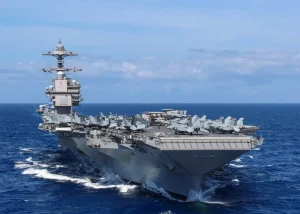 USS Gerald R Foard (CVN-78) set to depart for an earlier deployment in 2022. USN image.
The United States renewed strikes on Iranian military sites on Sunday evening, after the Islamic Revolutionary Guard Corps claimed to have closed the Strait of Hormuz and rejected claims it was still negotiating with the Americans.
Strikes targeted Iranian military air-defense systems, coastal radar sites, missile and drone facilities, and IRGC fast boats, U.S. Central Command said in a statement.
“U.S. Central Command (CENTCOM) completed a new wave of offensive strikes against Iran, July 12, hitting dozens of targets at multiple locations with precision munitions to degrade Iran’s ability to continue attacking international shipping flowing through the Strait of Hormuz,” the statement read.
At 5 p.m. ET today, U.S. Central Command forces began launching more strikes against Iran to continue degrading their ability to attack civilian mariners and commercial ships freely transiting the Strait of Hormuz. The Commander in Chief has directed the strikes to hold Iranian…
— U.S. Central Command (@CENTCOM) July 12, 2026
The renewed strikes came after the IRGC leadership claimed that the Hormuz Strait was closed to commercial traffic.
“The Strait of Hormuz is a vital maritime corridor for global trade. Iran does not control it,” the CENTCOM statement concluded.
The Iranian regime views control of the Strait as a critical issue, and has attempted to enforce that control several times since the start of the U.S.-Israeli campaign in late February.
In recent days, the IRGC targeted ships passing through the Strait outside of the regime-approved route, using drones, missiles, and fast boats. The U.S. strikes on Saturday and Sunday nights targeted some of the docks known to house the IRGC fast boats.
As in previous U.S. strikes in recent days, Israeli forces did not participate, nor did Iran target Israeli sites in retaliation.
Iranian state media confirmed the strikes, saying one person was killed, with explosions reported in several areas of the country, including the port city of Bandar Abbas, and the oil production region of Khuzestan Province.
BREAKING: U.S. Strikes on Iran Intensified — Heavy Attacks Reported Across Khuzestan Oil Heartland.
New wave of American strikes were ongoing for several hours, targeting Iran's vital oil-producing Khuzestan Province.
Confirmed hits include:
Mahshahr petrochemical complex.… pic.twitter.com/zLXzqZ38Nr— The Hormuz Report (@HormuzReport) July 13, 2026
Following the U.S. strikes, the IRGC said it targeted several American bases in Kuwait, Bahrain, and Jordan in retaliation.
The Jordanian military reported shooting down four Iranian missiles targeting Prince Hassan Air Base, while Kuwait’s defense ministry said it was responding to “hostile aerial targets.”
“The Armed Forces are currently intercepting hostile aerial targets within Kuwaiti airspace,” the head of Kuwait’s military said in a statement carried on state media.
According to reports in Arab news, the Iranian attacks destroyed radar systems in Oman. Bahrain also reported air raid sirens.
The regime militia also refuted claims by U.S. President Donald Trump that the Strait is open, saying, “The only way to open the Strait of Hormuz for vessels is to end the interventions of the US military in this strait and to respect the sovereignty of countries over their own coastal waters.”
Meanwhile, ship tracking data showed that traffic through the Strait slowed drastically over the weekend, following the U.S. strikes on Saturday evening, with only 6 vessels passing through on Sunday with trackers on. However, some vessels appeared to have turned off their transponders, to avoid detection as they passed through the waters near Oman.
In a statement by the foreign ministry, Iran accused the U.S. of disrupting traffic through the strait.
“The US regime has also caused the return of insecurity in the Strait of Hormuz and disruption of international commercial shipping by openly interfering in the process of Iran implementing the necessary arrangements in the Strait of Hormuz,” the statement read.
Significant uncertainty remains regarding the situation in Iran, with President Trump recently declaring the ceasefire to be “OVER!” However, during an interview with NBC’s “Meet the Press,” Trump also claimed that Iran was still interested in a deal, saying, “They agreed to a deal yesterday. A perfect deal for us. No nuclear.”
Trump then claimed that “within an hour, they launched a drone at a ship.”
Iranian leaders have publicly said they are no longer interested in negotiating with the U.S.
Israpundit is entirely dependent on readers support. Please help me continue educating people with the truth about what is going on in Israel and around the world.


Trump is not deranged. I believe this was always the plan behind the MoU. He must have known the Iranians would not keep their side, but by signing it he was perceived as being a peaceful negotiator. When – as Trump knew – the agreement was broken, he was free to go back without blame and finish off this evil regime; let’s hope he takes this opportunity and doesn’t falter.