
Peloni
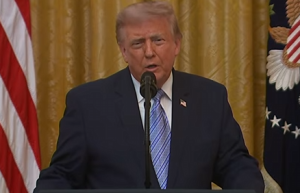 Pres. Trump Addresses the American public with results of investigations into Election Fraud in the US Elections Screengrab via Youtube
In an important article by Joan Swirsky prior to the last US election, she noted that Voter Fraud [was] The Only Issue That Matters in 2024. With this in mind, Trump’s remarks during a national address to the nation stands as an important first salvo in response to this issue. Notably, responding to a ridiculous suggestion by nonother than AOC, the Democrats favorite silly source of reason, ABC and NBC refused to carry Trump’s remarks indicating that his statements needed confirmation before they could be aired publicly. This was hardly a surprising move by these Legacy Media groups, and Trump addressed this fact in his own comments. What was likely more interesting than this is that following Trump’s 30 minute address, Fox News returned almost immediately to the coverage of the Iran war rather than to digest and reflect on what should be understood to be a shocking series of revelations by Pres. Trump with evidence aplenty in hand.
In his remarks, President Trump announced the immediate declassification and public release of intelligence documents that he said expose serious vulnerabilities in the U.S. election system, explaining that the information had been concealed from both the public and his administration for years. He emphasized that the purpose of releasing the documents is not to undermine confidence in elections but to restore it by identifying weaknesses and addressing them. Transparency and accountability is the only path which might lead to such an outcome, and in recognition of this fact, he challenged the American people to review the documents for themselves to weigh the truth about the facts which have been so long withheld from them.
Trump went on to indicate that the documents provide extensive details of an extensive Chinese efforts to interfere in US elections including the 2020 election cycle. He stated that intelligence reports reveal that China obtained approximately 220 million US voter records containing personal information and that they also established a specialized unit for the exploitation of this data. He additionally revealed that intelligence assessments concluded that the Chinese government also sought to influence the 2018 midterm elections and the 2020 presidential election through political, economic, and media-related activities which targeted his administration in an attempt to alter the outcome of the 2020 election and thereby prevent his reelection.
Trump also asserted that intelligence agencies and members of the Deep State deliberately suppressed information about China’s activities. He stated that the documents included evidence and intelligence concerning Chinese election interference which was specifically withheld from presidential briefings, and that analysts altered reports before reaching the president, and that officials prevented Congress and the public from learning of these security breaches. He added that recently discovered “burn bags” from the Obama presidency contained documents which raised additional questions regarding the handling of intelligence records and announced that he has directed the Office of the Director of National Intelligence, the Department of Justice, the FBI, and the CIA to investigate how this information was concealed and to address any criminal conduct which occurred in this concealment.
Turning to election infrastructure, Trump said the released intelligence assessments demonstrate that electronic voting machines, voter registration databases, ballot-counting systems, and other election-related technology have long been vulnerable to cyberattacks. He stated that the assessments conclude that foreign adversaries, including China, Russia, Iran, North Korea, as well as non-state actors, possess the capability to compromise election infrastructure. He also cited intelligence reports describing alleged methods employed by Venezuela’s Maduro government to digitally manipulate election results, and noted that these reports underscore the need to secure American voting systems against similar threats.
Trump said another group of documents concerns alleged election fraud that was either ignored or insufficiently investigated. He referenced FBI files relating to a voter registration investigation in Michigan, indicating that fraudulent voter registration forms were submitted and that individuals received incentives based on the number of registrations they produced. He criticized the Justice Department under President Biden for failing to fully pursue the case and directed the FBI and Department of Justice to reopen investigations and prosecute any crimes uncovered.
He also highlighted Department of Homeland Security findings that he said identified approximately 278,000 non-citizens registered to vote in federal elections, while explaining that the actual number could be even higher because some states did not provide complete voter registration data. He said these findings, together with foreign access to voter information, existing vulnerabilities in voting systems, and evidence of concealed fraud, demonstrate that the election system remains fundamentally insecure.
Trump criticized media organizations, specifically ABC and NBC, for declining to broadcast his address, noting their unwillingness to report evidence of election vulnerabilities. He also criticized election practices such as widespread mail-in voting, lengthy vote-counting periods, and the absence of voter identification requirements in some states, contending that these policies have weakened confidence in the electoral process.
Finally, Trump outlined a series of actions his administration intends to take. He said federal agencies will notify affected states about compromised voter data, assist states in addressing cybersecurity vulnerabilities before upcoming elections, and work with state governments to remove ineligible voters from voter rolls. He called on Congress to pass the Save America Act, which would require photo identification for voting, proof of U.S. citizenship, and tighter restrictions on mail-in voting except in limited circumstances such as illness, disability, military service, or travel. Concluding his remarks, Trump urged Americans to contact their elected representatives in support of the legislation, arguing that comprehensive election reforms are necessary to restore public trust and ensure secure, honest, and fair elections.
To be honest, I expected Trump to move forward on this topic long before this point, given its impact on the US midterm. Notably, as I have noted in the past, what begins in Washington never stays in Washington, and the tangible loss of secured elections which actually choose the leader of the free world has had an important bearing on the rest of the world. In fact, it was highly ironic that VP Vance chastised the Europeans for their inventive election techniques in the early hours of the Trump presidency while a vacuum still remained around addressing what took place in the US elections in 2020. Well, it would appear that this vacuum is now being filled, and Trump is trusting the evaluation of these materials to an important source of vetting which lies outside the normal bureaucratic, legal, and political norms of Washington.
Indeed, the documents referenced by Trump which are being made available for public review may be the most useful aspect of his attempt to right the ship of state regarding US election security. Importantly, the reason that this matter was not addressed after the 2020 election, if not before it, is due in no small part to the compromised nature of the relevant agencies and governing infrastructure which Trump is now relying upon to prosecute the restoration of legal and political norms in America. Hence, Trump’s call to the public to scrutinize the materials being released demonstrate an important role for the American people. They now have the means to weigh the legitimacy of what took place in 2020, something which was likely more relevant to the attempts of Legacy Media groups in the US to ignore Trump’s public address. This public review of the data will leave the final judgement in the hands of what should be understood to be the true sovereign in a representative democracy, and that sovereign is not the media, not the politicians and not the bureaucrats. In fact, the true sovereigns in a representative democracy is the people themselves, and based on their judgement, the future of the American Republic will rise or fall, and as has been true for generations, Western Civilization will likely follow America’s lead, either towards the restoration of representative government or towards the establishment of authoritarianism.


Leave a Reply
You must be logged in to post a comment.