
Ahmad Sharawi | July 17, 2026
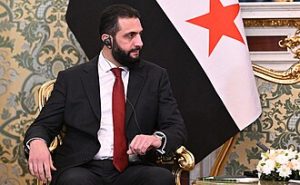 Abu Muhammad al-Jolani. Photo by Kremlin.ru, CC BY 4.0, Wikipedia
Outside Syria’s parliament building in Damascus, lawmakers filed past the stone façade for the chamber’s first session since Bashar al-Assad’s fall. Inside, the freshly minted lawmakers stood to take the constitutional oath as President Ahmad al-Sharaa looked on. The ceremony was carefully staged to show both Syrians and foreign observers that independent political institutions have returned after more than half a century of Assad family rule.
“Syria is writing a new chapter in its history – one that reflects its civilization, values, and heritage,” Sharaa declared. The contrast with the old parliament under Assad was very clear. There was no choreographed applause or theatrical displays of loyalty, rituals that had reduced the legislature under Assad to a room of obedient spectators. But silence or the lack of applause should not be mistaken for democracy. This was the unveiling of a new system, one designed to organize political life around Sharaa’s presidency.
The limits of the new parliament were built into it long before its members entered the chamber. Two-thirds of its 210 seats were filled through an indirect election procedure overseen by committees appointed by the president. Sharaa personally selected the remaining third. Ordinary Syrians did not vote directly for the representatives, and candidates did not represent political parties; the result is a body that may look different from Assad’s parliament but remains dependent on the executive branch.
Sharaa has effectively built a parliament without meaningful opposition — a result ensured by the provisions of the interim constitution, or “constitutional declaration,” that Sharaa imposed in March 2025 without any deliberative process. The official justification for placing the selection of lawmakers under executive control was that Syria’s political transition remained too fragile for direct elections. Millions of refugees had yet to return, organized political life was still in its infancy, and the courts were barely functional. Under those conditions, the argument went, the presidency needed to guide the formation of the new legislature.
But the composition of the assembly shows a more deliberate political project. Sharaa’s appointees were presented as a “blend between those who sacrificed” during the revolution and those with “national competencies and expertise,” while also strengthening women’s representation. Yet only 22 women were chosen, despite the government’s earlier promise that women would hold roughly a fifth of the 210 seats. Four seats remain vacant because no representatives have been selected from the Druze-majority province of Suwayda, which remains outside the government’s control.
Minority representation was even more indicative of a desire to create a façade of inclusivity that excluded independent figures. The parliament includes only one Druze member, Laith al-Balous, the leader of a faction aligned with Damascus. Among many Druze, Balous is regarded not as a representative of the community but as a “traitor” because of his role during the July 2025 massacres, in which more than 1,000 Druze were killed by government forces, as well as Sunni Bedouin tribes. Kurdish representation followed a similar pattern. Most Kurdish seats went to figures affiliated with the Kurdish National Council, a broadly pro-Damascus rival of the Syrian Democratic Forces, the Kurdish-led, U.S.-aligned military organization whose Autonomous Administration governed Kurdish majority areas in northeastern Syria for nearly a decade. The SDF-aligned political coalition received no seats at all, despite an integration agreement with Damascus that had explicitly promised political participation.
The Autonomous Administration, aligned with the SDF, rejected the initial parliamentary selection process as undemocratic, while the Syrian Democratic Council, also aligned with the SDF, denounced it as a “political farce”. Senior Kurdish officials argued that the vote merely concealed decisions already made by Damascus, saying that “placing the ballot box is nothing more than camouflage for these appointments,” while others described the process as “an appointment operation and an attempt to circumvent the will of the Syrian people.” Their criticism reflected a fear that Damascus was perpetuating the marginalization of the country’s Kurdish minority despite the autonomy it achieved during the civil war, and the heavy price it paid to beat back the Islamic State.
The parliament’s limited Alawite representation, with only 7 members selected, did little to win over a community already deeply distrustful of Damascus because of the massacre of more than 1,000 Alawites perpetrated by government forces and their allies in March 2025. Even before lawmakers were chosen, the Supreme Alawite Islamic Council had declared the process “invalid in principle and rejected in form and substance.” It argued that the proposed assembly possessed no “national or representative legitimacy” and was being imposed in a “coercive environment” that prevented Syrians from determining their own political future. Participation, the council warned, would amount to recognizing an authority lacking popular legitimacy and helping to consolidate a political order imposed from above.
Not all of Syria’s minorities viewed the new parliament with the same apprehension. Sharaa has empowered minority constituencies in line with his government and in service of its political interests. The Turkmen community, which secured at least 12 seats in the legislature, carries influence that extends well beyond its numbers. Several Turkmen lawmakers rose through institutions cultivated or supported by Ankara, including the Syrian Turkmen Assembly, the Turkey-backed opposition administration that governed areas in the north under Turkish control, and Turkey-backed armed factions. Ankara’s decade-long investment in Syrian Turkmen political and military networks has now translated into influence within Syria’s emerging political life.
But the deeper problem is not simply who was included or excluded. On paper, the parliament possesses powers that could allow it to restrain the president. It can propose, approve, and repeal laws; ratify treaties; and even override a presidential veto with a two-thirds majority. In practice, however, the selection process has produced a chamber dominated by Sharaa’s allies and therefore unlikely to exercise those powers against him. The president’s 70 appointees include Maher Alloush, Hassan al-Dugheim, and Hassan Soufan, all of whom Sharaa appointed to official roles during the transitional period. Sharaa assigned both Alloush and al-Dugheim to the National Dialogue Committee, which was responsible for organizing the national conference in February 2025, expected to draw up a consensus-based roadmap for the post-Assad transition. In the end, the conference served only as a short-lived façade of inclusivity for Sharaa’s consolidation of power. Hassan Soufan briefly held the post of governor of Latakia before serving on the Supreme Committee for Civil Peace, a body tasked with bridging sectarian divides that was mainly a publicity exercise.
The loyalty of Alloush and Al-Dugheim is both ideological and personal. Alloush is a writer and key ideologue of the Syrian Islamist movement. Al-Dugheim, meanwhile, is a member of the Syrian Islamic Council, a Turkey-based religious body that seeks to strengthen the role of religious institutions in Syrian society. Even those who drafted the governing framework acknowledge it does not entail checks and balances. “There is virtually no oversight of the president’s actions,” constitutional committee member Ray’an Keheilan conceded.
That is the danger of mistaking the return of parliamentary ceremonies for democratization. Foreign governments keen to stabilize Syria may see a functioning legislature as evidence that the country is moving toward some form of representative government under the rule of law. But the real test is not whether lawmakers can deliver speeches beneath the parliament’s dome. It is whether they can reject an executive decision, investigate abuses by the security forces, compel ministers to answer for government failures, and represent communities that remain deeply distrustful of Damascus. Judged by its composition and constitutional powers, there is little reason to believe this parliament can do any of those things.
That does not mean Syria would be better off without a parliament. The country needs a functioning legislature that can pass laws and eventually hold the executive accountable. The problem is that, in its current form, this parliament is more likely to alienate constituencies outside Sharaa’s political orbit than foster national integration. Rather than creating a forum in which Syria’s competing political and communal interests can negotiate their relationship with the state, it risks formalizing the dominance of one political camp while allowing the government to claim that representative institutions have already been restored.
Syria’s expanding diplomatic relations have fostered the illusion of political stability. International recognition and meetings with foreign leaders may suggest that the country is on the right track, but diplomatic normalization is not the same as political inclusion. The United States and other governments have repeatedly praised Sharaa’s ability to unify the country, yet rather than subject himself to any kind of evaluation at the hands of the people he claims to represent, Sharaa went through with his plan to engineer a parliament largely dependent on the executive and carefully insulated from meaningful opposition.
More than a year and a half after Assad’s fall, many Syrians are still waiting not only for security and reconstruction, but for a genuine political process. If communities continue to be excluded and if power continues to accumulate in the presidency, frustration will deepen rather than disappear. It is too early to declare that Syria has returned to authoritarian rule. But it is also far too early to celebrate the birth of representative government. Those who mistook the fall of Assad for the arrival of democracy should look again.
Ahmad Sharawi is a senior research analyst at the Foundation for Defense of Democracies.
Israpundit is entirely dependent on readers support. Please help me continue educating people with the truth about what is going on in Israel and around the world.


Leave a Reply
You must be logged in to post a comment.