
Peloni: It is a disturbing observation to note that Trump having suggested the possibility of talking with Hezbollah. Doing so would only serve to raise their political standing while ignoring literally thousands of American deaths on their hands, as well as their role in the subsidizing and coordinating with the ongoing drug trade which Trump has been facing down in America. While it is stated that ‘conventional’ approaches have thus far failed, it should be noted that the only approaches to deal with Hezbollah have been thru negotiations based on promises of disarmament used to force Israel back across an undefensible border which ultimately led to the continued slaughter of Israelis in the North. What would be an unconventional step would be to support an Israeli buffer zone til such time as already agreed upon stipulations made by Lebanon, including by Pres. Aoun himself, of disarming Hezbollah was enacted. Of course, Aoun wants Israel out of Lebanon first, but that is the very mechanism on which the past ‘conventional’ approaches were based and failed. Time for a new approach, and talking with terrorists won’t solve the crisis. It will only serve to distract from the fact that the old approaches of forcing Israeli concessions is also the basis of the new approach. Thus far Aoun has disarmed not a single Hezbollah soldier and Israel is being forced into a ‘pilot’ test program. Forcing Lebanon to act would be a new approach, but it seems thus far that is not the path being pursued, which is why it will almost certainly fail.
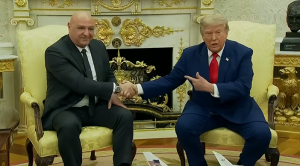 President Trump meets with Lebanese Joseph Aoun in the Oval Office. Screengrab via Youtube.
U.S. President Donald J. Trump has never been accused of thinking inside the box. If anything, the opposite is true.
Now he is bringing that same unconventional approach to one of the most complicated problems in the Middle East: how to disarm Hezbollah without triggering a Lebanese civil war, allowing the terrorist organization to regroup or leaving Israel vulnerable along its northern border.
During an Oval Office meeting on Tuesday with Lebanese President Joseph Aoun, Trump publicly floated an idea that would have been nearly unthinkable under most American presidents. He offered to personally speak with Hezbollah. That’s not just outside-the-box thinking – it’s about as unconventional as it gets.
“I would speak to Hezbollah. I speak to everybody,” Trump said. “I’ll speak to people that a lot of people think I shouldn’t be speaking to and things work out.”
Trump said he would only open such a channel if Aoun believed it would help. “If the president wanted me to speak to Hezbollah, I would,” Trump added.
That is classic Trump. He sees himself as the ultimate dealmaker who can communicate with virtually anyone – including sworn enemies and terrorist organizations – if he believes a conversation might produce results.
It’s an approach that leaves many traditionalists uneasy, but in Trump’s mind, why not? Conventional approaches have produced few lasting results.
Whether it can work with Hezbollah is another question entirely.
Yet Trump’s willingness to think outside the box is only one piece of the puzzle. The bigger challenge is that Washington, Jerusalem and Beirut are not operating from the same playbook.
Lebanon wants Israel to complete its withdrawal from southern Lebanon before fully confronting Hezbollah.
Israel, meanwhile, wants meaningful guarantees that Hezbollah will be disarmed before giving up its remaining positions. Reconciling those competing priorities – not simply opening a dialogue with Hezbollah – may ultimately determine whether Trump’s latest initiative succeeds or stalls.
“There’s a Hezbollah problem,” Trump acknowledged as he sat beside Aoun. “We’re going to help it. We’re going to help it a lot. We are going to solve a lot of problems. We’ve already solved some of them for Lebanon.”
The president also reportedly suggested that Syria could play a role in cutting Hezbollah’s weapons supply routes or applying pressure on the organization.
Other ideas under consideration include deploying specially selected Lebanese army units that would be vetted, trained and equipped by the United States before taking control of territory evacuated by Israel.
It’s a tenuous situation at best. Hezbollah isn’t simply a terrorist force positioned along Israel’s northern border. It is deeply embedded within Lebanon’s Shiite community and wields significant political, religious, social and economic influence throughout the country.
Any attempt by the Lebanese army to forcibly disarm it could spark violent internal conflict. A civil war in Lebanon is a very real possibility.
The first test is already underway through so-called “pilot zones” in southern Lebanon.
Under the U.S.-brokered framework agreement reached June 26, Israeli troops are expected to gradually withdraw from selected areas. Lebanese soldiers would then move in immediately, preventing Hezbollah from returning and the Lebanese government would ultimately become the country’s sole armed authority.


Trump’s suggested approach will take time. While it may be useful to get vetted units of the Lebanese Armed Forces involved, trained and armed to deal with their erstwhile comrades in arms, that will require constant monitoring. There is no reason for the IDF to leave even one second before the LAF is ready to go.