
Peloni: Michel Benchimol provides a very careful and very thoughtful analysis of JD Vance’s worrying potential as the GOP’s next leader.
America Needs a Conservative Successor Built on Consistency, Experience, and Independent Judgment
Michel Benchimol
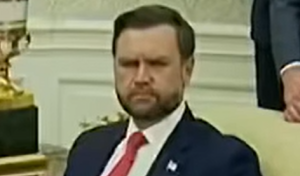 VP Vance during Trump meeting with Lebanon Pres. Aoun. Screenshot via Youtube.
WHY I NO LONGER BELIEVE J.D. VANCE SHOULD BECOME PRESIDENT
Trust, Judgment, and the Qualities America Should Demand From Its Next Conservative Leader
There was a time when I believed J.D. Vance might very well become one of the brightest stars in the Republican Party.
Like many conservatives, I admired his intelligence. He was articulate without sounding rehearsed.
He was quick on his feet during interviews, comfortable defending conservative principles in hostile environments, and seemed capable of expressing ideas with far greater clarity than many career politicians.
He struck me as someone who represented a younger generation of conservative leadership—someone who could eventually carry the movement forward after Donald Trump.
If someone had asked me then whether I could imagine J.D. Vance one day sitting in the Oval Office, I probably would have answered yes.
That is what makes writing this article so difficult.
My opinion did not change because of a single speech.
It did not change because of one policy disagreement.
It did not even change because of one controversial interview.
It changed gradually.
Like confidence slowly leaking from a tire, my trust diminished over time until one day I realized something I had never expected to conclude.
I no longer believe J.D. Vance should become President of the United States.
Notice what I am not saying.
I am not questioning his intelligence.
I am not suggesting that he lacks political talent.
Nor am I arguing that everything he believes is wrong.
On many issues—including border security, reducing government bureaucracy, restoring American manufacturing, energy independence, and confronting the excesses of progressive politics—I continue to share many of the same conservative objectives.
This article is not about ideology.
It is about something much more important.
It is about judgment.
It is about temperament.
And, above all else, it is about trust.
Trust is perhaps the most valuable political currency a leader possesses. Once earned, it allows people to accept difficult decisions even when they disagree with them.
Once lost, it is almost impossible to recover.
The presidency is unlike any other office in government.
A senator can be wrong.
A governor can recover from mistakes.
Even cabinet secretaries operate within a larger administration.
The President of the United States carries a different burden entirely.
He commands the world’s most powerful military.
He negotiates with allies and adversaries.
He appoints Supreme Court justices whose decisions shape the nation for generations.
He responds to wars, economic crises, terrorist attacks, pandemics, and international conflicts.
Every decision carries enormous consequences.
That office demands far more than intelligence.
It demands wisdom.
It demands humility.
It demands the ability to recognize the difference between certainty and understanding.
Those qualities cannot be measured by poll numbers or television appearances.
They reveal themselves over time.
Unfortunately, that same passage of time is what caused me to lose confidence in J.D. Vance.
The Difference Between Admiration and Confidence
Politics often rewards confidence.
Campaigns reward certainty.
Cable television rewards confrontation.
Social media rewards absolute conviction.
The presidency rewards something entirely different.
History consistently demonstrates that America’s strongest presidents were not necessarily those who spoke with the greatest certainty.
They were those who understood the weight of uncertainty.
Ronald Reagan projected optimism, yet he carefully listened to competing viewpoints before making consequential decisions.
Dwight Eisenhower commanded the largest military operation in history, yet entered the presidency with remarkable caution about using American military power.
George H. W. Bush possessed perhaps the strongest foreign policy résumé of any modern president, but rarely spoke as though he alone possessed all the answers.
What united these men was not simply experience.
It was humility.
Each understood that leadership is not measured by how often you speak.
It is measured by how well you listen.
That distinction has become increasingly important to me as I have watched today’s Republican Party search for its future.
There is a temptation in politics to assume that whoever currently occupies the vice presidency naturally becomes the next standard-bearer.
History tells us otherwise.
Richard Nixon eventually became president—but only after losing one presidential election and spending years rebuilding public confidence.
George H. W. Bush earned the presidency after serving as ambassador, CIA director, congressman, Republican National Committee chairman, and vice president.
Joe Biden spent decades in the Senate before becoming vice president and later president.
Experience alone did not guarantee presidential success.
The office itself ultimately revealed strengths and weaknesses that no résumé could fully predict.
Serving as vice president is not a certificate of readiness.
It is merely one chapter in a political career.
Every candidate must still answer the same question.
Should this person be trusted with the presidency?
For me, J.D. Vance once answered that question affirmatively.
Today, he does not.
The obvious question is:
What changed?
The answer is not one event.
It was a series of observations that slowly reshaped my opinion.
Some involved the company he increasingly kept.
Others involved the way he approached foreign policy.
Still others involved moments that revealed, in my opinion, an emerging sense of certainty that seemed increasingly disconnected from experience.
Each incident, taken by itself, might have been insignificant.
Together, they painted a picture that gradually caused me to question not his intelligence—but his judgment.
And in the Oval Office, judgment matters more than brilliance.
The Slow Erosion of Trust
There is an important distinction I want to make before going any further.
I am not writing this article because J.D. Vance disagrees with me on every issue.
He doesn’t.
Nor am I writing it because I have suddenly become less conservative.
I haven’t.
My political philosophy has remained remarkably consistent over the years. I still believe in limited government, secure borders, fiscal responsibility, a strong national defense, individual liberty, and an America that leads the free world with confidence rather than apology.
My concern is not with conservative principles.
It is with the person I now believe may someday be asked to carry those principles into the Oval Office.
People often ask, “What was the moment you changed your mind?”
The honest answer is that there wasn’t one.
Trust rarely disappears overnight.
It erodes.
One conversation.
One interview.
One public appearance.
One decision.
Then another.
Eventually you reach a point where you look back and realize that your confidence is simply gone.
That is exactly what happened to me.
The Company We Keep
There is an old saying that we are, to some degree, influenced by the company we keep.
That does not mean we become identical to our friends, colleagues, or interviewers. Nor does it mean that appearing on someone’s podcast or television program automatically means we embrace everything that person believes.
But over time, patterns matter.
Repeated associations matter.
The voices we choose to engage with repeatedly often reveal the ideas we find persuasive or worthy of amplification.
As I watched J.D. Vance over the past several years, I noticed him increasingly appearing alongside media personalities such as Tucker Carlson and Megyn Kelly, as well as others who share a similar outlook on America’s place in the world.
Let me be clear.
This is not an accusation.
It is an observation.
I respect the fact that conservative media contains a wide range of opinions, just as liberal media does.
Healthy debate is essential to democracy.
What concerns me is the particular worldview that seems to emerge from some of these conversations.
Increasingly, I hear arguments that suggest America’s alliances are more burden than benefit, that long-standing international commitments should be viewed primarily through a transactional lens, and that America’s leadership abroad is often more liability than asset.
Reasonable people can support a less interventionist foreign policy.
That debate is legitimate.
But there is an important difference between avoiding unnecessary wars and retreating from global leadership.
For nearly eighty years, American alliances have not simply protected other nations—they have protected American interests.
NATO has helped deter major conflict in Europe.
Strategic alliances in Asia have helped contain authoritarian expansion.
Partnerships in the Middle East, however imperfect, have often prevented regional conflicts from becoming even more dangerous.
Leadership is expensive.
Retreat can be even more expensive.
When I hear commentators dismiss decades of American alliances as though they have little strategic value, I worry that they underestimate the complexity of the world America actually inhabits.
My concern is not that J.D. Vance listens to these voices.
Every politician should listen to a broad range of opinions.
My concern is whether he has begun adopting too much of their worldview without sufficiently challenging it.
Presidents need advisers who disagree with them.
They need people willing to say, “Mr. President, I think you’re wrong.”
History teaches that leaders make their greatest mistakes when everyone around them thinks alike.
Echo chambers are dangerous in business.
They are dangerous in government.
They are potentially disastrous in the White House.
From Critic to Loyal Ally
Another development that caused me to pause was Vance’s extraordinary political transformation regarding Donald Trump.
This issue has been discussed extensively, but I believe it deserves consideration because it speaks directly to judgment and consistency.
Before entering politics, J.D. Vance was one of Donald Trump’s sharpest Republican critics.
He questioned Trump’s temperament.
He questioned his character.
He questioned whether Trump was suited to become president.
These were not passing remarks.
They reflected serious concerns expressed publicly and repeatedly.
Then came one of the most dramatic reversals in modern American politics.
Within a relatively short period, Vance became one of Trump’s strongest defenders and eventually accepted the vice-presidential nomination on Trump’s ticket.
Could his views have genuinely changed?
Of course they could have.
People evolve.
New experiences alter perspectives.
Good leaders should be willing to admit when they have been wrong.
I have no objection to changing one’s mind.
In fact, intellectual honesty sometimes requires it.
What gives me pause is not that Vance changed his opinion.
It is the speed, the completeness, and the political timing of that change.
Those circumstances naturally invite questions.
Did experience genuinely alter his convictions?
Or did political opportunity accelerate his conversion?
Only J.D. Vance can answer that question with certainty.
But voters are entitled to ask it.
The presidency demands leaders whose principles appear durable even when they are politically inconvenient.
Consistency builds confidence.
Dramatic reversals, however sincerely motivated, inevitably invite scrutiny.
That scrutiny is neither unfair nor partisan.
It is simply part of evaluating someone who seeks the highest office in the land.
Judgment Is More Important Than Agreement
One of the mistakes people often make in politics is assuming that agreement on policy automatically translates into confidence in leadership.
It does not.
I can agree with someone on eight out of ten issues and still question whether they should become president.
Why?
Because presidents are ultimately judged not by campaign promises but by decisions made during moments no one anticipated.
No candidate campaigns on responding to the next terrorist attack.
No candidate campaigns on managing the next global financial crisis.
No candidate knows what international emergency may arise during his presidency.
Those moments test judgment—not ideology.
They reveal character, temperament, patience, humility, and the ability to absorb information before acting.
Those are the qualities I increasingly found myself questioning as I watched J.D. Vance’s political development.
The final turning point would come during one meeting at the White House.
Watching it, I realized that the concerns I had slowly accumulated over time were no longer isolated observations.
They had become a pattern.
And that pattern convinced me that J.D. Vance, despite his many talents, is not the person I want sitting behind the Resolute Desk.
That meeting, more than any other event, permanently changed my opinion.
The Day I Lost Confidence
Every person has a moment when a collection of doubts suddenly comes into focus.
Until then, each concern exists independently.
One interview here.
One speech there.
One decision that makes you uncomfortable.
Another that causes you to pause.
Individually, they can be explained away.
Collectively, they become a pattern.
For me, that pattern crystallized during the widely publicized Oval Office meeting between President Donald Trump, Vice President J.D. Vance, and Ukrainian President Volodymyr Zelenskyy.
I have no intention of debating the merits of continued American military assistance to Ukraine in this article.
Reasonable people can disagree on that issue.
Some believe the United States has done too much.
Others believe it has not done enough.
Still others believe Europe should shoulder a far greater share of the burden.
Those are all legitimate policy debates.
That meeting changed my opinion for an entirely different reason.
It wasn’t primarily about Ukraine.
It was about presidential temperament.
There Is a Time to Speak—and a Time to Listen
Leadership is often misunderstood.
Many people think leadership means always having the answer.
The older I become, the more convinced I am that true leadership begins by recognizing when someone else in the room knows more than you do.
There is wisdom in listening.
There is strength in humility.
There is confidence in asking questions rather than rushing to provide answers.
Watching that meeting, I expected to see the vice president of the United States engage respectfully—but firmly—with the leader of a nation that has been fighting a brutal war for years.
Instead, I came away with a very different impression.
J.D. Vance spoke with a certainty that, to me, came across as lecturing President Zelenskyy on the strategic and diplomatic choices Ukraine should be making.
Whether that was his intention or not, that was the impression he left on me.
And impressions matter.
Especially when the audience is not only the American people, but America’s allies and adversaries around the world.
Experience Deserves Respect
Volodymyr Zelenskyy is not beyond criticism.
Far from it.
He has made decisions with which many people disagree.
He has asked allies for enormous financial and military support.
He has pursued strategies that have been questioned by military analysts.
Like every wartime leader, he is accountable for his decisions.
Criticizing those decisions is entirely legitimate.
But criticism and condescension are not the same thing.
That distinction is important.
President Zelenskyy has spent years governing a nation under invasion.
He has lived with missile attacks on cities.
He has attended the funerals of soldiers.
He has spoken with grieving families.
He has watched millions of his citizens become refugees.
He has made decisions knowing that every mistake could cost thousands of lives.
One does not have to agree with every decision he has made to recognize the extraordinary burden he carries.
Watching J.D. Vance engage with him, I found myself asking a simple question.
Where does that level of certainty come from?
J.D. Vance served honourably in the United States Marine Corps.
That service deserves respect.
Anyone who volunteers to wear the uniform of the United States earns the gratitude of the nation.
Military service teaches discipline, sacrifice, teamwork, and courage.
But serving in the Marines is not the same as leading a country through a multi-year war.
It is not the same as directing military operations.
It is not the same as balancing diplomacy, intelligence, logistics, economics, and battlefield realities while your nation’s existence hangs in the balance.
Those are fundamentally different responsibilities.
My concern was never that Vance questioned Zelenskyy.
My concern was the confidence with which he appeared to assume that he understood the situation better than the man living it every single day.
That, to me, reflected something I never want to see in a president.
Not confidence.
Arrogance.
The Difference Between Confidence and Arrogance
People often confuse these two qualities.
They are not the same.
Confidence is rooted in preparation.
Arrogance is rooted in certainty.
Confidence says:
“Here is how I see the situation, but I want to hear your perspective.”
Arrogance says:
“I already know enough.”
Confidence welcomes disagreement.
Arrogance dismisses it.
Confidence asks questions.
Arrogance delivers lectures.
The presidency demands confidence.
It cannot afford arrogance.
Every president eventually discovers that reality is more complicated than campaign speeches.
Every foreign leader possesses information unavailable to outside observers.
Every military commander understands factors invisible to television audiences.
Every intelligence briefing reveals complexities the public never sees.
That is why wise presidents listen before they decide.
History Rewards Humility
The presidents I admire most all shared one characteristic.
They understood the limits of their own knowledge.
Ronald Reagan was known for surrounding himself with advisers who challenged him.
Dwight Eisenhower had commanded Allied forces during the largest military operation in history, yet remained remarkably cautious about committing American troops.
George H. W. Bush entered office after serving as ambassador to the United Nations, envoy to China, CIA director, congressman, Republican National Committee chairman, and vice president.
Despite that extraordinary résumé, he rarely projected the impression that he alone possessed all the answers.
The greatest leaders understand something that ambitious politicians sometimes forget.
Wisdom and humility usually travel together.
The more responsibility someone carries, the more cautious they often become.
The more experience they accumulate, the more they appreciate complexity.
Watching that Oval Office exchange, I saw the opposite.
I saw certainty.
I saw self-assurance.
I saw a confidence that, in my opinion, exceeded the experience upon which it rested.
Perhaps others saw something entirely different.
That is their right.
This article reflects my own reaction.
And my reaction was immediate.
I found myself thinking:
This is not how a future president should conduct himself.
A President Represents More Than Himself
One of the realities of international diplomacy is that every meeting sends multiple messages.
Foreign leaders are watching.
Allies are watching.
Adversaries are watching.
Markets are watching.
The words spoken in the Oval Office echo far beyond its walls.
Every gesture is interpreted.
Every expression is analyzed.
Every exchange becomes part of America’s diplomatic reputation.
That places a tremendous responsibility on the president—and on the vice president.
Strength is essential.
Firmness is essential.
But so is respect.
Respect is not weakness.
Listening is not surrender.
Humility is not indecision.
In fact, history suggests exactly the opposite.
The strongest leaders often project quiet confidence rather than performative certainty.
That meeting convinced me that J.D. Vance possesses many admirable qualities.
Intelligence.
Energy.
Communication skills.
Political instinct.
But it also convinced me that there remains a difference between being an exceptionally talented politician and being prepared to occupy the most demanding office in the world.
For me, that distinction is decisive.
The Oval Office requires more than intelligence.
It requires judgment refined by experience, humility strengthened by responsibility, and the wisdom to recognize that no leader—however gifted—has a monopoly on insight.
Watching that meeting, I concluded that J.D. Vance has not yet demonstrated those qualities to the degree I would expect of someone seeking the presidency.
That realization did not make me angry.
It made me disappointed.
Because I had once believed he might become exactly the kind of leader the Republican Party needed.
I no longer believe that.


Rubio Yes, Never Vance
https://open.substack.com/pub/lel817/p/rubio-yes-never-vance?r=1q2uiq&utm_campaign=post-expanded-share&utm_medium=post%20viewer
Michel Benchimol has provided us with an excellent article that describes my feelings and opinion as I had written it myself. I agree, he is much more eloquent than I and he hits all the issues correctly. Many thanks!