
Peloni: We are an ancient and powerful people, with the means of achieving great successes even while we face great adversity in every age. Yet, we will be consumed by the success of the plague of self destruction, bitter rivalries, and internal enmity if we can not temper the recurring trait of baseless hatred from dominating our agendas. Unity is the basis on which our survival can be charted, while our destruction will come from the contrary. We saw this in our ancient past, and as I have recently noted, and which Victor Satya captures so well below, we have also seen this in the very hours of the reconstitution of our state had begun to be realized. We can face any foe, and all of them at once as we have recently seen, but only by doing so as one people with a common purpose rather than as various factions who are too busy vying for the destruction of one another while mistaking where the real enemies lie. While noting this, it is interesting that while Netanyahu is calling for a unity govt, joining all factions in the country as one, the opposition maintains there strongest focus as being a govt which does not include the largest party while admitting that it is simply due to their great disgust of the man leading it. This campaign of division is characterized by their willingness to join with non-Zionist and shamefully compare the leadership of Raam to an actual Israeli hero. Make no doubt about it, baseless hatred is on the ballot in Octobers elections, and the choice could not be more clear. The only questions we need to consider is that, as we are facing onslaughts from every angle, and as the world is reshaping the entire Middle East, will the pursuit of sinking another Altalena be the consequence of the next election, and, if so, how terrible might the tragedy be that follows the latest example of our own divisions once more flying the flag of Baseless Hatred as our most resilient and defining trait.
A promise forged in the smoke of the Altalena now faces its greatest test—not on the battlefield, but between brothers.
Victor Satya | July 25, 2026
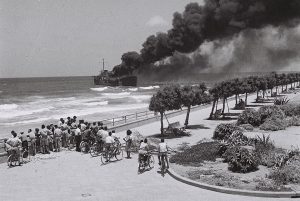 Tel Aviv Altlana Description: The ship Altlana catches fire off the coast of Tel Aviv. Wikipedia
Every Jewish child inherits two things before learning politics.
A family.
And a story.
The family teaches them their name; the story teaches them who they belong to.
Long before there was an Israel divided into coalitions and oppositions, before there were arguments over judges, draft laws, commissions of inquiry, settlements, religion or constitutional reform…
There was simply a people.
Scattered across continents.
Speaking different languages.
Yet carrying the same memory and the same covenant.
Then came June 1948; the Jewish state was barely old enough to stand.
Arab armies surrounded it.
Every rifle mattered.
Every bullet mattered.
Yet off the coast of Tel Aviv, something happened that no enemy had managed to accomplish.
Jews fired upon Jews.
The Altalena burned.
Nearly two dozen Jewish lives ended at Jewish hands, in what became one of the deepest wounds in Israel’s national memory precisely because no foreign flag flew over the battlefield. When the smoke disappeared, Menachem Begin spoke words that were less a speech than a covenant.
“Milchemet achim—le’olam lo.”
A war between brothers—never.
He was not promising that Jews would never disagree. He was pleading that they would never again forget who stood on the other side of the argument. Because Begin understood something older than Zionism itself.
Every civilization is eventually tested. The Jewish people are always tested in the same way.
Not merely by enemies outside the walls…
But by what happens inside them.
That test has returned.
Not with artillery but with politics, not with burning ships but burning trust. Today the first fracture bears the name of the Haredi draft.
One Israel buries sons returning from Gaza and asks how sacrifice can remain unequal forever. Another Israel fears that compelling Torah scholars into military service risks weakening the spiritual inheritance that preserved the Jewish people long before the IDF existed.
Neither concern is imaginary.
Neither emerges from hatred.
Both emerge from love.
Love of country.
Love of Torah.
Love of survival.
Yet something tragic happens when love loses perspective.
Brothers slowly become opponents.
Opponents slowly become threats.
Meanwhile, Hamas, Hezbollah, Iran and every organization devoted to Israel’s destruction have never troubled themselves over whether a Jew wears black trousers or an IDF uniform.
The second fracture runs through Israel’s judiciary.
A constitutional debate became an emotional one, then a national one.
Eventually a civilizational one.
Supporters of reform believed they were rescuing democracy from unelected power. Opponents believed they were rescuing democracy from elected power. Each side spoke the language of salvation. Each increasingly described the other in the language once reserved for enemies.
History has seen this pattern before.
It begins with constitutional arguments.
It ends with societies forgetting that constitutions exist to preserve nations—not replace them.
Then October 7 arrived.
For one unbearable morning…
Politics disappeared.
The terrorists did not sort families by voting records; they did not ask which they did not separate kibbutznik from settler, religious from secular nor coalition from opposition.
To them there existed only one category.
Jew.
The oldest hatred in history has always possessed remarkable clarity. It is often Jews themselves who forget it. Yet even after October 7 another argument emerged.
Who failed?
Who should investigate?
Who should answer?
An independent commission?
A government panel?
Political accountability?
Institutional accountability?
Necessary questions all. Necessary in every democracy.
But democracies, like families, must remember the order in which certain duties belong. There is a time to assign responsibility, and there’s a time to remember whose grave everyone is standing beside. Too often those boundaries have blurred. The dead have become witnesses in political trials they never asked to attend.
Seen individually, these are difficult disputes.
Seen together…
They resemble something much older.
The names change.
The pattern does not.
The rabbis gave it a name nearly two thousand years ago.
Sinat chinam.
Baseless hatred.
When the Second Temple fell, Rome received the credit. Jewish memory assigned responsibility elsewhere. Rome destroyed the walls.
Division had already weakened the foundations.
The Altalena repeated the lesson.
October 7 repeated it again.
History has become almost embarrassingly repetitive; Israel’s enemies rarely invent Jewish fractures. They simply arrive when the cracks are already visible. None of this argues against disagreement; in fact Jewish civilization would scarcely exist without it.
Open a page of Talmud, and you will find arguments stretching across centuries.
Question after question.
Voice answering voice.
The greatness of Jewish civilization was never that everyone thought alike. It was that every argument began with an assumption that both voices belonged to the same, and that assumption feels increasingly fragile. Perhaps that is why Begin’s sentence feels less like history today and more like prophecy.
He was not asking future generations to become politically identical but for them to remain recognizably related. Because the greatest tragedy is not that brothers disagree; brothers have always disagreed. The tragedy begins when they stop recognizing one another as brothers at all.
Every generation receives the Jewish state.
Not every generation remembers how easily it can be wounded from within.
That is why Begin’s words continue to echo long after the smoke above the Altalena disappeared.
They were never instructions for 1948.
They were instructions for every generation fortunate enough to inherit what previous generations only dreamed of.
Milchemet achim—le’olam lo.
Not because disagreement is dangerous, but because forgetting that disagreement exists within a family has always been. History has never demanded that Jews agree, only that they remember who they are before deciding who is right.
Everything else…
History has already written before.



Leave a Reply
You must be logged in to post a comment.