
Peloni: Closing the sanction loopholes will not only hasten the economic collapse of Iran, but will simultaneously diminish Washington’s enemies abroad.
Max Meizlish & Janatan Saye | July 31, 2026
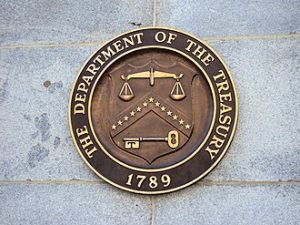 United States Department of the Treasury on the Building, Washington DC. Photo by MohitSingh – Own work, CC BY-SA 3.0, Wikipedia
Tehran faced two rounds of new U.S. sanctions in as many days.
On July 29 and July 30, the Treasury Department’s Office of Foreign Assets Control (OFAC) issued back-to-back sanctions targeting the Islamic Republic’s extortion operation in the Strait of Hormuz, as well as entities supporting the regime’s drone procurement and personnel transfers.
Washington issued both designation packages under Executive Order 13224, the counterterrorism authority for targeting the Islamic Revolutionary Guard Corps (IRGC). The IRGC directly enables Tehran’s aggression toward commercial shipping in the Strait of Hormuz and U.S. assets in the region. In addition to enforcing its naval blockade and striking the regime’s military assets, Washington is bringing its sanctions to bear against the capabilities that sustain the regime’s survival.
Iran Seeks To Solidify Control Over Strait Despite U.S. Sanctions
The July 29 action sanctioned the Persian Gulf Marine Insurance Company and HormuzSafe Marine Services Authority, two firms Treasury says the IRGC uses to force commercial vessels to buy mandatory maritime “insurance” for transiting the strait. HormuzSafe accepts payment in bitcoin and other digital assets in order to evade U.S. sanctions. In May, OFAC targeted the Persian Gulf Strait Authority (PGSA), an IRGC-established entity used to extort commercial shipping in the strait. PGSA had previously threatened that “the consequences of transiting unauthorized routes shall be borne by the vessel owner, operator and master.”
One day after the July 29 designation, QatarEnergy’s Al Areesh became the first Qatari liquefied natural gas carrier in three weeks to exit the strait. According to Nour News, an outlet affiliated with Iran’s Supreme National Security Council, the vessel transited through an Iranian-controlled channel in the strait “in accordance with arrangements imposed by Iran.” Whether Doha paid for that passage is unclear.
China, Russia, and Pakistan’s Growing Role in Supporting Tehran’s Aggression
The July 30 action sanctioned six entities and individuals in China, Russia, Iran, and India that support Mahan Air, the sanctioned carrier the IRGC-Quds Force uses for personnel travel, military training, and the transport of drone components. The same action hit an Iranian front company that solicited the locations of American and Israeli equipment to support Iranian strike planning. U.S. Defense Secretary Pete Hegseth said on July 21 that Beijing and Moscow were “enabling” Iranian operations, following earlier reports that Tehran used Chinese and Russian spy-satellite imagery to target U.S. bases.
A July 28 Reuters report said that Iran will receive up to 400 Chinese-made shoulder-fired systems capable of downing low-flying aircraft and drones through a Hong Kong intermediary and smuggled overland through Pakistan. Islamabad reportedly let Iran park military and intelligence aircraft at a Pakistan Air Force base near Rawalpindi in April, sheltering them from U.S. and Israeli strikes, while publicly presenting itself as a mediator between Washington and Tehran.
U.S. Should Expand Enforcement Against Enabling Financial Institutions, Shadow Fleets
Washington should engage Doha to determine whether any direct or indirect payments were made to the PGSA or any other entity to secure safe passage of the Al Areesh. Ensuring Iran does not profit from or legitimize its extortion racket at sea should be a priority for the administration. Washington should also extend interdiction of sanctioned or Iranian-linked vessels beyond Iranian ports and the strait to known illicit ship-to-ship transfer sites, such as the Eastern Outer Port Limits off Malaysia, where the largest concentration of the at-least-24.4-million-barrel buildup of Iranian crude at sea in Asia is idling amid weak Chinese demand.
Likewise, Treasury should step up enforcement against financial institutions in Hong Kong and the United Arab Emirates, without which the Iranian regime would be unable to support its operations. These jurisdictions create a permissive environment for money laundering and sanctions evasion, which is why Treasury should propose a Section 311 action under the USA PATRIOT Act, requiring enhanced due diligence for transactions involving the typologies of Iranian shadow banking and oil-related sanctions evasion. Treasury should also consider targeted measures to disrupt future Chinese arms exports to Iran.
Max Meizlish is a research fellow for the Center on Economic and Financial Power (CEFP) at the Foundation for Defense of Democracies (FDD). Janatan Sayeh is a research analyst at FDD, where he focuses on Iranian domestic affairs and the Islamic Republic’s regional malign influence. For more analysis from Max, Janatan, and FDD, please subscribe HERE. Follow FDD on X @FDD, @FDD_CEFP, and @FDD_Iran. Follow Max and Janatan on X @maxmeizlish and @JanatanSayeh. FDD is a Washington, DC-based, nonpartisan research institute focusing on national security and foreign policy.


Leave a Reply
You must be logged in to post a comment.