
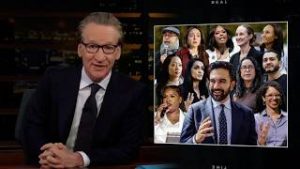
Peloni: Bill Maher reminds us that words are meaningful, and the words being spewed from the mouths of today’s Democratic party carry the meaning of subterfuge, anarchy and literal revolutionary elimination of the American Constitution and Western civilization. Good for Maher in making the statement that so long as these are the words defining the American Democratic party his vote is in play. Joining his voice to that of Ragin Cajun James Carvelle whose political strategies led to the Clinton revolution some thirty years ago, and the eight congressmen Maher referenced in his monologue, this is a really small but meaningful response to the long quiet which has led the Democratic party to become a party focused on normalizing hatred, indecency, terror and revolution. In fact, it is because of the lonag quiet objections of men such as Maher and Carville that the party of Kennedy has so solidly morphed into the party of Mamdani that not even a dozen party loyalists and congressmen are making their objections know regarding the Islamist-Communist take-over of the democratic party, and while Maher has focused his comments on the Communist aspect of this modern day junta, it must be made equally clear by Maher and his fellow Democratic conscientious objectors that it is a two front takeover of his party that is trying to also take over his country as well.
 Video Loads Below


Bill Mahr stands out in the Democratic world. He is a voice of sanity and reason, with few soul-mates…Fetterman, maybe. Why such people choose to stay in the Dem party is a mystery. While I admire such people for their courage and fortitude, I really have to ask, is there any chance that Mahr can be an influencer on the Democratic side, or is he just an anomoly that makes for an interesting news story once in a while?
He said the Dems were the racist party and the Republicans were the antiracist party but they switched when JFK got elected.
“Did Barry Goldwater oppose the Civil Rights act of 1964 out of racism?
” +3 Barry Goldwater opposed the Civil Rights Act of 1964 primarily due to strict constitutional principles regarding federal power and private property rights, rather than personal racism. He had previously supported earlier civil rights bills (1957 and 1960) and desegregation initiatives in his home state of Arizona.Constitutional ObjectionsFederal Overreach: Goldwater believed the national government was taking powers meant for the states.Private Business Restrictions: He specifically objected to Title II (public accommodations) and Title VII (employment), arguing that forcing private business owners and employers how to run their properties violated individual liberty and property rights.Personal Record and Complex LegacyDesegregation Actions: He helped desegregate the Senate cafeteria and was an early member of the Arizona NAACP chapter.Political Consequences: Despite his personal lack of racial animus, his principled opposition aligned him with white Southern segregationist voters who opposed integration, deeply damaging his national legacy and alienating Black voters from the Republican Party.”
“nixon desegregation”
“+7 President Richard Nixon oversaw a massive, rapid desegregation of Southern public schools through a cabinet-level committee led by George Shultz, dropping the percentage of Black children in all-black schools from 68% in 1969 to below 19% by 1970, despite his political “Southern Strategy” and personal opposition to forced busing.Administrative Action and EnforcementCabinet Committee: Created a federal task force in March 1970 led by Vice President Spiro Agnew and Labor Secretary George Shultz to manage peaceful school transitions.Legal Compliance: Enforced Supreme Court mandates (such as Alexander v. Holmes County Board of Education) ordering an immediate end to dual school systems, declaring the Brown v. Board of Education ruling constitutionally correct.Statistical Impact: Integrated Southern classrooms faster than any prior administration; by 1974, only 8% of Black children in the South remained in entirely segregated schools.The Busing Controversy and LimitsOpposition to Busing: Publicly opposed court-ordered student busing to achieve strict racial balance, advocating instead for local neighborhood schools.De Facto vs. De Jure: Drew a sharp legal line between government-mandated Southern segregation (de jure), which he dismantled, and housing-pattern segregation (de facto) common in Northern cities.Political Balancing: Maintained a delicate political balancing act, using anti-busing rhetoric to appease conservative white voters while legally complying with federal desegregation orders.”
“most black voters switched their allegiance fr9m the Republicans to the Democrats in 1936 ”
” +1 Yes, most Black voters shifted their support from the Republican Party to the Democratic Party during the 1936 presidential election, giving roughly 70% to 75% of their votes to Franklin D. Roosevelt.Reasons for the ShiftEconomic Relief: The New Deal programs helped poor Americans, including Black communities, during the Great Depression.The “Black Cabinet”: FDR included a group of African American public policy advisors, known as the Black Cabinet.Republican Neglect: The GOP did little to keep the loyalty of Black voters, who historically voted Republican since the time of Abraham Lincoln.”