
Ambassador (ret.) Yoram Ettinger | “Second Thought: a US-Israel Initiative” | August 18, 2026
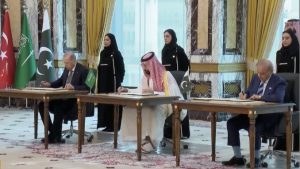 Signing of the Mecca Agreement by Erdogan, MBS, and Pakistani PM Shehbaz Sharif. Screengrab via Youtube.
*Since the 7th century, the life expectancy of intra-Muslim/Arab agreements, as well as Muslim agreements with “infidels”, have repeatedly proven to be determined by Islamic – not by Western – norms and regime-contingent. Their survival has been decided by foundational Islamic precepts, as well as by the longevity of the specific (tenuous) regime, or the durability of their (tenuous) policies.
*The foundational precedent is the 628AD Treaty of Hudaybiyyah, and this is currently more significant than any other single agreement. It has become doctrinally paradigmatic rather than a mere historical event. Thus, the Prophet Muhammad concluded a ten-year truce with the “infidel” Quraysh tribe of Mecca. Within two years, citing a violation by a client tribe of the Quraysh, Muhammad abrogated the agreement, conquering Mecca and forcing the conversion of the Quraysh to Islam. Muslim/Arab regimes have treated the Hudaybiyyah Treaty as The Supreme Model-to-Emulate of a Hudna (temporary truce), legitimately and religiously revocable when the balance of power shifts, as distinct from Sulh (a fuller, more permanent peace concluded among “believers”).
*The Constitution of Medina (622AD) was a multi-tribal agreement – the highly regarded foundation of the first Islamic state – signed by the Prophet Muhammad with rival tribes, including Jewish clans. It was gradually dissolved by expelling and obliterating the rival tribes.
*The First Fitna (656AD–661AD civil war) was momentous, underscoringthe fundamentals of the Muslim polity. It evolved around an agreement that was concluded after the 657AD Battle of Siffin between Ali (the 4th Caliph) and Mu’awiya (the ruler of Syria who challenged Ali’s authority). The agreement collapsed summarily, leading to Ali’s assassination (3 of the first 4 Caliphs were assassinated!). It also led to the founding of Mu’awiya’s Umayyad dynasty by violence (“bullet”) rather than by a settlement (“ballot”), which is still a Middle Eastern norm. Hence, succession in the caliphates that followed was overwhelmingly resolved by civil war rather than binding accords, as demonstrated by the Abbasid overthrow of the Umayyads; the fragmentation into rival caliphates (Fatimid, Umayyad of Córdoba, Abbasid); and the recurring pattern of vassal agreements with governors that held according to the durability of the regime.
*Ottoman-Safavid/Iran treaties (e.g., Amasya 1555AD, Zuhab 1639AD) were renegotiated roughly every generation as the frontier shifted militarily. They were durable only relative to the military stalemate, not as instruments of trust.
*In the post-Ottoman order, this violently-tenuous pattern was featured in the power-sharing 1943 Lebanese National Pact, which was in force as long as the demographic and regional balance of power persisted. It collapsed during the 1975-1989 civil wars, which still linger, as the 1989 Taif Agreement that supposedly ended the civil war is deeply frayed.
*Israel Peace Accords with Egypt Camp David (since 1979) and Jordan (since 1994) are holding for the time being, but the populations of both countries have been systematically brainwashed through anti-Jewish and anti-Israel school curriculum, mosque sermons and official media, which are the most authentic reflection of the long-term vision/strategy of non-democratic regimes. The potential toppling of the highly vulnerable General el-Sisi and King Abdoullah regimes could catapult the Muslim Brotherhood (Hamas’ “parent company”) to power in Egypt, while transforming Jordan into another platform of anti-US Islamic terrorism, dooming the peace process with Israel.
*The 1993 and 1995 Israel-PLO Oslo Accords were abrogated by the PLO before the ink dried. Thus, Arafat pre-recorded a message, aired on Jordan TV on September 13, 1993, while the Oslo Accord was signed on the White House Lawn, stating that the Accord was consistent with the PLO’s Phased Strategy – uprooting Israel in phases. On May 10, 1994, Arafat spoke in a Johannesburg mosque, announcing that the Oslo Accord was consistent with the foundational 628AD Hudaybiyya Agreement. As expected by reality-driven observers, the two Oslo Accords ushered in an unprecedent wave of Palestinian terrorism, as did 6 agreements reached with Hamas between 2007 and 2023.
*Tenuous Arab regimes and agreements:
^Since 1943, Libya’s Wheelus Air Force Base was the largest US military base outside the US during the rule of the pro-US King Idris. But, the base was evacuated in 1970 following the toppling of the King by the pro-Soviet Gaddafi.
^Iran was “The American Policeman of the Gulf” when ruled by the pro-US Shah, but has become a key epicenter of anti-US wars, terrorism, drug trafficking and money laundering since the 1979 Iran takeover by the Ayatollah regime.
^Under the rule of King Faisal II, Iraq joined the US-backed anti-USSR 1955 Baghdad Pact, along with Britain, Turkey, Iran and Pakistan. However, the July 1958 coup, climaxed by the hanging of King Faisal II, transformed Iraq into a pro-Soviet Persian Gulf country.
^The 1975 Iran-Iraq Algiers Agreement was annulled by Iraq in September 1980 (following the Ayatollah’s Islamic Revolution), leading to the 1980-1988 Iraq-Iran War.
^The 1958 Egypt-Syria agreement to establish the United Arab Republic, combining the two countries into a single sovereign state, was dissolved in September 1961 in the aftermath of a Syrian military coup.
^From the 1960s-1980s, North Yemen was pro-US, while South Yemen was pro-USSR. During the pre-January 1991 Gulf War, United Yemen opposed the US-led war on Saddam Hussein. Since 2014, Yemen’s Houthis – a proxy of the Ayatollah regime – have joined the “Death to America” club, shelling the pro-US Saudis and Emiratis, as well as attacking Red Sea shipping lanes.
^Etc…..
The Bottom Line
*In the non-democratic Middle East, Islamic/Arab regimes do not ascend to power through the ballot. They tend to be tenuous, as are their policies and agreements, which are not anchored in democratic and legal structures, but in foundational Islamic precepts and precedents. The durability of agreements reflects the lifespan of the regimes, which are generally vulnerable, driven by religion and ideology, and which transcend financial and diplomatic considerations.
*The US attempts to negotiate agreements with the Ayatollah regime, Hezbollah and Hamas take lightly the fact that the 1,400-year-old DNA of these entities – as documented in their constitutions, school curriculum and mosque sermons – mandates them to topple all pro-US Arab regimes and bring the “infidel” West, and especially “The Great American Satan” to submission.


So with this wealth of information available to all of us, why would we want to reach an agreement with any of them? There are other means of sleeping on the job.
None of the agreements with Muslim entities should be regarded as binding the Muslims in any way. They will use any excuse to claim that the agreement was broken.
One of the most common excuses is, simply, claimed insult, which can seldom be proven and never accepted when Muslims insult others or provoke being insulted.
Sure, there are a few cases where insult can be proven like the cartoons featuring Allah but they can insult people they call infidels all they want without fear, because for some reason, courts accept their claims while ignoring ours.