
By: Fatima El Hashimi | MEMRI | Aug 26, 2026
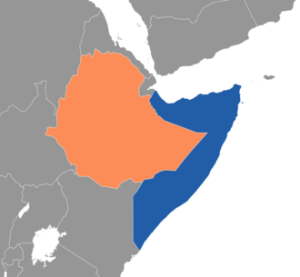 Ethiopia (highlighted in orange) and Somalia (highlighted in blue). Image by Myself, created with mapchart.net – https://www.mapchart.net/index.html, CC BY-SA 4.0, Link
The Ethiopia-Somaliland Memorandum of Understanding (MoU) should move forward. Somaliland’s insistence on immediate Ethiopian recognition has effectively frozen its implementation, undermining an agreement whose strategic benefits extend well beyond the two parties.[1] Ethiopia should maintain its commitment to the MoU but resist immediate recognition, while supporting behind the scenes a broader international diplomatic campaign for Somaliland’s eventual recognition.[2]
The January 2024 MoU offers Ethiopia reliable access to the sea while providing Somaliland with significant economic and defense benefits. The agreement would enable deeper cooperation in infrastructure, trade and maritime security, strengthening Somaliland’s defenses and contributing to the security of the wider region. Ethiopia, despite being landlocked, maintains a naval capability,[3] making secure maritime access strategically important not only for Addis Ababa but also for Somaliland and its Western partners.
Immediate recognition by Ethiopia will create serious unintended consequences. Ethiopia has for decades maintained forces in Somalia to combat Al-Shabaab and remains an important component of the region’s counterterrorism architecture. If Addis Ababa formally recognized Somaliland, Mogadishu would respond by demanding the withdrawal of Ethiopian forces and restricting security cooperation. Ethiopia would then lose its ability to contain jihadist threats along its own border. This would also undermine Somaliland’s security. Ethiopian forces have helped prevent Al-Shabaab from expanding toward Somaliland.[4] A rupture between Ethiopia and Somalia, whose growing dependence on Turkey has given Ankara considerable influence over Mogadishu, would therefore create greater space for jihadist activity across the Horn of Africa.
What appears to be a diplomatic victory for Somaliland could ultimately produce greater insecurity for Somaliland itself.
The consequences would extend to Israel and the United States. A full rupture between Ethiopia and Somalia would serve the interests of neither. Egypt would exploit the opportunity to exert influence over Somalia with the goal of destabilizing Ethiopia. Turkey and Qatar, which sponsor the Muslim Brotherhood, would likely do the same.
Ethiopia should therefore avoid creating a crisis that would simultaneously weaken its position in Somalia and in the region, increase jihadist pressure and provide additional space for external powers to exploit its vulnerabilities.
The alternative is not to abandon Somaliland’s recognition. It is to internationalize it.
Ethiopia, Somaliland, Israel and their partners should coordinate a diplomatic campaign aimed at persuading additional states to recognize Somaliland. Potential partners could include countries in Latin America, such as Colombia and Honduras, as well as selected Pacific states such as Papua New Guinea. It is worth noting that, in August 2026, under the newly inaugurated government of President Abelardo de la Espriella, Colombia officially recognized Morocco’s sovereignty over Western Sahara.[5]
Each recognition would reduce the political cost for the next country and gradually transform Somaliland’s status from a bilateral dispute into an international diplomatic process.
Policy Recommendations
Somaliland should recognize that the MoU itself advances its strategic interests. Freezing the agreement to demand immediate Ethiopian recognition risks sacrificing the concrete economic and security benefits the MoU offers Somaliland. International recognition should be pursued through broader diplomacy – by working with other countries to gradually build support for Somaliland’s recognition on the international stage.
Recognition of Somaliland, cannot be at the cost of destabilizing Ethiopia, and the wider Horn of Africa. Ethiopia should be given time. The benefits of preserving the MoU are greater than the benefits of forcing Ethiopia to an immediate decision on recognition.
*Anna Mahjar-Barducci is MEMRI Senior Research Fellow.
[1] Sahan.global/issues/the-somali-wire/sw-issue-no-962, June 24, 2026.
[2] Ena.et/web/eng/w/eng_3815417, January 3, 2024.
[3] Hornreview.org/2025/09/15/ethiopias-naval-revival-the-future-of-the-red-sea, September 15, 2025.
[4] Ethiopian military forces in Somalia have served as a vital bulwark against Al-Shabaab’s expansion in the Horn of Africa.
[5] Moroccoworldnews.com/2026/08/333718/colombia-officially-recognizes-moroccos-sovereignty-over-western-sahara-2, August 8, 2026.


Leave a Reply
You must be logged in to post a comment.