
As a new school year begins, thousands of children will enter Canada’s national human rights museum and encounter a politically constructed narrative that presents Palestinian displacement as an ongoing Israeli crime while withholding essential history.
Ron East | TheJ.ca | Aug 28, 2026
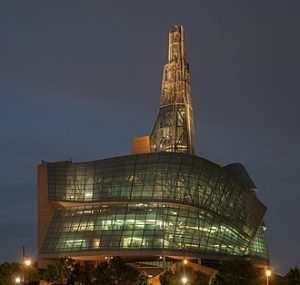 By Ethan Sahagun – Own work, CC BY 4.0, Link
WINNIPEG, CANADA | The school buses will soon begin arriving.
Teachers will organize their classes. Students will walk through the doors of the Canadian Museum for Human Rights in Winnipeg. They will be told they are entering a trusted national institution dedicated to truth, understanding and respect.
Then some of them will be introduced to Palestine Uprooted: Nakba Past and Present.
Let the indoctrination begin.
That may sound harsh, but Canadians should examine what the museum has chosen to teach before dismissing the accusation.
The Canadian Museum for Human Rights describes its exhibition as an exploration of the “ongoing forced displacement and dispossession of Palestinians.” It tells visitors that present-day violence in Gaza must be understood through Palestinian experiences of displacement, war and loss beginning in 1948.
The museum says that approximately 750,000 Palestinians were forcibly displaced during Israel’s creation. It describes militias and Israeli forces expelling civilians and destroying or emptying hundreds of villages. It presents the Nakba not merely as a historical event but as an “ongoing process” connected to occupation, settlements, home demolitions, movement restrictions, blockade and repeated wars. These claims are presented on the museum’s official exhibition page.
Students will encounter house keys symbolizing an asserted right of return, Palestinian artwork depicting Israeli military restrictions, poetry, oral testimonies and interactive “memory boxes” organized around forced displacement, longing for home, resistance and lasting trauma.
They will then be asked: “How can learning about Palestinian experiences shape the way we think about human rights today?”
That is not a neutral question attached to a balanced historical presentation. The exhibition has already built in the desired moral conclusion.
Palestinians are presented as victims. Israel is positioned as the cause of their continuing victimhood. Palestinian “resistance” is culturally validated. Israel’s creation and continued existence are placed within a framework of displacement, dispossession and human rights violations.
That is not neutral curation. It is moral accreditation.
No one should deny that Palestinians suffered during the 1948 war. Families lost homes. Civilians were displaced. Innocent people experienced fear, violence, and trauma.
Palestinian stories deserve to be heard.
But hearing a story is not the same as presenting one national narrative as complete history. Personal testimony can illuminate history, but it cannot replace historical context.
What will the students learn about why the 1948 war occurred?
Will they be told that the United Nations proposed dividing the territory into Jewish and Arab states? Will they learn that Jewish leaders accepted partition while Arab leaders rejected it?
Will they learn that Palestinian Arab forces began attacking the emerging Jewish state and that five Arab armies invaded after Israel declared independence?
Will they hear about Jerusalem’s besieged Jewish population, the destruction of Jewish communities or the expulsion of Jews from the Old City?
Will they learn that the Jewish people are indigenous to the Land of Israel, maintained a continuous presence there and returned through a lawful national movement after centuries of persecution?
Will they learn about the approximately 850,000 Jews who fled or were expelled from Arab and Muslim countries, many of whom were absorbed by the newly established Jewish state?
Will they be told that Palestinian displacement occurred through several different circumstances, including expulsions, flight from active combat, fear of violence, societal collapse, and instructions or warnings from Arab leaders in some areas?
The museum’s expanded web description now acknowledges that some Palestinians fled in fear or left after warnings and instructions from local leaders. That is more context than its earlier promotional language provided. It still does not correct the exhibition’s central moral architecture.
The history remains organized around a predetermined conclusion: Palestinian displacement is an enduring Israeli human rights violation.
The museum’s accompanying Nakba resource guide goes further. It declares that more than 5.9 million UNRWA-registered Palestinian refugees are “still being denied the right to return to their homes.”
That sentence does not merely describe a Palestinian demand. It endorses a political and legal conclusion.
It does not explain that the mass return of millions of Palestinian descendants would eliminate Israel as a Jewish-majority state. It does not explore the unprecedented inheritance of Palestinian refugee status across generations under UNRWA. It does not ask why Arab countries kept generations of Palestinians in refugee camps rather than integrating them. It does not discuss competing legal interpretations or the fact that a negotiated solution has always been part of the peace process.
Young visitors are given the demand, but not its consequences.
This matters because the CMHR is not an obscure activist gallery.
It is a federally funded national institution established under the Museums Act. Its mandate is to enhance public understanding, promote respect and encourage reflection and dialogue. It offers free virtual and onsite programming for students from kindergarten through Grade 12. Its education programs include hands-on activities and “engaging lessons” intended to create what it calls the next generation of human rights champions. More than 30,000 students participated in its education programs during the 2023-24 school year.
Not every participating student will necessarily tour the Nakba exhibit. However, the display is now embedded within the national museum, promoted on its website and connected to an online resource guide accessible to teachers and students across Canada. It will remain open until Nov. 30, 2028.
That creates the potential to influence tens of thousands of young Canadians over multiple school years.
Elementary students may absorb the exhibit emotionally through pictures, objects and stories.
Middle-school students may begin interpreting Israel’s creation as a human rights injustice.
High-school students may leave equipped with the vocabulary of “ongoing Nakba,” “forced displacement,” “resistance” and “right of return,” but without the historical knowledge needed to evaluate those terms critically.
Eventually, some of those students will arrive at Canadian universities.
We already know what awaits them there.
An August 2026 national report commissioned by the federal government found that Jewish postsecondary students described harassment, threats, Holocaust distortion, social exclusion, pressure to disclose their political views and anti-Israel bias in classrooms. Students reported being singled out over Israel, while some professors assigned antizionist material without scholarship explaining the Jewish people’s connection to their ancestral homeland. The federal report described antisemitism as a serious campus-climate problem.
The road to those campuses does not begin on the first day of university.
It begins when children are taught that one side possesses trauma, identity and human rights, while the other side represents power, dispossession and oppression.
It begins when “Zionist” is transformed from a description of Jewish national self-determination into an accusation.
It begins when the rebirth of the Jewish state is introduced not as one of history’s most significant acts of national liberation, but as someone else’s continuing catastrophe.
Jewish organizations warned the museum about these consequences.
Mark Berlin, the museum’s only Jewish trustee at the time, resigned shortly before the exhibition opened. He wrote that a story separated from surrounding facts is “just a story” and accused the museum of failing its statutory and moral obligation to present the full truth.
CMHR CEO Isha Khan defended the exhibition. She argued that presenting Palestinian experiences does not negate the human rights violations suffered by Jewish people and that sharing one community’s story does not minimize another’s.
That response avoids the central objection.
The controversy is not about whether Palestinian stories may be presented. It is about whether a national human rights museum may remove those stories from essential historical context, place them inside an authoritative human rights framework and then direct children toward a predetermined political conclusion.
Students deserve education, not advocacy disguised as education.
Before any school books a visit, administrators and parents should demand answers.
Will students visiting the Nakba exhibit receive balanced preparatory materials? Will educators explain Arab rejection of partition and the invasion of Israel? Will Jewish history, Jewish indigeneity and the displacement of Jews from Arab lands be included? Will Hamas be identified as a terrorist organization? Will the murder of Israeli civilians during the Second Intifada be discussed when the museum describes it as a Palestinian uprising? Will Jewish and Israeli students be protected from classroom exercises that portray their identity as an injustice?
The museum should publish its complete research framework, sources, scripts and educational guidance. It should commission an independent review involving credible historians with differing perspectives. Schools should notify parents before bringing children to the exhibit and provide a genuine opportunity to decline participation.
Most importantly, students must be taught how to examine competing evidence rather than being directed toward one approved answer.
A human rights museum should teach children to think.
It should never tell them whom to hate.


Isy asper is rolling in his grave